



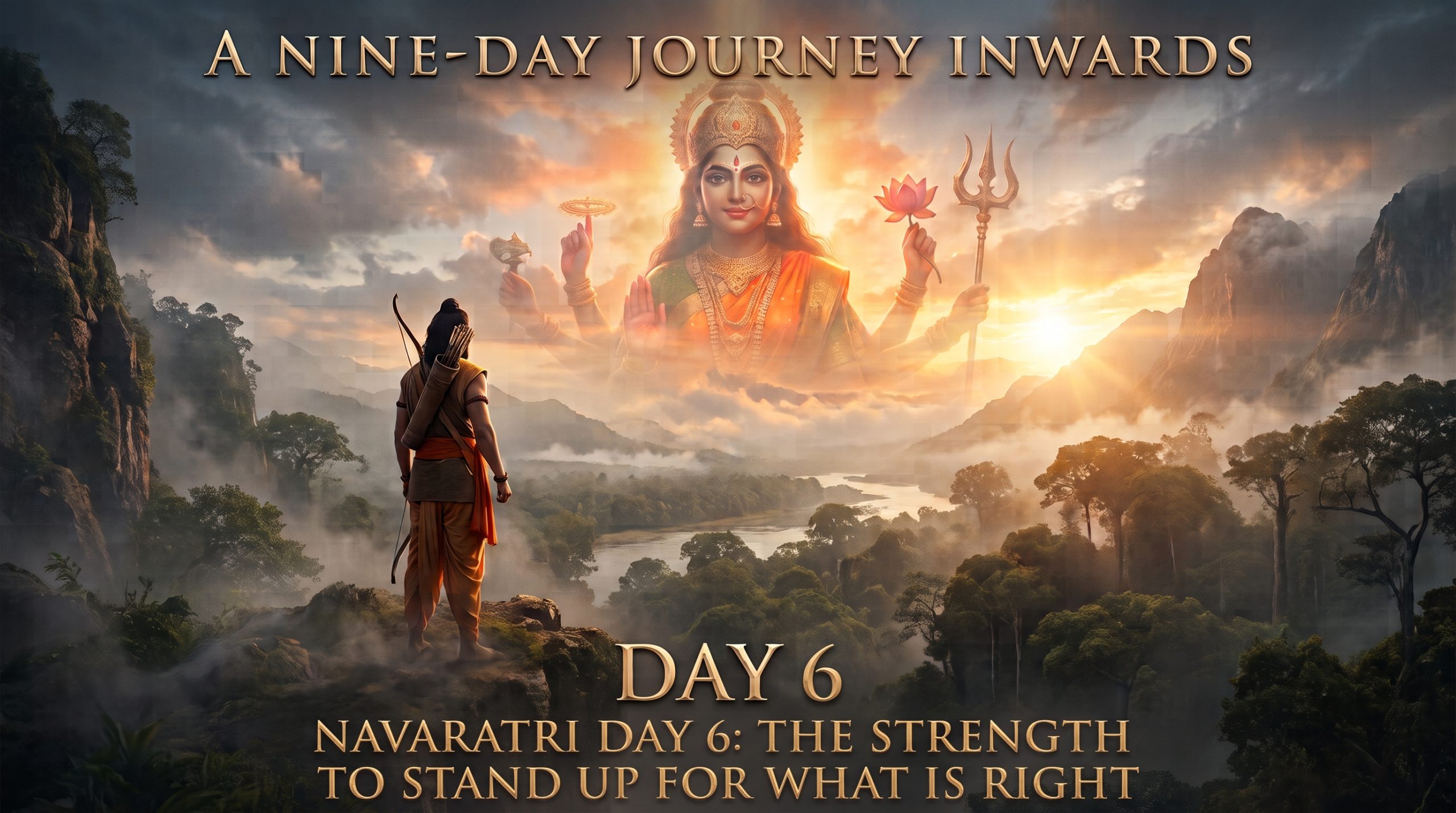
On the sixth day of Navaratri, we honor Goddess Katyayani, a fierce manifestation of the divine feminine associated with the defeat of Mahishasura, the buffalo demon whose growing power threatened the balance of the world. While her story is about the triumph of a goddess over a demon, it asks us to consider a question that remains relevant in every generation: when we recognize that something is wrong, what responsibility do we have to act?
The story of Katyayani is celebrated through the “Mahishasura Mardini Stotram,” a Sanskrit hymn that praises the Goddess as the slayer of Mahishasura. The words “Mahishasura Mardini” mean the destroyer of Mahishasura. The hymn’s powerful rhythm and vivid imagery have made it an enduring part of devotional traditions, especially during Navaratri. Yet its significance extends beyond the celebration of divine power. It invites us to reflect on the forces that allow injustice to grow and the strength required to confront them.
Mahishasura represents a form of power that has lost its sense of responsibility. In the traditional story, his strength becomes an instrument of domination, and his ambition threatens the well-being of others. The Goddess’s intervention restores balance. Read as an inner journey, the story also challenges us to recognize how power, when separated from accountability, can distort judgment. The struggle is not always between two individuals.
Standing up for what is right is different from simply believing that we are right. Conviction can give us the determination to challenge wrongdoing, but conviction without humility can become its own form of domination. We have all seen how people can defend their positions with absolute certainty while refusing to consider evidence that contradicts them. The language of justice can itself be used to justify prejudice, retaliation, or the desire to win.
Read: Navaratri Day 5: The wisdom to nurture without controlling (October 15, 2026)
Katyayani’s example asks for something more demanding than certainty. It asks us to distinguish principle from personal pride and justice from the satisfaction of defeating someone we oppose.
The Ramayana provides a powerful example through Rama’s confrontation with Ravana. Ravana possesses extraordinary knowledge, strength, and authority, yet his abduction of Sita represents an abuse of power. His accomplishments do not excuse his actions, nor does his intelligence make him immune to accountability. Rama’s decision to confront him becomes a struggle to restore what Ravana’s actions have violated.
The story reminds us that ability and achievement alone do not establish moral worth. What matters is how power is exercised and whether we accept responsibility for the consequences of our choices.
This lesson is particularly relevant to young people navigating a world in which public opinion can shift rapidly and social acceptance can feel essential. It is easy to condemn injustice when doing so earns approval. It is more difficult to speak when the person being mistreated is unpopular, when a friend is responsible, or when taking a position could cost us something. Online, we may share a statement supporting a cause while remaining silent when the same principle is tested in our own communities. The challenge is to move beyond expressing our values to living them.
Read: Navaratri Day 4: Creativity, the intelligence to connect the dots (October 14, 2026)
That does not mean every disagreement requires confrontation or that every person who sees a problem must respond in the same way. Sometimes the right action is to speak openly; at other times, it is to gather facts, support someone privately, seek help from the appropriate authority, or challenge a decision through established channels. Moral responsibility requires us to understand the situation before acting, but it should not become an excuse for endless hesitation when harm is clear.
The symbolism of Katyayani also asks us to examine the ways we use power in our own lives. We may not command armies or govern kingdoms, but we exercise influence as parents, colleagues, teachers, friends, and members of our communities. Do we use that influence to protect our own position, or to address what is unfair? Do we remain silent because speaking would be inconvenient?
On this sixth day of Navaratri, we are reminded that integrity is not established by our declarations or the causes we publicly endorse. It emerges when our actions remain faithful to our principles, especially when doing so is difficult. Standing up for what is right requires conviction, but it also requires humility, discernment, and the willingness to accept the consequences of our decisions.
Our values are not measured by what we proclaim when it is easy, but by what we are willing to stand for when it costs us something.