



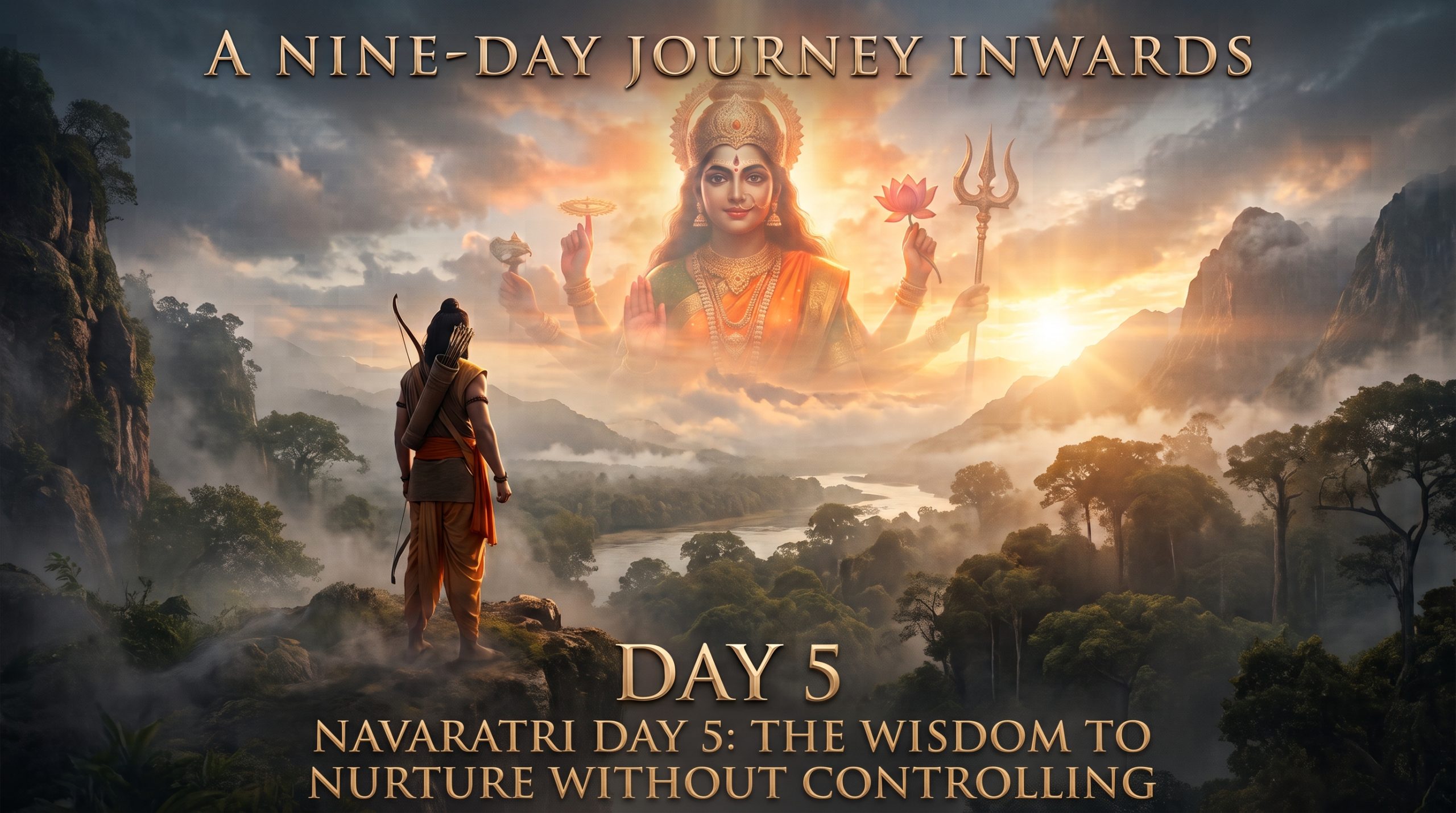
As we’ve seen over the past four days, Navaratri invites us to look beyond the rituals that honor the divine feminine and examine the qualities we can cultivate within ourselves. Each of the nine forms of Durga offers a different perspective on how we live, make choices, and relate to others. On the fifth day, we honor Skandamata, the mother of Skanda, also known as Kartikeya, the warrior deity. Her image, holding her child while seated on a lotus, represents the strength of maternal care and the responsibility that comes with nurturing another life.
Yet the significance of Skandamata extends beyond motherhood. Her symbolism invites us to consider a question that reaches into every relationship: how do we help another person grow without trying to determine who that person must become?
Nurturing is often mistaken for directing. Parents want their children to succeed, teachers want their students to excel. These intentions may come from genuine affection or a desire to help. But the desire to protect someone from disappointment can gradually become a desire to control their decisions. We begin by offering guidance and end by expecting obedience. We confuse the future we imagine for another person with the future that person should pursue based on our own beliefs.
READ: Sreedhar Potarazu | Navaratri Day 4: Creativity, the intelligence to connect the dots (October 14, 2026)
Think of flying a kite. If we hold the string too tightly, refusing to allow any slack, we can prevent the kite from rising with the wind. If we let go entirely, we lose the ability to guide it. Flying a kite requires us to understand when to hold tension and when to gradually release it, allowing the wind to lift the kite higher while maintaining enough connection to guide its flight. Nurturing another person requires the same judgment. We must know when to offer direction, when to provide support, and when to loosen our hold so that others can discover their own strength. The challenge is not to keep them close to us, but to help them rise while giving them room to find their own direction.
Care does not require us to eliminate every obstacle from another person’s path. Nor does it mean withdrawing when someone makes a decision we would not make ourselves. It means providing the support, wisdom, and security that allow another person to develop the judgment to navigate life independently.
The Ramayana offers a meaningful reflection on this distinction through the lives of Sita and her sons, Lava and Kusha. After Sita takes refuge in the hermitage of the sage Valmiki, her sons grow up learning the values, discipline, and knowledge that will shape their lives. Valmiki becomes their teacher, while Sita’s presence and example remain central to their upbringing. Their story reminds us that the development of a child is rarely the work of one person alone. Families, teachers, communities, and mentors all contribute to the formation of character.
READ: Sreedhar Potarazu | Navaratri Day 3: The responsibility to protect others and at what cost (October 13, 2026)
What matters is not simply what we teach, but what we enable others to discover for themselves. A child may inherit our values without sharing every one of our opinions.These are not necessarily failures of influence.
This distinction is especially relevant for a generation growing up amid constant comparison and public scrutiny. Social media offers young people extraordinary opportunities to find communities, express themselves, and learn from others. It also creates pressure to conform to expectations about appearance, achievement, relationships, and identity. Parents and mentors can respond to that pressure by imposing even tighter controls, believing that greater supervision will guarantee better outcomes. But excessive control can prevent young people from developing the very qualities they need: independent judgment, resilience, and the ability to take responsibility for their choices.
The alternative requires adults to distinguish between genuine danger and the discomfort of watching someone make a different choice. It asks us to listen before advising, to explain rather than merely command, and to recognize that our experience, however valuable, cannot substitute for another person’s experience of living.
READ: Sreedhar Potarazu | Navaratri Day 2: The wisdom of perseverance (October 12, 2026)
Skandamata’s symbolism also asks us to examine our own motivations. Do we offer guidance because another person needs it, or because their independence makes us uncomfortable? Do we want them to flourish, or do we want their success to validate our own choices? The answers are not always easy, because control can disguise itself as concern. Genuine nurturing requires the humility to accept that the people we help may ultimately choose paths we would never have chosen for ourselves.
The fifth day of Navaratri reminds us that strength is not measured only by what we accomplish or whom we protect. It is also measured by our ability to help another person discover and exercise their own strength. To nurture well is to remain present without claiming ownership, to offer wisdom without demanding conformity, and to care deeply without making another person’s life an extension of our own.
The purpose of nurturing is not to shape another life in our own image, but to help it discover what it is capable of becoming.