



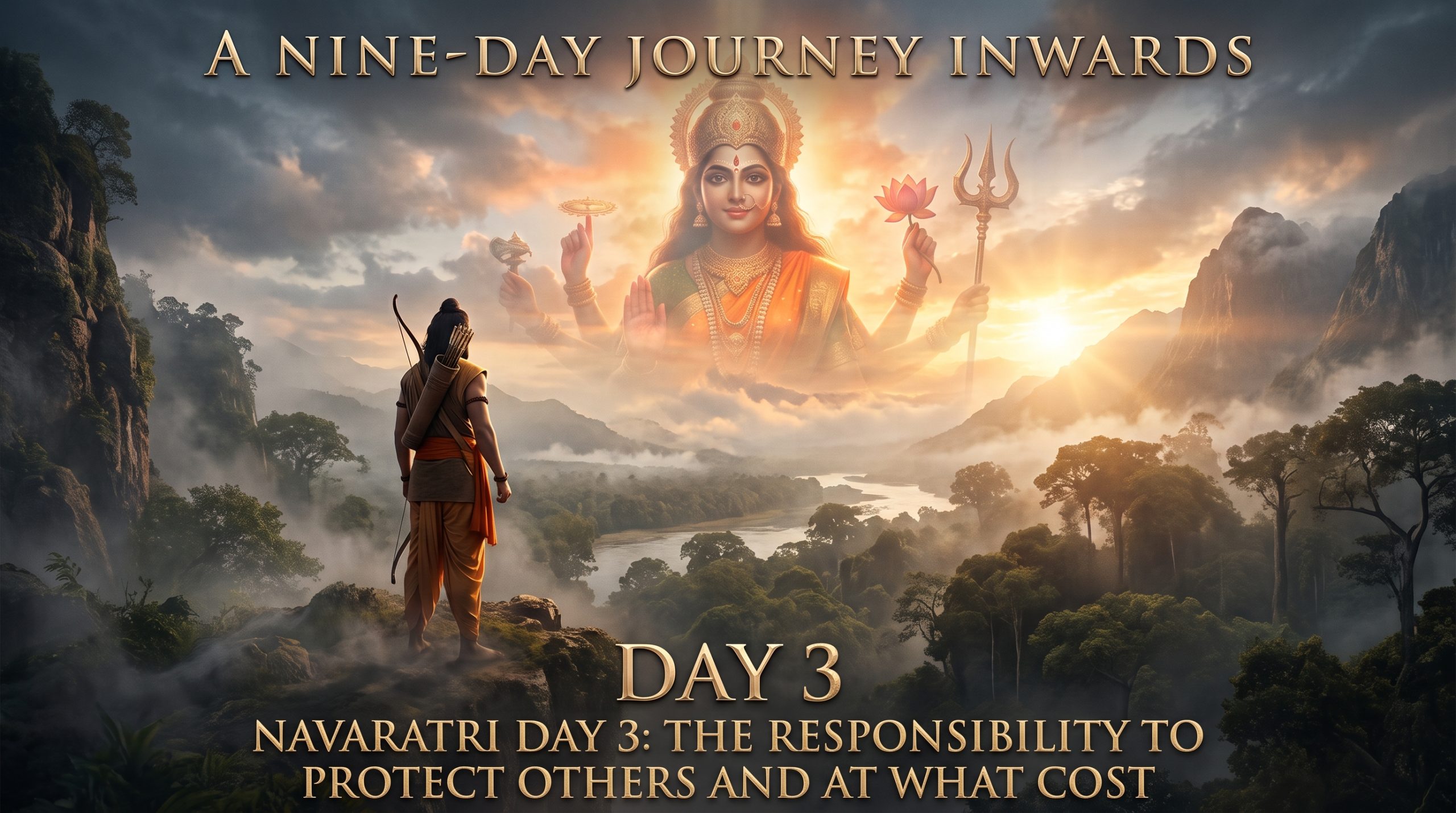
The third day of Navaratri honors Goddess Chandraghanta, the third manifestation of the divine feminine. Traditionally depicted riding a tiger or lion, with weapons in her many hands and a crescent moon shaped like a bell on her forehead, she represents protection, vigilance, and the readiness to confront forces that threaten others. Her image reminds us that strength is not merely a personal attribute. Hindu mythology of course offers vivid imagery that represents more than what just meets the eye. Its deeper purpose in this persona lies in how we use it to protect those who are vulnerable.
Compassion is often understood as the ability to recognize another person’s suffering. But recognition alone is not enough. We can feel sympathy for someone who is being mistreated, acknowledge an injustice, and still choose not to become involved. The more difficult question is whether we accept any responsibility in helping others, particularly when helping them carries a personal cost.
“Ramayana” offers several powerful examples of responsibility that is tested to its limits. Lakshmana accompanies Rama into exile, leaving behind the comforts of Ayodhya to remain beside his brother and Sita. His decision is not just about brotherly love. Throughout their 14 years in the forest, he watches over them, helps establish their shelter, and remains alert to dangers that could threaten their safety. His devotion illustrates that protecting others often involves sustained, unglamorous acts of service rather than a single dramatic gesture.
Lakshmana’s role also reveals that protection requires judgment. When the demoness Surpanakha threatens Sita after her advances toward Rama are rejected, Lakshmana intervenes all the while knowing the consequences but also what’s at stake for his kin. Taking on responsibility to defend others is never comfortable and there is inherent risk and therein lies the sacrifice we are willing to make.
READ: Sreedhar Potarazu | Navaratri Day 2: The wisdom of perseverance (October 12, 2026)
Hanuman offers another dimension of this virtue. When he crosses the ocean to find Sita in Lanka, he undertakes a mission in which the life and well-being of another person take precedence over his own safety. Upon finding her in the Ashoka grove, he reassures her that Rama is searching for her and offers evidence that she has not been forgotten. His role is not limited to defeating enemies. He restores hope to someone who is isolated, threatened, and uncertain whether help will arrive at the same time risking his own life.
Hanuman’s actions more importantly demonstrate the importance of combining strength with discernment. He does not begin his mission by attacking Lanka indiscriminately. He searches carefully, finds Sita, establishes her trust, and communicates Rama’s message. Protection is not simply the ability to overpower a threat; it is the ability to respond in ways that genuinely serve the person who needs help.
Jatayu provides perhaps the most direct expression of this responsibility. When he witnesses Ravana carrying Sita away, the elderly bird challenges a far more powerful adversary in an attempt to rescue her. He ultimately suffers fatal injuries, but before dying, he tells Rama what happened and helps direct the search for Sita. Jatayu’s intervention demonstrates that the responsibility to protect others does not depend on certainty of success or the expectation of reward.
Together, these mythological characters reveal different dimensions of the same principle that are seldom apparent on the surface. Lakshmana represents the constancy of protection through service. Hanuman represents protection through intelligence, devotion, and discernment. Jatayu represents the refusal to remain indifferent when another person is in danger. None of them acts merely to enhance his own reputation. Their actions are directed toward someone whose vulnerability creates a responsibility to respond.
READ: Sreedhar Potarazu | A nine day journey inwards (October 11, 2026)
For Gen Z, this lesson has particular relevance in a world where suffering and mistreatment are often witnessed through screens. A humiliating video can circulate while thousands of viewers watch without intervening. Online harassment can become entertainment, and the fear of becoming a target can discourage people from defending someone being attacked. Yet protection does not always require a dramatic confrontation. It may mean reporting abuse, refusing to participate in humiliation, supporting someone who has been isolated, or ensuring that a person in danger reaches someone who can help.
Goddess Chandraghanta invites us to consider what we do with the strength, influence, knowledge, or privilege we possess. They create opportunities to help others who may lack the means to defend themselves. The responsibility to protect is not limited to family or friends; it extends to the stranger whose suffering we might otherwise find convenient to ignore.
Navaratri asks us to look beyond the virtues we admire in mythology and consider how they should shape our conduct. The measure of protection is not the power we display, but whether that power helps preserve another person’s dignity and safety.
Aphorism for Day 3: Our humanity is measured not by how we treat those who can help us, but by how we respond to those who need our help.