



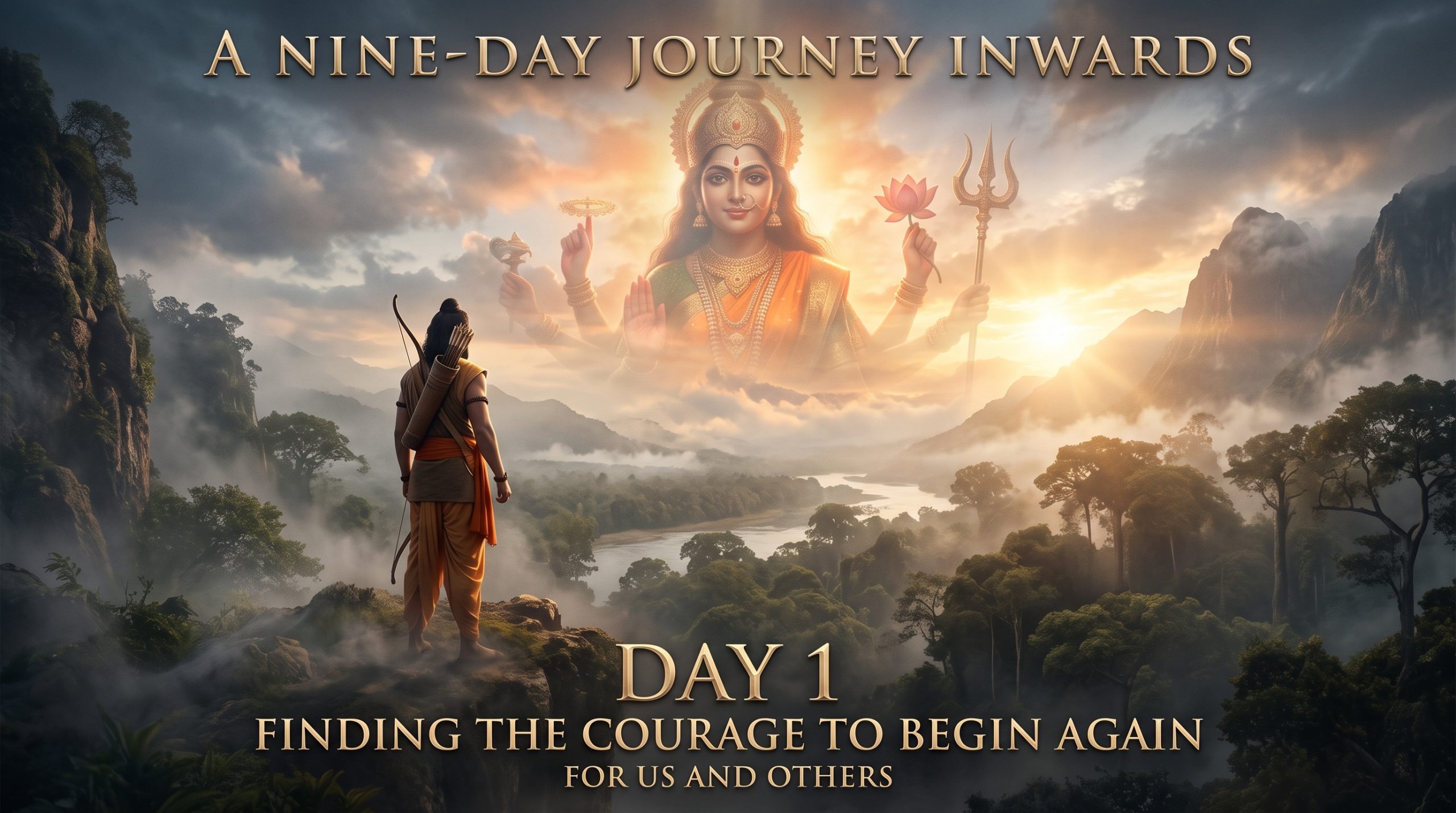
Day 1 : Finding the Courage to Begin Again for Us and Others
Every autumn, millions of Hindus across the world celebrate Navaratri, a festival honoring the divine feminine through nine nights of prayer, ritual, music, and dance. The word Navaratri comes from the Sanskrit words nava, meaning nine, and ratri, meaning night. Across India, the festival takes different forms, but its central theme is the triumph of good over evil and the restoration of balance when destructive forces threaten the world.
Yet Navaratri can mean something more than a religious celebration. It can also be understood as a journey inward, an opportunity to examine who we are, what we value, and what we need to change. Courage, compassion, discipline, and wisdom represent virtues that each of us can strive to cultivate.
This festival season may have no meaning at all to younger generations navigating a world of non-stop connectivity alongside uncertainty about identity, purpose, and belonging. Social media encourages constant comparison, rewards instant reactions, and often reduces complicated human experiences to simple judgments. Young people are asked to project confidence even when they feel uncertain and to define themselves before they have had sufficient time to discover who they are.
READ: Sreedhar Potarazu| ‘Grin and bear it’: The mantra Indian parents get wrong (October 10, 2026)
Navaratri offers a different perspective and forces us to ask how the world sees us and to look within ourselves . Instead of measuring ourselves against others, it encourages us to confront our own fears, assumptions, and limitations. Its spiritual significance does not depend on whether one approaches the festival through religious faith or cultural tradition. The underlying questions are the same : What kind of person am I becoming? What stands in the way of that growth? And what can I do differently tomorrow?
The nine nights and 10 days ( Dasara ) offer a framework for this introspection. Each day is associated with a different manifestation of the Goddess, and each can inspire reflection on a particular dimension of human character. That is the underlying theme of each of the mythological forms that are worshipped.
The journey also connects meaningfully with the Ramayana, one of India’s most enduring epics. The story of Rama’s struggle against Ravana culminates in the defeat of a powerful adversary whose extraordinary knowledge and abilities cannot overcome his pride and refusal to act according to dharma, or moral duty. In many traditions, Vijayadashami marks this triumph of righteousness over wrongdoing.
But the Ramayana also invites us to look beyond the battle between Rama and Ravana. What if the struggle between good and evil is not only something that takes place in the world around us, but something that takes place within us? We may not possess Ravana’s ten heads, but we can recognize the many impulses that compete for control of our decisions: anger, jealousy, ambition, insecurity, resentment, and pride. The challenge is to acknowledge these tendencies honestly in ourselves.
This becomes especially meaningful when we consider the traditional account of Valmiki, the revered sage associated with the composition of the Ramayana. According to later devotional traditions, Valmiki was once Ratnakara, a robber whose life changed through spiritual awakening and disciplined reflection. His transformation reminds us that a person’s past need not determine the entirety of their future.
There is an important distinction here between the actor and the action. An action can be wrong, harmful, and deserving of accountability without becoming the only thing we see when we look at the person who committed it.. When we separate the person from the action, we do not excuse the wrongdoing; we recognize that accountability and redemption can coexist.
Our ego often makes this distinction difficult. We become attached to our judgments, our grievances, and our belief that we are right. We may find it easier to condemn another person permanently than to acknowledge that people are capable of change. Sometimes, our moral certainty becomes less about correcting a wrong and more about preserving our own sense of superiority. The inner work of Navaratri asks us to recognize that tendency in ourselves.
READ: Sreedhar Potarazu | The users manual for AI: Chapter 11 of The Gita (September 26, 2026)
The first day, dedicated to Goddess Shailaputri, begins with courage. Before we can change, we must be willing to acknowledge where we stand. That means examining our own conduct without excuses, accepting responsibility for the harm we may have caused, and resisting the temptation to believe that either our own mistakes or someone else’s must define a lifetime.
Over the next nine days, the symbolism of the Goddess and the lessons of the Ramayana can help us reflect on the choices that shape our lives. The objective is not to become perfect, but to become more conscious of how we think, how we treat others, and how we respond when life tests our values.
Navaratri reminds us that transformation does not begin with the defeat of an external enemy, it’s the enemy within . When we have the courage to look within, we recognize the humanity of others, and understand that an action may define a moment without defining an entire life.
Day One: Judge the action with clarity, hold the actor accountable with fairness, and never let your ego erase the possibility of transformation.