



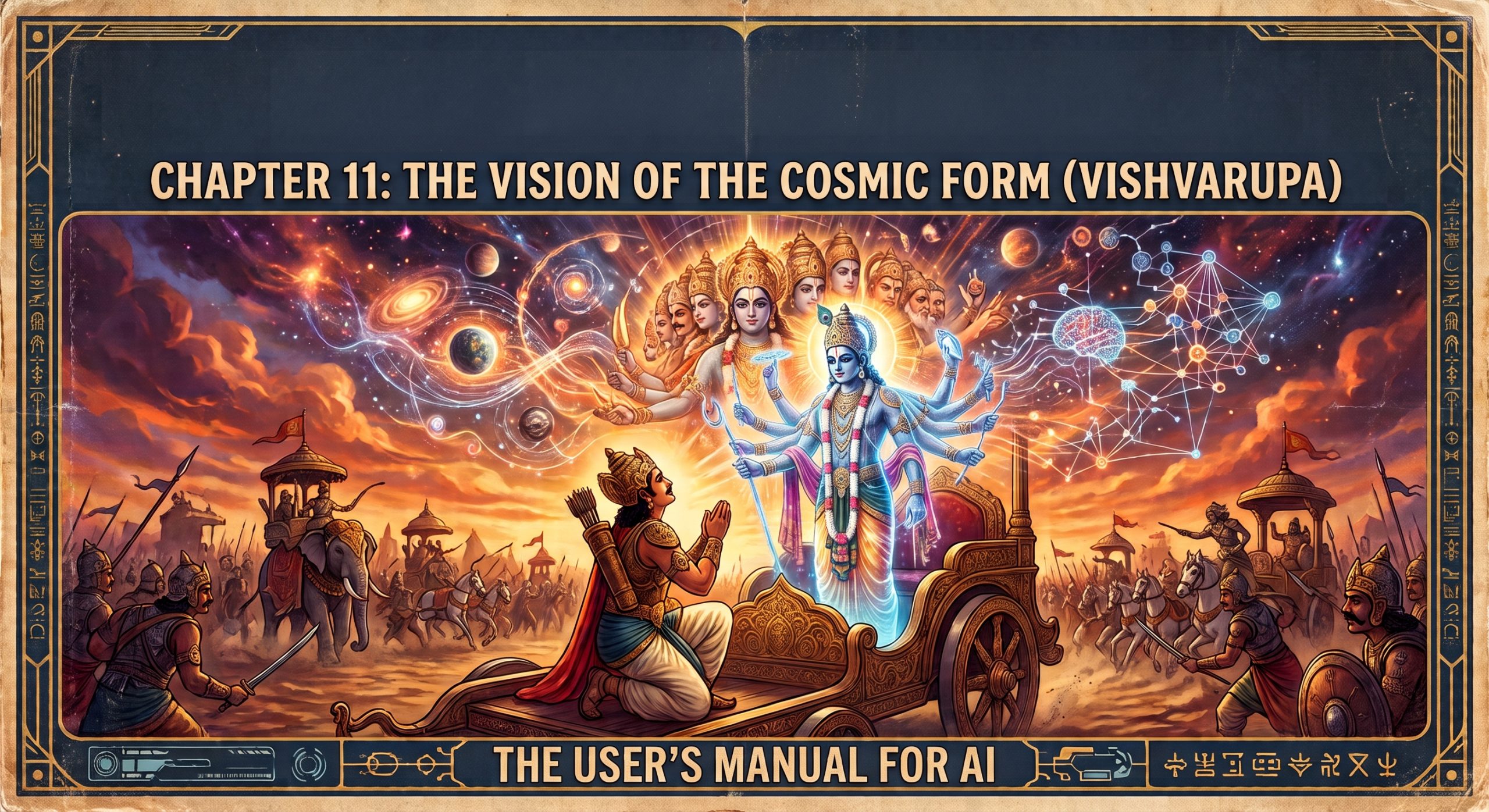
There is an important lesson about perspective hidden in one of the most famous episodes of the Bhagavad Gita in Chapter 11 that serves as an important manual for us to more effectively use AI.
On the battlefield of Kurukshetra, Arjuna, the warrior, asks Krishna to reveal his true nature to understand who He truly is. “You say you are God but how do I know that” says Arjuna.
Krishna responds by “granting” Arjuna a divine “faculty” of sight that goes beyond mere vision. What follows in Chapter 11, the Vishwaroopa Darshana Yoga,” (divine vision of the Universe) is one of the most extraordinary descriptions in the Gita and in fact world literature even quoted by Oppenheimer in 1945.
Krishna reveals his Vishwaroopa, the universal form. Arjuna sees images countless faces, eyes, weapons and beings extending in every direction. He sees creation and destruction simultaneously. He sees something far beyond the ordinary scale of human perception. The vision seems fantastic and yet unrealistic simultaneously.
But there is an important detail that can easily be overlooked. Arjuna sees it by adjusting his focus. The image was always there but what was required is a tuning of his perspective. There is nothing at all that Krishna does other than to just “be”.
To further complicate the optical lessons of Chapter 11, the enemy king on the side of the battlefield is ironically blind and cannot directly see what is happening between Arjuna and Krishna. He receives a secondhand account of the events unfolding about the “reveal “through Sanjaya, an observer who himself has been granted the extraordinary ability to perceive what is taking place and narrate it to the king.
The experience therefore passes through several lenses of perspective. Krishna enables the divine vision. Arjuna perceives it by adjusting his vision. Sanjaya then observes and communicates to the King what he sees. Dhritarashtra receives the account and creates his own blind vision.
And between seeing and understanding lies the great mystery.
READ: SREEDHAR POTARAZU | AI is the mirror. The Sutras are the questions. Socrates is still asking. `(
The Gita even gives us a word for the extraordinary difficulty of such perception. After Arjuna has witnessed the universal form, Krishna describes it as sudurdarsham, something exceedingly difficult to behold. The Sanskrit term comes from su-durdarśam, emphasizing the extraordinary difficulty of seeing or beholding what Arjuna has experienced.
The significance of the word goes beyond the mechanics of vision. The problem is not simply that the Vishwaroopa is large or complex. It is that ordinary human perception is not sufficient to comprehend it. Arjuna has acquired a different capacity to see.
That distinction has become relevant in the age of artificial intelligence.
Our challenge with AI today is not simply that we have created machines that may become more intelligent than us. It is that we have been given an instrument that allows us to see ourselves in ways we have never been able to see before. The machine is becoming a new kind of observer. It is becoming an instrument of revelation.This may ultimately be more important than the question of whether AI becomes smarter than human beings.
What happens when we can see something but do not know what it means?That is where the Gita becomes unexpectedly relevant.
Krishna’s revelation does not solve Arjuna’s problem simply by giving him more information. Arjuna’s problem is ultimately one of perspective. He has to understand what he is seeing and determine what the revelation means for him.The same problem confronts us with AI.
AI can reveal patterns without necessarily understanding their meaning. It can identify what tends to happen without knowing why it happens. It can generate an extraordinarily persuasive explanation without possessing the human experience that gives that explanation meaning.
In that sense, AI begins to resemble Sanjaya. Sanjaya can perceive what Dhritarashtra cannot directly see and communicate it to him. AI increasingly does something similar. It can process a world of information beyond our natural cognitive bandwidth and report patterns back to us.
That is the “vishwaroopa” or divine vision AI gives us to see things not readily apparent
But the analogy has limits.
Sanjaya is not merely a machine for transmitting information. He is an observer and narrator. AI, by contrast, is a computational system that detects patterns, generates outputs and increasingly mediates our interaction with information.The important parallel is not that AI is Sanjaya.
It is that AI is becoming our Sanjaya-like narrator . It stands between an increasingly complex reality and the human observer. And that creates a relevant question.
If AI is increasingly capable of telling us what it sees, who will tell us what it means? That brings us back to Arjuna. If AI is the instrument that expands our perception, then we are Arjuna standing before an increasingly complex revelation.
We are the observers. We are the ones who have to decide what the revelation means. And this is where Krishna becomes important.
AI should not be Krishna. Krishna represents something that AI cannot simply produce by becoming more powerful: perspective, wisdom, meaning and responsibility.
Krishna does not merely show Arjuna something extraordinary. He helps Arjuna understand his place within what he has seen. That distinction may become one of the defining issues of the AI era.
We are building machines capable of revealing more and more about the world and about ourselves. But revelation does not come with an instruction manual for how to live with what has been revealed. AI can tell us what we have done. But it cannot automatically tell us what kind of people we should become.
That remains a human question. And this is where Dhritarashtra becomes particularly relevant.
READ: Sreedhar Potarazu | AI is burning through free cash flow (July 25, 2026)
Dhritarashtra represents the temptation to surrender our own capacity for perception and judgment to the intermediary. He cannot see the battlefield directly. He depends upon Sanjaya. The danger for us is not that AI will become Sanjaya. The danger is that we will become Dhritarashtra.
The more powerful the intermediary becomes, the more important the observer’s judgment becomes. This is particularly important because AI does not enter the world without human assumptions. It is trained on human data. And therefore, when AI shows us ourselves, it may also show us the accumulated consequences of our own biases, incentives, assumptions and blind spots.
That is perhaps the most important connection between Vishwaroopa and AI. Arjuna does not receive a comforting vision.
He receives an overwhelming one. The Vishwaroopa contains beauty and terror, creation and destruction, beginning and end. It expands his understanding of reality while simultaneously destabilizing his previous understanding of his own place within it.
AI may produce a much less mystical but surprisingly similar experience for humanity.
It is beginning to reveal the complexity of systems we previously understood only superficially by showing us how interconnected our behavior is. And perhaps most unsettlingly, it can show us that some of what we believed was uniquely human may actually be reproducible as patterns of computation.
But there is a fundamental difference between revealing reality and understanding reality.
The Gita does not suggest that Arjuna’s ability to see the Vishwaroopa automatically gives him wisdom. He still has to interpret what he has witnessed and decide how he wants to act .
That may be precisely where humanity stands today. AI is expanding our field of vision. And can increasingly show us things that would otherwise remain hidden.
But the more powerful the instrument becomes, the more important the observer becomes.
Perhaps the future of AI will therefore depend less on whether machines can see more and more on whether human beings can learn to interpret what they see. And it requires something even more difficult: the willingness to change our own beliefs when the evidence reveals something we did not want to see.
That may be the real meaning of the Vishwaroopa analogy. Krishna’s revelation does not make Arjuna less important. It makes his responsibility greater. The more he sees, the more he must understand. The more he understands, the more consequential his choice becomes.
Perhaps that is the lesson hidden in the ancient story for the modern technological age. AI may be our new instrument of perception. It may become our Sanjaya, bringing patterns into view that were previously beyond our ability to see. We may be Arjuna, standing before an expanding universe of information and confronting a reality larger than our previous understanding. And we must be careful not to become Dhritarashtra, surrendering our judgment to the voice that tells us what it sees.
The Vishwaroopa was not the end of Arjuna’s journey. It was the moment when seeing demanded understanding. And perhaps that is where the AI age truly begins.