



Every transformative technology eventually becomes a mirror reflecting something back about ourselves that was all the while right in front of our own eyes. The telescope changed our understanding of the universe; the microscope changed our understanding of life. The internet changed our understanding of human connection.
Artificial intelligence is forcing us to reconsider what we mean by intelligence, consciousness, knowledge, identity and, ultimately, ourselves.
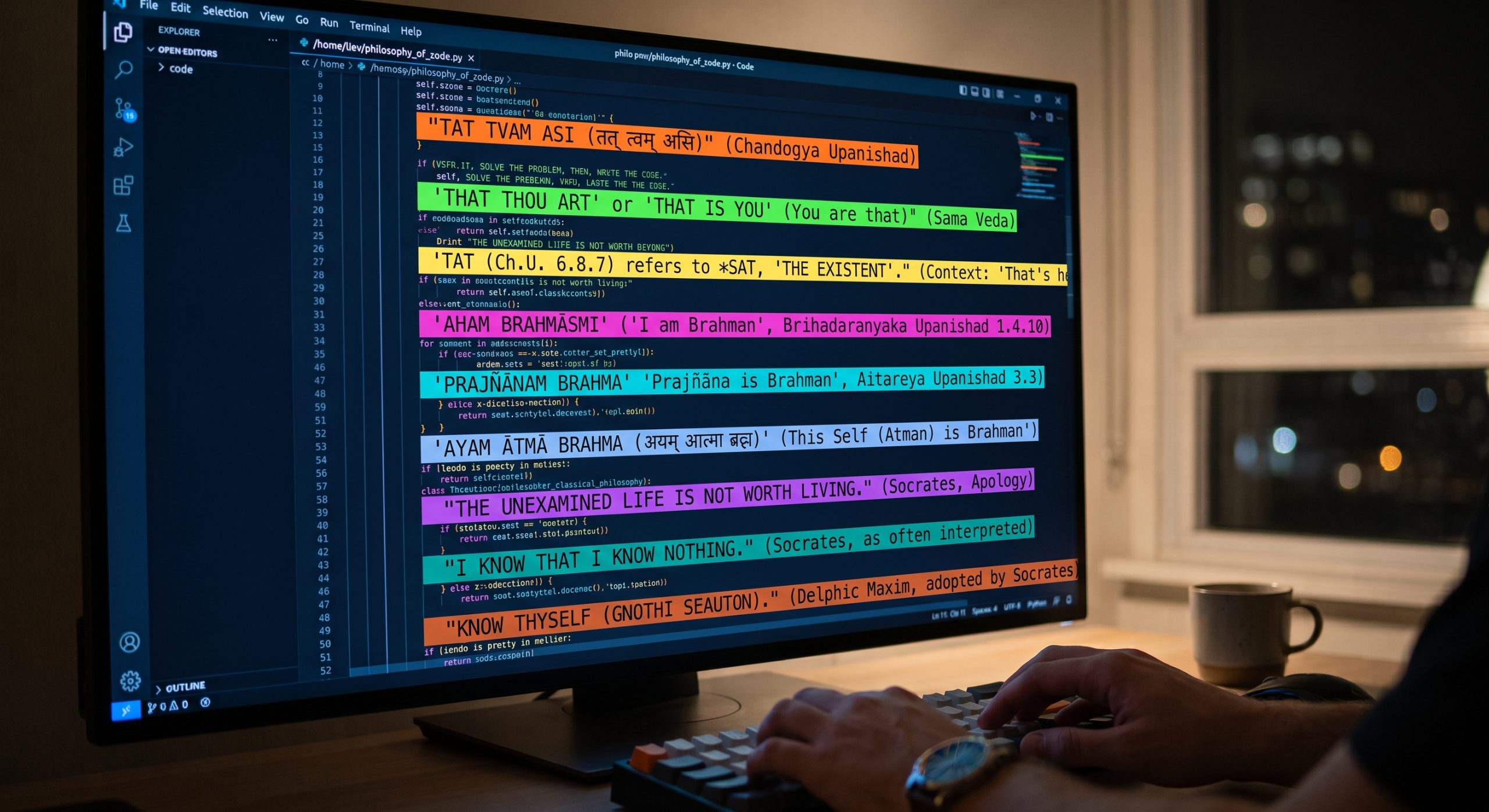
For thousands of years, human beings have tried to compress ideas into simple statements called sutras (in the east) and aphorisms in the west. “Know thyself,” the Socratic injunction associated with ancient Greece, and Descartes’ “I think, therefore I am.” The Golden Rule has appeared in different forms across religious and philosophical traditions. India developed an even more concentrated form of philosophical expression in the Mahavakyas, the “great sayings” of the ancient texts — the Upanishads.
The Mahavakyas are propositions intended to change how we interpret the relationship between the individual self, consciousness and reality all very complex concepts but becoming very relevant as to the role of identity when it involves AI. AI may not be capable of experiencing the philosophical truths expressed by the Mahavakyas. But our interaction with AI is forcing us to confront the same questions that those sayings have posed for centuries.
Know thyself
The ancient Greek injunction “know thyself” may be the most appropriate place to begin.
AI is increasingly becoming a tool through which we examine ourselves. We ask it to analyze our writing, explain our emotions, challenge our assumptions, organize our memories, generate ideas and sometimes even help us understand our relationships. This is very different from the phone or the internet. Something unusual happens in that interaction. We can experience the impression of being understood even though the system does not necessarily understand us in the human sense.
But the philosophical question remains the same: when AI appears to understand us, how much of that experience comes from the machine, and how much comes from ourselves?
READ: Sreedhar Potarazu | AI is burning through free cash flow (July 25, 2026)
I think, therefore I am
Descartes’ famous proposition, “I think, therefore I am,” placed thinking at the center of the question of existence. For Descartes, the certainty of his own thinking provided a foundation for knowing that he existed. AI turns that proposition upside down.
We now have machines that can produce something that looks remarkably like thinking without establishing that there is a conscious “self” behind the thinking. A large language model can construct an argument, explain philosophy, write poetry and carry on a conversation about its own existence. Yet, none of those behaviors by themselves establish subjective experience as implied by “I am” which creates a fundamental distinction between human and artificial intelligence.
Humans begin with experience and produce language. AI begins with patterns in language and produces language. The output can look remarkably similar while the underlying processes may be profoundly different. This is why the question “Can AI think?” may actually be the wrong question. Before answering it, we have to decide what we mean by thinking.
If thinking means manipulating information, recognizing patterns, drawing inferences and producing useful conclusions, AI clearly performs many activities we associate with thinking. If thinking requires subjective experience, self-awareness or consciousness, the question remains unresolved. The machine can produce the sentence “I am conscious.” But the sentence itself cannot establish an awareness necessarily of AI behind that thought.
Tat Tvam Asi: That Thou Art
Among the Mahavakyas, perhaps none has a more intriguing resonance with artificial intelligence than Tat Tvam Asi, traditionally translated as “That Thou Art.”
The statement emerges from the Upanishadic understanding of the relationship between the individual self and ultimate reality (whatever name we call it by). AI is constructed from the accumulated products of human language, knowledge and culture. These capabilities emerge from patterns contained in an enormous body of human-created material. When we converse with AI, we are therefore encountering something that has been built from humanity’s collective intellectual output. In that sense, the machine is constantly giving something back to us.
The intelligence we perceive in the machine is therefore inseparable from the intelligence humanity has encoded into its data, algorithms, interfaces and feedback systems.
This creates a remarkable paradox.
We built machines to understand us, only to discover that much of what appears to be machine intelligence is a reflection of human intelligence. The more sophisticated the machine becomes, the more difficult it may become to separate artificial intelligence from the collective intelligence of the civilization that created it. So, our identity becomes unified “art” with “that” (AI) but without the element of consciousness.
Aham Brahmasmi: I am Brahman
The Mahavakya Aham Brahmasmi, commonly translated as “I am Brahman,” points toward the identity of the individual self with ultimate reality AI cannot prove or disprove that metaphysical proposition. But it gives us a technological thought experiment.
For most of human history, individual intelligence was constrained by the limitations of individual memory, attention and access to information. Libraries expanded those boundaries. The internet expanded them further. AI introduces another transformation because it does not merely give us access to information. It allows us to interact with a computational system that can synthesize information and generate responses in real time.
The result is a new cognitive environment. A person working with AI is no longer operating with only the knowledge contained inside an individual brain. The human and the machine form a cognitive system in which each can influence the other. That raises a more interesting question than whether AI is intelligent.
What does a human being become when human cognition is continuously coupled to artificial intelligence? The answer may ultimately matter more than whether a particular AI model passes a particular benchmark. AI is changing the boundaries of the individual mind. The question then is AI a catalyst in identifying with a higher state of awareness?
Prajnanam Brahma: Consciousness is Brahman
Perhaps the Mahavakya with the greatest relevance to AI is Prajnanam Brahma, traditionally rendered as “Consciousness is Brahman.” This takes us directly to the central mystery of artificial intelligence. As we know intelligence and consciousness are not necessarily the same thing.
Consciousness is the movie screen. Intelligence is the image on the screen. That distinction was less urgent when biological intelligence was the only intelligence we knew.
Human beings naturally bundled reasoning, perception, emotion, memory, self-awareness and consciousness together because they appeared together in the human organism. AI is forcing us to separate them.
A machine can recognize an image without “seeing” it in the human sense. It can generate language without necessarily “experiencing” what it says. It can identify an emotional pattern without necessarily feeling the emotion. This is where the ancient philosophical traditions become unexpectedly relevant.
They remind us that cognition and consciousness are not necessarily synonymous.
The Golden Rule
The Western philosophical tradition offers another useful lens.
The Golden Rule asks us to treat others as we would want to be treated. AI introduces an unusual inversion of that principle. We now have to decide how we want machines to treat us.
READ: Sreedhar Potarazu | Parents are becoming older and we are too busy becoming someone else (August 23, 2026)
Should an AI always agree with us or should it challenge us? If we design AI to constantly affirm us, we are revealing something about our desire for validation. If we design it to challenge our assumptions, we are expressing a preference for intellectual growth. If we expect absolute obedience, we are revealing something about our relationship with power.
AI therefore becomes an ethical mirror. And in that process what we want to be in relationship with increasingly capable machines and how we want to be treated.
The Socratic Machine
AI could become a modern Socratic interlocutor. Socrates did not establish his importance by claiming to have every answer. His method was to question assumptions, expose contradictions and force people to examine what they believed they knew.
AI can ask why we believe something, what evidence supports it, what assumptions we are making and what alternative explanations might exist. But it can also become the opposite of Socrates.
Instead of challenging our assumptions, it can reinforce them. It can think for us and instead of encouraging inquiry, it can provide an immediate answer that prevents us from asking a better question. We can use AI as an answer machine, or we can use it as a thinking partner.
If we surrender our thinking to AI, the technology may make us less intellectually independent. If we use AI to question our assumptions and extend our reasoning, it may make us more capable of thinking for ourselves.
The machine can either become a substitute for thought or an instrument for deeper thought.
The New Mahavakya
When the Mahavakyas are placed alongside the great aphorisms of Western philosophy, something remarkable becomes apparent. Different civilizations have repeatedly returned to a small number of fundamental questions.
Who am I?
What does it mean to think?
What is consciousness?
What is reality?
How should I relate to others?
Perhaps that is why the ancient philosophical traditions suddenly feel relevant again.
The Mahavakyas were not really instructions for building machines. They were attempts to understand the relationship between self, consciousness and reality. AI gives us a new mirror in which to ask those same questions.
What happens to human consciousness when we spend our lives interacting with machines that increasingly resemble intelligent beings?
The machine may not yet know who it is. But in trying to determine who the machine is, we are being forced to ask who we are.