



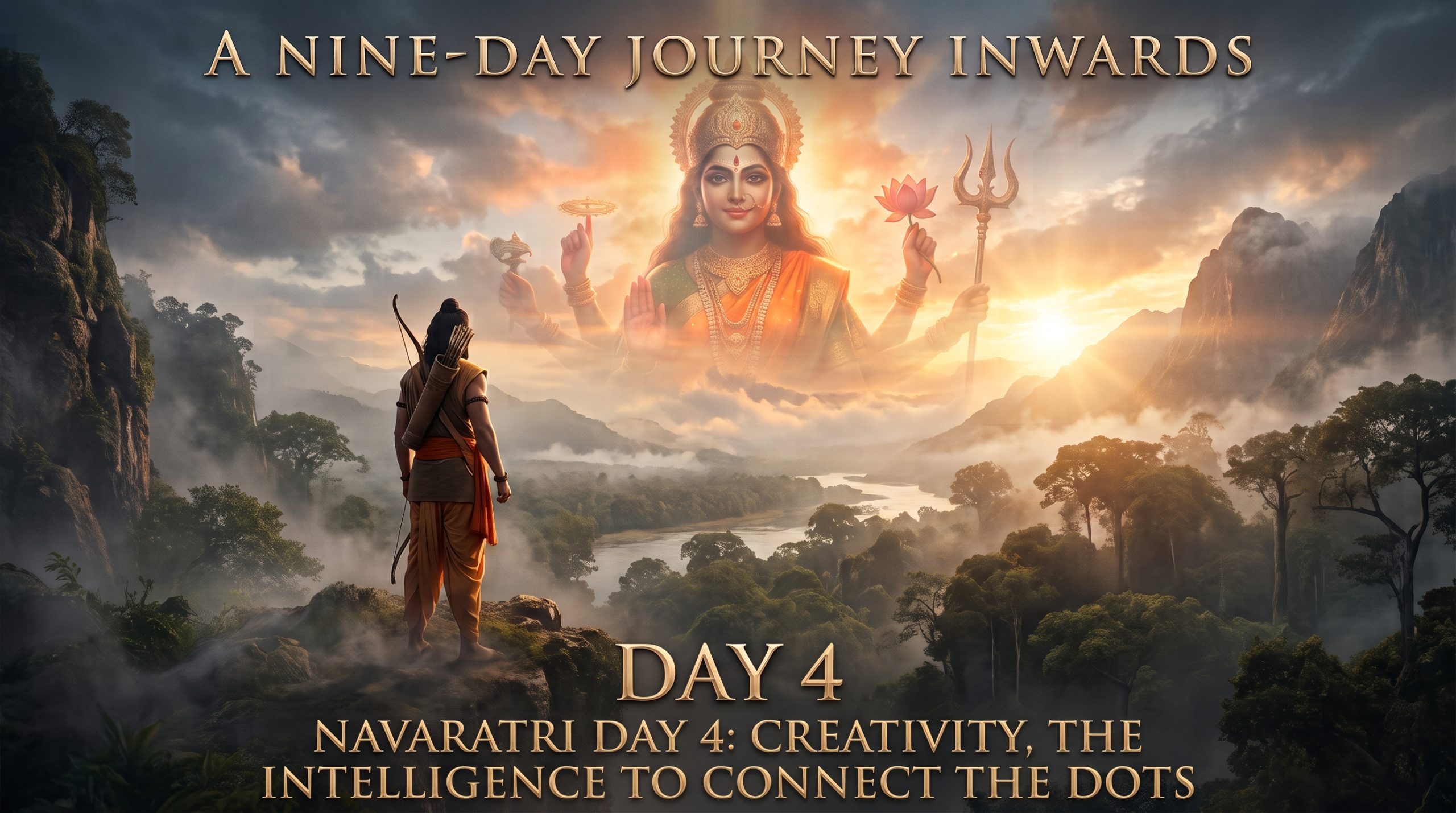
The fourth day of Navaratri honors Goddess Kushmanda, the fourth manifestation of the Divine Feminine in the traditional Navadurga sequence. She is associated with the creation of the universe and the cosmic energy that sustains it. According to Hindu mythology, her radiant smile brings the cosmos into existence, making her a symbol of the creative force through which possibility becomes reality.
Kushmanda invites us to consider creativity not merely as the ability to produce something new, but as the capacity to see connections where others see separation. Creation begins when seemingly unrelated elements come together to form something that did not exist before. The ability to connect ideas, experiences, and knowledge across different domains may be one of the most powerful expressions of intelligence.
We often equate intelligence with mastery of a particular subject. We reward specialization, and encourage people to build expertise in increasingly narrow fields. Specialization is essential to developing a skill but it has limitations when the knowledge remains confined within disciplinary boundaries. Some of the most important advances in human history have emerged when someone recognized that an idea from one field could illuminate a problem in another. And this often happened by accident whether it was Edison or Newton.
READ: Sreedhar Potarazu | Navaratri Day 3: The responsibility to protect others and at what cost (October 13, 2026)
The development of artificial neural networks in AI drew inspiration from the way biological nervous systems process information. Today, researchers working across neuroscience, mathematics, computer science, and engineering continue to explore how insights from one discipline can inform another. The breakthrough often lies not in knowing more about a single subject, but in recognizing a meaningful relationship between several.
For Gen Z, this way of thinking is particularly important. Young people are entering a world in which artificial intelligence can retrieve information, summarize complex material, and perform increasingly sophisticated technical tasks. The ability to ask meaningful questions, combine different perspectives, recognize patterns, and imagine possibilities that are not immediately obvious becomes increasingly valuable.
Connecting ideas requires enough understanding of each field to recognize which relationships are meaningful and which are superficial. Creativity emerges from the interaction between knowledge and imagination. The challenge for education is not to abandon specialization, but to encourage intellectual curiosity beyond its boundaries.
READ: Sreedhar Potarazu | Navaratri Day 2: The wisdom of perseverance (October 12, 2026)
The Ramayana offers an illustration of this principle through Rama’s search for Sita. Faced with a challenge that cannot be solved by strength alone, Rama depends on an alliance of individuals whose abilities complement one another. Hanuman’s intelligence, discernment, and extraordinary capacity for action help him locate Sita in Lanka. Sugriva contributes the resources of the Vanara kingdom, while Nala and Nila are traditionally credited with helping construct the bridge across the ocean. The eventual crossing becomes a collective achievement, drawing upon different forms of knowledge, skill, and effort.
The bridge to Lanka is especially relevant to this idea. An apparently insurmountable physical barrier becomes a problem that can be approached through cooperation and ingenuity. The solution does not arise from one individual possessing every necessary skill. It emerges when different capabilities are organized around a shared objective.
Kushmanda’s symbolism takes us back to the same underlying principle on a cosmic scale. Creation represents the emergence of order, possibility, and life from what was previously un-manifest. In our own lives, creativity similarly requires us to move beyond what is familiar and imagine relationships that have not yet been explored. It asks us to resist the assumption that the boundaries between disciplines are also the boundaries of what we can understand.
READ: Sreedhar Potarazu | A nine day journey inwards (October 11, 2026)
For Gen Z, the lesson is not to become a generalist who knows a little about everything, but to develop enough depth to think rigorously and enough breadth to see beyond a single perspective.
A scientist who understands human behavior, an engineer who considers ethics, or an artist who draws upon mathematics may discover possibilities that remain invisible within a narrower frame. The ability to connect the dots depends on being curious about dots that may initially appear unrelated.
Navaratri’s fourth day invites us to see creativity as more than individual talent or artistic expression. It is the intelligence to recognize relationships, imagine alternatives, and bring different forms of knowledge together in service of something greater.
In a world increasingly capable of producing answers, the ability to discover connections and ask questions that open entirely new directions may become one of our most important human strengths.
Day 4: Intelligence masters the individual dots; creativity discovers the connections that reveal a picture no one has seen before.