



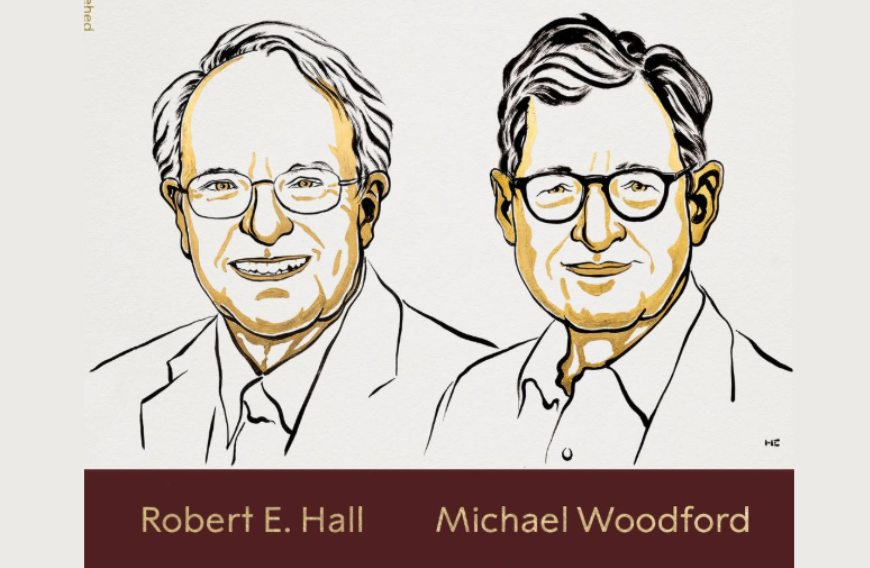
American economists Robert E. Hall and Michael Woodford have won the 2026 Nobel Prize in Economic Sciences for their research on how governments and central banks can stabilize economies during periods of financial uncertainty, inflation and economic downturns.
The award was announced by the Royal Swedish Academy of Sciences on Monday. The committee recognized their work “for the microeconomic foundations of macroeconomic stabilization.” The prize carries 12 million Swedish kronor (about $1.2 million), which will be shared equally between the two economists.
“This year’s laureates in economic sciences, Robert E. Hall and Michael Woodford, have developed new macroeconomic models that have significantly improved our ability to implement effective stabilization policy. On the basis of these models, well-timed fiscal and monetary policy measures can reduce the economy’s peaks and troughs,” the Royal Swedish Academy of Sciences said.
Hall is a professor at Stanford University in California, while Woodford is a professor at Columbia University in New York.
Their work emphasizes the importance of understanding individual decisions at the microeconomic level, including those made by households and businesses, to develop more effective economic policies. Traditional economic theories often examined the economy from a broader perspective, focusing on indicators such as overall production, inflation and employment.
READ: Navi Pillay, South African jurist of Indian Tamil descent, wins 2026 Nobel Peace Prize (October 9, 2026)
Hall’s research examined how households decide how much to spend or save based on their income and expectations about the future. Businesses, meanwhile, make decisions about pricing, hiring and investment. These individual choices collectively influence the broader economy.
Their work also helped advance the concept of “forward guidance,” in which a central bank communicates its likely future interest rate decisions to influence public expectations and economic behavior. When central banks signal that interest rates are likely to remain low, households may be more inclined to borrow and businesses may increase investment.
Forward guidance became an important policy tool during the 2008 global financial crisis, when central banks cut interest rates significantly and used communication about future policy to support economic recovery.
“Making more explicit statements about the likely future path of interest rate policy, as opposed to relying on simply being able to cut interest rates further immediately, that was an important part of the policy response in the years from 2009 onward,” Woodford said.
Another important concept in modern macroeconomics is price stickiness, which refers to the tendency of prices to adjust slowly in response to changing economic conditions. Understanding why prices do not immediately respond to shifts in demand, costs or monetary policy helps economists assess how policy decisions affect inflation and economic activity.
READ: Francis Halzen wins 2026 Nobel Prize for using Antarctic ice to study the universe (October 6, 2026)
John Hassler, chair of the Committee for the Prize in Economic Sciences, said in a statement, “With them, we are better equipped to deal with shocks in the economy, such as energy crises or sudden changes in how much households consume.”
The economists’ work also relates to the concept of the “output gap,” which measures the difference between an economy’s actual output and its potential output. The measure helps policymakers assess whether an economy is operating below or above its sustainable productive capacity.
The economics award is formally known as the Sveriges Riksbank Prize in Economic Sciences in Memory of Alfred Nobel. It was established by Sweden’s central bank and first awarded in 1969. Unlike the five original Nobel Prizes established under Alfred Nobel’s 1895 will, the economics prize was created separately.
Last year, the award went to Joel Mokyr, Philippe Aghion of France and Peter Howitt of Canada for their research explaining how technological innovation drives economic growth.