



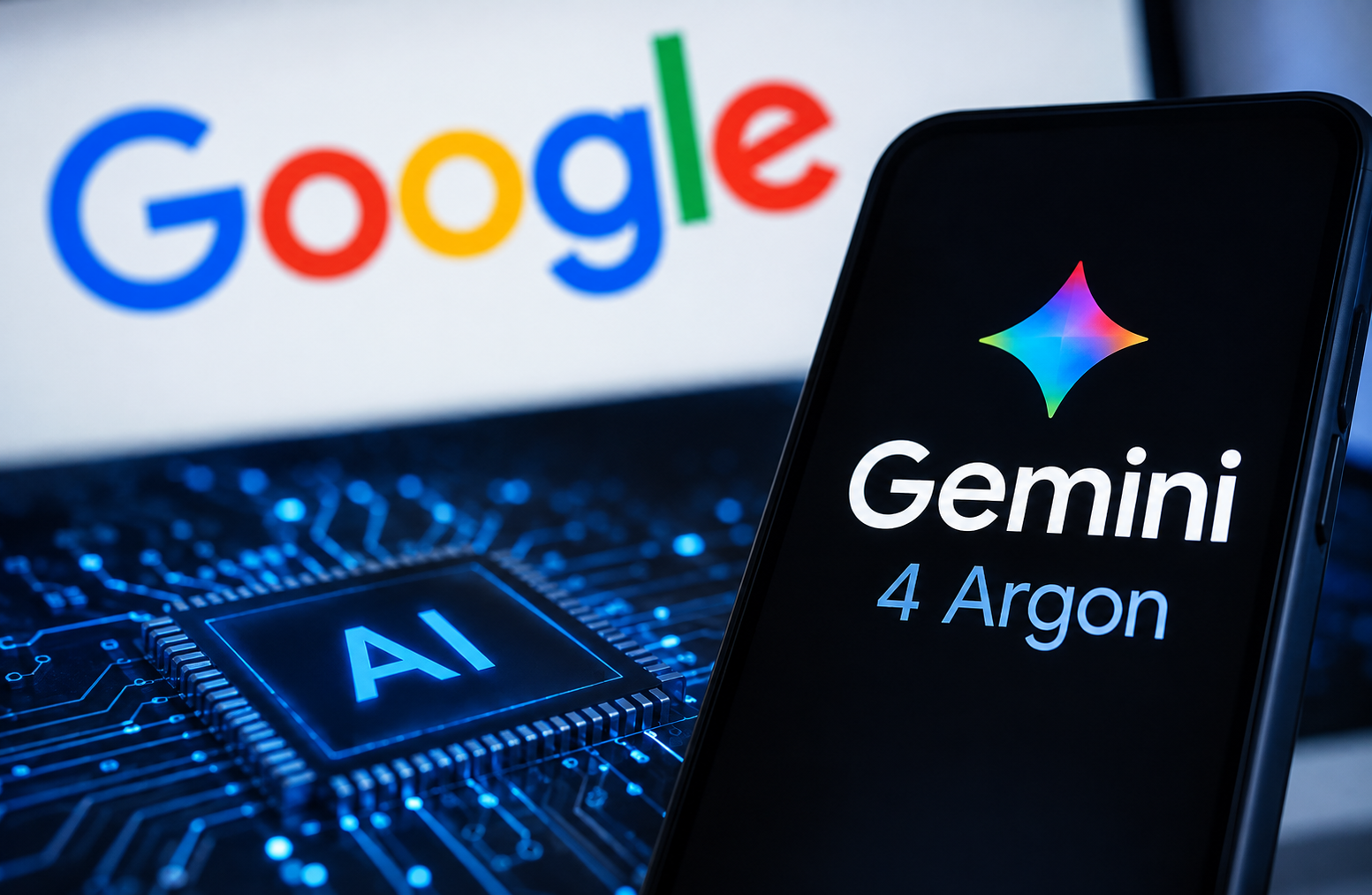
Google has released its flagship artificial intelligence model, Gemini 4 Argon, to developers, businesses and eligible subscribers worldwide, stepping up competition with OpenAI and Anthropic in the advanced AI market. The Oct. 13 launch follows weeks of cybersecurity testing and delays in Google’s model development, according to Reuters and LinkedIn News. Google is positioning Argon as a model designed to handle complex, multistep tasks across software engineering, finance, law, cybersecurity and science.
The model is available to developers through Google’s paid Gemini API tier and to businesses through its AI platforms. Google AI Pro and Ultra subscribers can access Argon through the Gemini app and AI Mode in Search, while its Antigravity coding tool is available to Ultra subscribers.
READ: Google launches Gemini agent as AI giants race to build autonomous workers (October 8, 2026)
According to Reuters, introductory API pricing starts at $2 per million input tokens and $10 per million output tokens. Google plans to double those rates after Nov. 30.
Google expands AI capabilities
Google said Argon is designed to tackle demanding workflows that require sustained reasoning and execution across multiple steps. Early applications include modernizing large software codebases, improving model inference and supporting research in quantum computing and life sciences.
Companies that tested the model early include Deloitte, LexisNexis, Ambience Healthcare and Isomorphic Labs, Reuters reported.
Google also cited internal productivity gains from using Argon through Antigravity. The company said teams increased AI-assisted code submissions by more than 35% while reducing code rollbacks by nearly a third.
The release marks an important step in Google’s effort to strengthen its position in a market where OpenAI and Anthropic have been competing aggressively for developers and enterprise customers.
Cybersecurity and safety measures
Google initially limited access to Argon while it assessed the security implications of its capabilities. The company has since expanded availability while maintaining a separate access program for cybersecurity specialists.
Under the Fairwind Program, vetted cybersecurity defenders can access a version of the model without its standard cyber guardrails to help identify and address software vulnerabilities. Google said it would expand the program to hundreds of additional partners.
The company has also emphasized safeguards against misuse and prompt-injection attacks as its models become more capable of carrying out multistep tasks.
A fresh start after development delays
The launch follows a difficult period for Google’s AI division. Reuters reported that Google abandoned plans to release Gemini 3.5 Pro after delays, despite CEO Sundar Pichai initially indicating that the model would arrive in June.
READ: Google unveils Gemini 4 Argon with coding and security capabilities (October 1, 2026)
The company also underwent leadership changes at Google DeepMind, with co-founder and CEO Demis Hassabis stepping aside and several leaders associated with Gemini leaving the company, Reuters reported.
Google is now using Argon to reassert its position in advanced AI, particularly in applications that require more than conversational responses, including software development, scientific research and enterprise knowledge work.
The company also plans to offer 10,000 scientists six months of free access to the highest usage tier of Google Antigravity, broadening opportunities for researchers to use its AI tools.
The model’s wider availability gives developers and businesses another option as they evaluate the performance, cost and safety of advanced AI systems. Its adoption will depend on how effectively it handles complex real-world tasks and competes with offerings from rival AI companies.