



Editor’s note: This article is based on insights from a podcast series. The views expressed in the podcast reflect the speakers’ perspectives and do not necessarily represent those of this publication. Readers are encouraged to explore the full podcast for additional context.
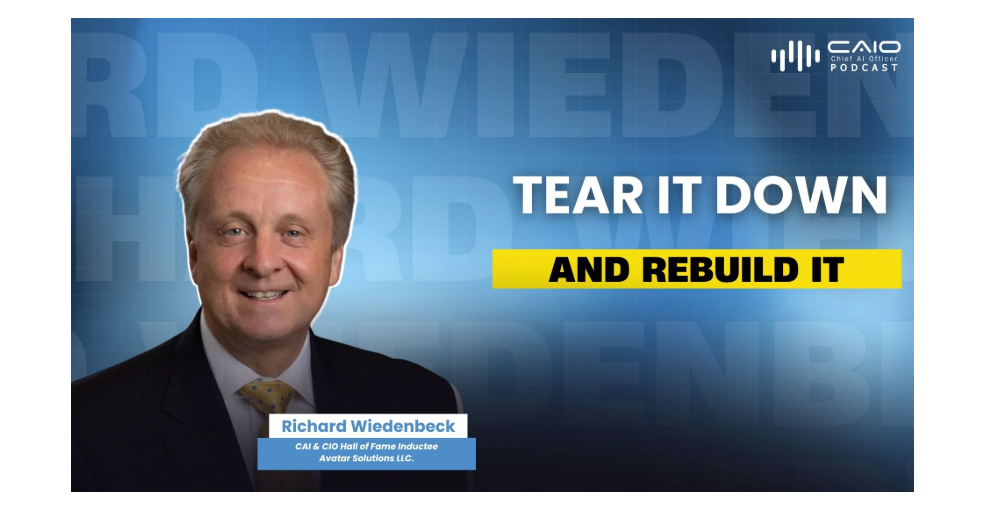
On the “CAIO Connect” podcast, hosted by Sanjay Puri, Richard Wiedenbeck, chief AI officer and CIO Hall of Fame inductee at Avatar Solutions LLC, challenges one of the biggest misconceptions in enterprise AI: that it is primarily a technology problem. Instead, Wiedenbeck argues that AI is fundamentally about business value, transformation and leadership. As organizations move from using AI to assist with work to allowing it to perform tasks autonomously, the role of leadership is being rewritten in real time.
Wiedenbeck’s core thesis is simple yet powerful: “A really good CIO is a business leader first who understands how to bring technology to value in the company. […] I mean, at the end of the day, AI is a form of technology, but it’s also a form of intelligence.”
AI represents a convergence of business strategy, governance and change leadership. Organizations that treat AI as just another IT implementation risk missing its full potential to deploy intelligence across the enterprise.
Using a striking analogy, Wiedenbeck compares today’s leaders to “mechanical engineers in the age of electricity.” Many organizations are using AI to make existing processes faster rather than rethinking them entirely. The real opportunity lies not simply in optimizing workflows but in redesigning them — shifting from “playing checkers faster” to “playing chess differently.”
READ: Former Swedish prime minister Stefan Löfven on AI and the future of work (August 25, 2026)
AI introduces new capabilities, including generative AI, agentic systems and AI workers, that demand a fundamental rethink of how work gets done. These technologies can “help us rethink how entire departments get done, how end-to-end processes get done. Not just how do I automate them in the traditional sense, that’s mechanical engineering.” Companies must reconsider entire departments, processes and decision-making frameworks to operate at significantly greater speed and scale.
One of the most provocative parts of the discussion revolves around the future of the CIO. Wiedenbeck does not dismiss the role but reframes it: Its relevance depends on the ability to lead transformation. CIOs who continue to act as order-takers risk being sidelined, while those who evolve into business and transformation leaders can assume a central role in the AI-driven enterprise.
“The job is about finding a way to lead into a future that is probably hard to see. And then, where are we going to extract value? And I look at AI and say it’s really a culmination of good business leadership, good change leadership,” he explained.
Contrary to fears about widespread job displacement, AI is not necessarily about immediately replacing jobs but about shifting how work is performed. At organizations such as Ameritas, the focus is on transferring tasks from humans to AI to improve unit economics while strategically redeploying employees. Over time, however, AI will not merely execute tasks; it will reshape how work itself is designed.
READ: NYU’s Dr. Hoda A. Alkhzaimi on sovereign AI, technology convergence, and the future of global governance (August 10, 2026)
Traditional return-on-investment models may fall short of capturing AI’s full impact. Wiedenbeck outlines a broader framework that includes cost reduction, revenue enablement, quality improvement and risk mitigation. Not all value can be quantified directly, but that does not make it any less real. Leaders must learn to interpret these indicators and act on them.
Another contrarian insight challenges the emphasis on clean, structured data. According to Wiedenbeck, companies do not need perfect data to begin their AI journeys. What matters is identifying the right data for the task at hand rather than striving for unrealistic levels of perfection.
A critical gap also exists at the board level. Many organizations treat AI purely as a risk issue, placing it under the purview of audit committees. Wiedenbeck argues that this is a mistake. AI must be discussed as a driver of strategic transformation, with active engagement from both executives and board members.
The conversation on the “CAIO Connect” podcast underscores a defining shift: AI is no longer just a tool; it is a force reshaping the enterprise. As Puri and Wiedenbeck highlight, success will depend on leaders who can rethink systems, redesign work and embrace AI as a driver of business value. In this new era, the winners will not simply be those who adopt AI but those who transform their organizations because of it.