



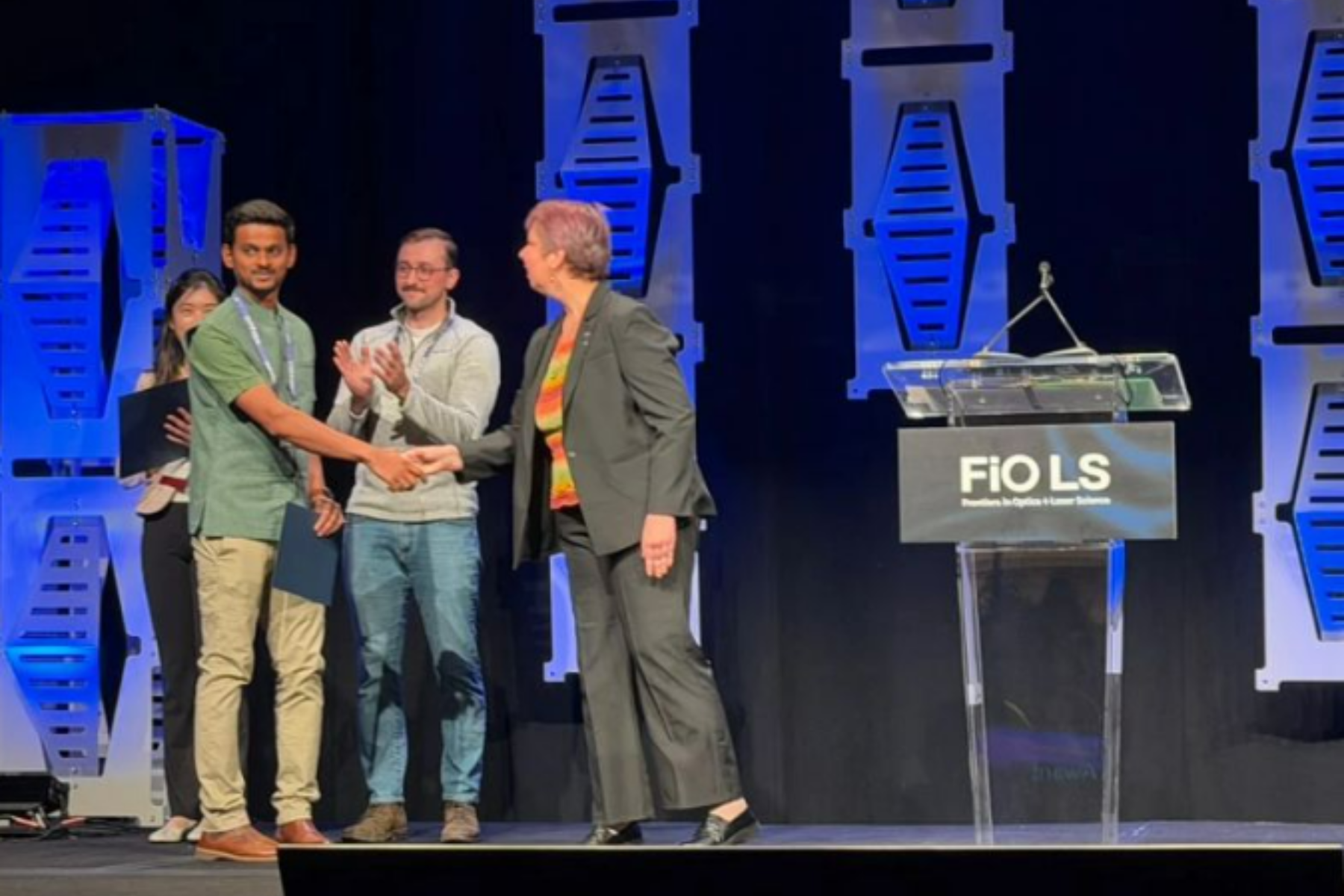
Smrithan Ravichandran, a former graduate student at the University of Maryland, has received the 2026 Carl E. Anderson Dissertation Award from the American Physical Society’s Division of Laser Science for his doctoral research on high-intensity lasers.
His dissertation, titled “Relativistic electron dynamics in petawatt laser fields with applications to fundamental measurements,” examines how electrons behave in extremely intense laser fields and how their movement can help researchers characterize laser conditions for precision experiments.
The award recognizes Ravichandran’s doctoral research and its contribution to developing experimental approaches for studying nonlinear quantum electrodynamics with high-intensity lasers.
His research addresses challenges in using multi-petawatt lasers to investigate nonlinear quantum electrodynamics, which examines the behavior of light and matter under extremely intense electromagnetic fields.
Read: Indian American researcher wins University of Maryland honor (May 14, 2026)
Such experiments require researchers to characterize the laser’s focal region accurately while the system operates at full power and they must also account for particles within that region that could interfere with measurements.
Ravichandran investigated electrons released from residual gas molecules inside the laser’s focal region. When exposed to intense laser fields, these electrons can be expelled at sharp angles relative to the direction of the laser’s propagation.
Through experiments and numerical simulations, he demonstrated that the spatial distribution of these electrons can provide information about the laser focus, including its peak intensity, optical aberrations and the presence of particles that could affect measurements.
The findings offer a potential method for characterizing extreme laser conditions in real time. Such measurements could help researchers conduct more precise experiments to test predictions of nonlinear quantum electrodynamics that remain difficult to investigate using existing laser-based techniques.
Read: 17 Indian Americans in Forbes 2026 America’s Top Lawyers list (September 18, 2026)
Ravichandran’s work also reflects his interest in communicating complex scientific concepts to wider audiences. In 2025, his presentation, “Harnessing Powerful Lasers to Help Build a Fish Tank of the Universe,” won the University of Maryland’s Three Minute Thesis video competition.
The presentation introduced his research into the use of powerful lasers to investigate fundamental questions about light and matter under extreme conditions.
Ravichandran earned his Bachelor of Technology in engineering from the Indian Institute of Technology Madras in 2020 before joining the University of Maryland’s Chemical Physics Program.
He completed his doctoral research under the guidance of Wendell Hill, a professor and director of the university’s Institute for Physical Science and Technology.
Ravichandran is now a postdoctoral researcher at the University of Rochester’s Laboratory for Laser Energetics, where he continues his work in high-intensity laser science.