



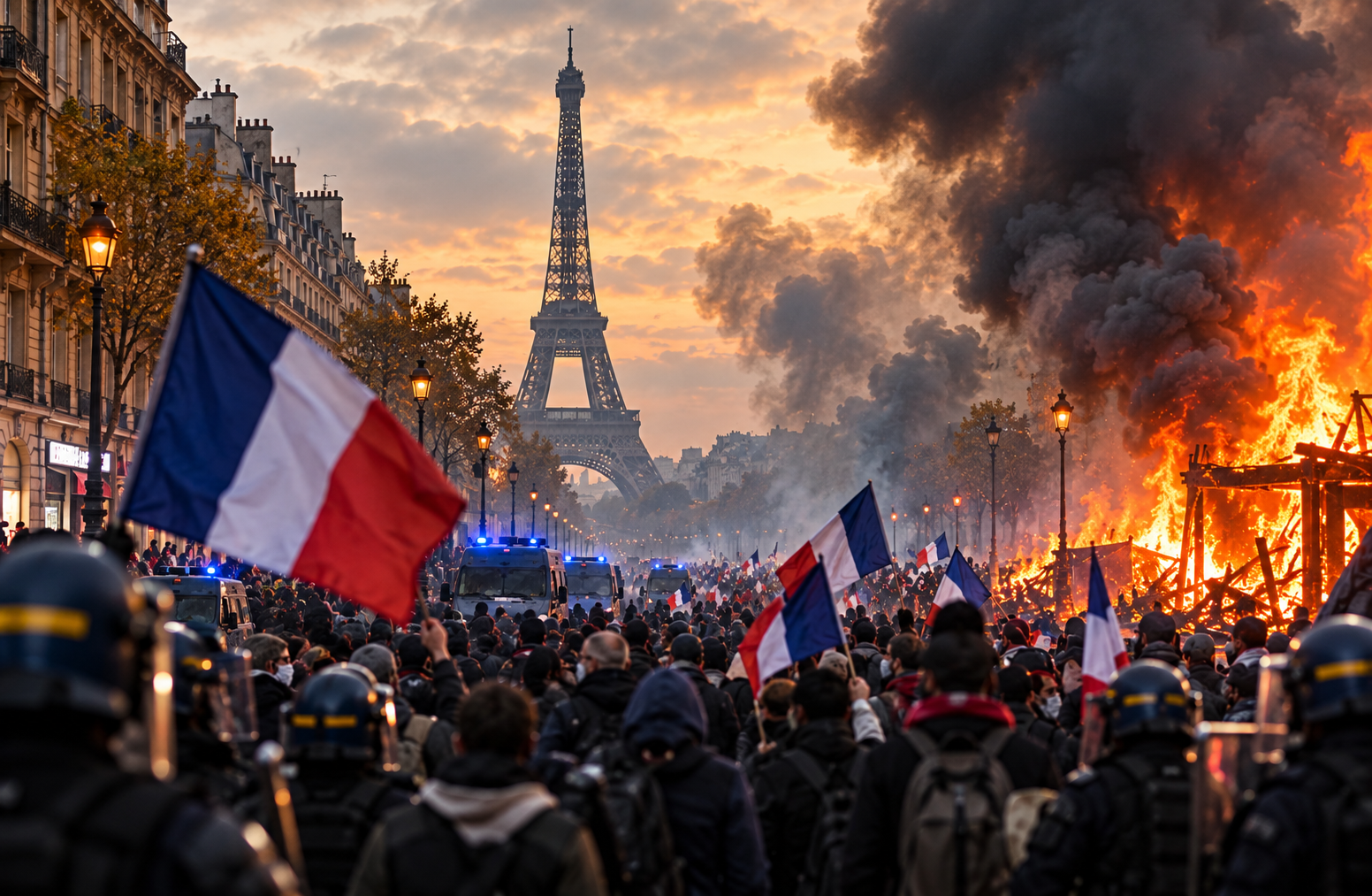
France is facing its worst civil unrest and street violence in decades, triggered by massive nationwide protests over the cost of living, high fuel prices, and deteriorating conditions in public schools and services. The crisis has raised concerns among the economists over government debt across western nations, including U.S.
The unrest in France escalated into riots, looting, and arson. The unrest comes as the French government struggles to control its growing public debt and rising borrowing cost which have been raising concerns about the country’s fiscal stability. As per the country’s statistics agency, the public debt exceeded more than $4 trillion in June. This has surpassed the size of the economy.
READ: Thomas Massie, Ro Khanna launch new push to release Epstein files (September 1, 2026)
An estimated 550,000 people took to the streets across France amid growing public dissatisfaction on how government is handling the situation. Protestors have also raised concerns about overcrowded classrooms, staff shortages, and deteriorating infrastructure in public schools. Rising bond yields that resulted in increased cost of servicing debt leaves policymakers in France to choose options such as raising taxes and cutting public spending.
Similar parallel challenge – rising debt in U.S.
France’s fiscal stress has widely drawn attention to the U.S. as the country faces its own debt burden. Though financial circumstances differ in case of U.S., the country too face pressure to finance government spending while managing borrowing costs.
According to the reports, U.S. public debt stood at $32 trillion which is roughly equivalent to the country’s annual Gross Domestic Product (GDP). The federal budget deficit exceeded $2 trillion. Adding to the fiscal burden, annual interest payments on the debt have also crossed $1 trillion and hence consuming a significant share of government revenue.
In U.S., rising borrowing costs are adding to the pressure, making it more expensive for the government to repay debt and for people and businesses to borrow money. Inflation concerns, rising energy prices, and strong borrowing demand have also caused uncertainty in bond markets. However, the situation may not become like France anytime soon.
U.S. has advantage because dollar stands as the world’s leading reserve currency that supports international demand for U.S. Treasury securities. This allows Washington to borrow on terms that other governments are unable to. Unlike France, U.S. economy is much more diversified and thus it eliminates risks to a level, though not entirely. Adding to the advantage is strong investment in the artificial intelligence sector that could ultimately support the country’s growth in coming years.
But persistent deficits and growing interest payment could eventually leave the government with vulnerability. Such conditions if exist, it will have less flexibility to fund public services or respond to economic shock.
Trump uses France as a warning for voters
Meanwhile, U.S. President Donald Trump has used France’s situation as a political warning to American voters ahead of the upcoming Nov midterm elections. Speaking at an election rally in Kansas, Trump warned the voters that U.S. could experience similar turmoil if the rival Democrats come into power.
“When you see burning steeples and raging fires in France, just remember that is what the radical Dumocrats want to do to America,” Trump said, using his mocking nickname for Democrats.
“We’re not going to let that happen to this country,” he added.
READ: Ro Khanna warns Trump against letting tech billionaires ‘write the rules’ for AI safety (October 1, 2026)
Americans have long expressed frustration over rising prices and the cost of living. According to a Pew Research Center survey, around 24% believe Trump’s policies have had a positive impact on the economy, while 53% to 61% say his actions, particularly sweeping tariffs, have harmed economic conditions.
Against this backdrop, Trump’s remarks draw a connection between the unrest in France and the potential consequences of a Democratic victory, framing the upcoming elections around concerns over economic stability and public disorder.