



By Hanaa Mohamed and Naira Ismail
For us, a summer vacation in India usually means spending time with family and returning to a place that has always been part of our lives.
We were born and raised in the United States, but our families come from Kasaragod, a lush district at the northern tip of Kerala, tucked between the Arabian Sea and the Western Ghats.
Last summer, when we traveled there, we decided to learn more about the place our parents once called home.
What we found was a story we had heard about, but never fully understood.
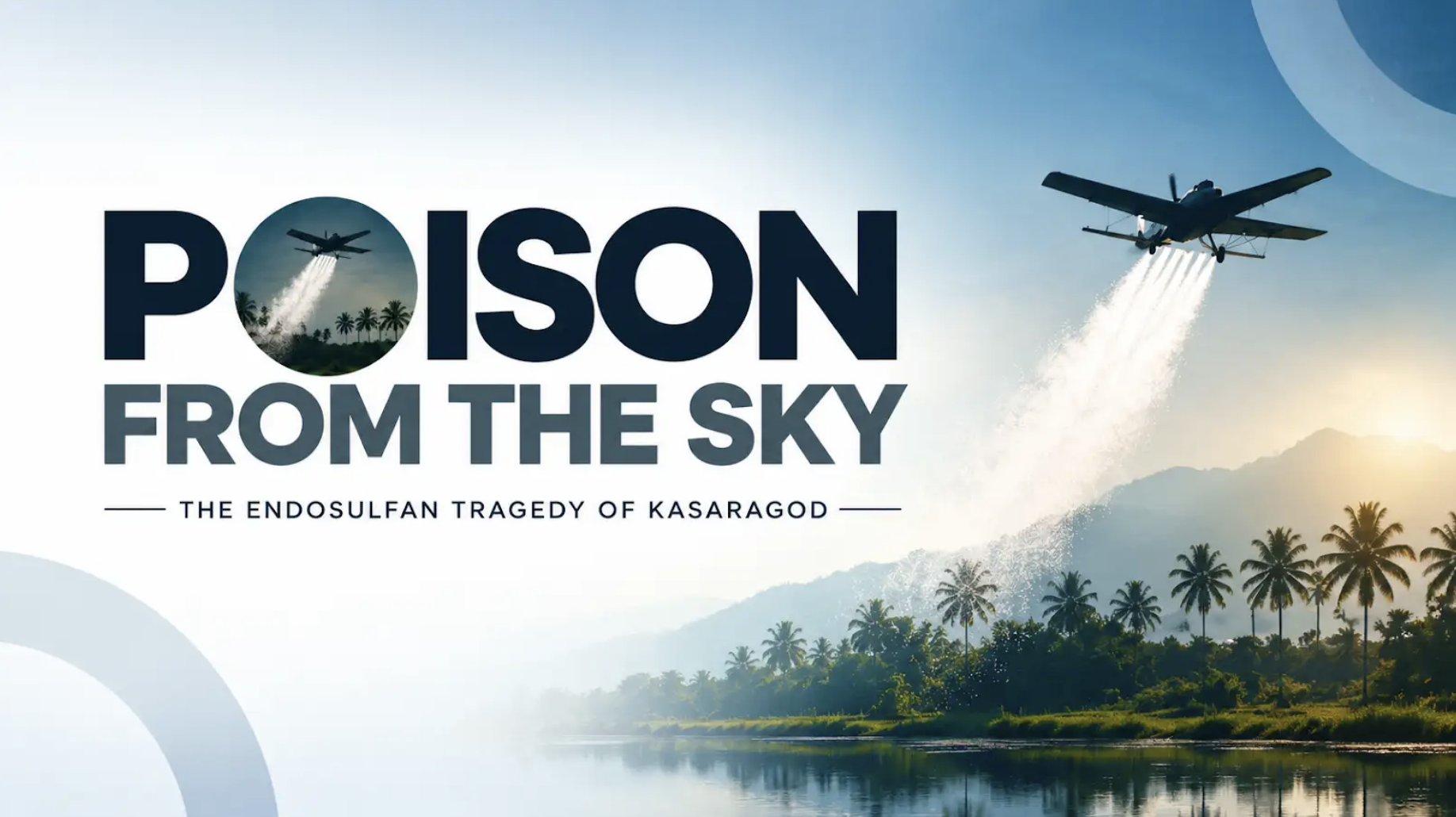
Nearly half a century ago, helicopters began flying over Kasaragod’s sprawling cashew plantations, spraying endosulfan, a pesticide used to control pests. The spraying would eventually become the center of one of India’s most notorious environmental and public-health tragedies.
READ: When the U.S.-Israel war against Iran shakes the Gulf, India’s Kerala state feels the shock (April 5, 2026)
The helicopters are gone now. Endosulfan is banned.
But the tragedy is not over.
We saw that in the people we met.
Beginning in the late 1970s, endosulfan was sprayed aerially over thousands of acres of cashew plantations in Kasaragod. Activists say the spraying continued for decades, exposing communities living around the plantations.
One health official we interviewed explained that Kasaragod’s geography made aerial spraying particularly problematic. The district is crisscrossed by rivers and streams and dotted with wells. Although instructions called for water sources to be covered during spraying, the official said doing so was simply impractical.
The pesticide, the official said, entered streams, rivers and wells used by local residents.
Writer and longtime activist Ambikasuthan Mangad told us that the consequences extended beyond human health.
For roughly 25 years, he said, endosulfan was sprayed across about 12,000 acres, while environmental safeguards were largely ignored. He described deaths, severe illnesses and damage to local plants and animals.
Numbers, however, can make a tragedy seem abstract.
It was only when we entered people’s homes that we began to understand what those numbers meant.
Behind the statistics
We visited the family of Zainaba, one of the most widely reported victims of the endosulfan tragedy and someone whose story became a recognizable human face of the crisis in Kerala.
Her mother remembered helicopters passing directly over their home.
“They stopped the spraying only after many fell ill and it drew public outcry,” she told us.
The family lived surrounded on three sides by plantation land.
Activist B.K. Mohammad Kunhi accompanied us through some of the affected communities. For years, he has worked with families, helping provide food and other assistance and arranging homes for some of those in greatest need.
He took us to Muliyar panchayat, one of the areas associated with the endosulfan crisis.
There we met Aysha.
Aysha has lived with severe disabilities for nearly four decades. Her sister cares for her. Their house was built with help from Mohammad Kunhi’s charity, which also provides food and other assistance.
Their lives seemed to revolve around survival.
“We survive on the food kit they provide and government rice,” Aysha told us. “We have nothing else and no one to care for us.”
She spoke about falling repeatedly and about living with pain.
It was one of those moments when interviewing someone stopped feeling like an assignment.
We were simply listening.
And there was very little we could say.
In the coastal community of Bekal, we met another family.
Fathima is 18 and has experienced serious health problems, including epilepsy, since birth. Her mother had previously lived in Povval in Muliyar panchayat, near one of the areas affected by the spraying.
Her father left and remarried, and her mother now cares for her with limited resources and little outside support. The family told us it had received government financial assistance for a period but that the payments stopped, and they did not know why.
Aysha and Fathima are two people.
Activists told us there are many more.
A tragedy enters literature
One of the people who helped bring their stories to a wider audience was Ambikasuthan Mangad, a writer, professor and activist who has been involved in the anti-endosulfan movement since 2000.
His novel “Enmakaje,” set in a village northeast of Kasaragod town, transformed the tragedy into literature.
Its world is populated by children with congenital abnormalities, families living with chronic illnesses and a natural environment under assault. The book helped carry a story that had largely remained confined to rural Kasaragod far beyond the district’s boundaries.
When we spoke with Mangad, however, he did not talk about the tragedy as something belonging to history.
He talked about people who are still alive.
He described elderly mothers continuing to care for adult children with profound disabilities. He remembered visiting families where children had endured extraordinary suffering.
“This is the tragic fate of children affected by endosulfan contamination,” he told us. “They die isolated, and their deaths go unnoticed because they lived in rural areas.”
That sentence stayed with us.
The long fight
The suffering eventually fueled a movement against endosulfan and the indiscriminate use of pesticides.
But activists told us recognition came painfully slowly.
Residents, physicians, environmentalists and campaigners spent years trying to establish a connection between aerial spraying and the unusual pattern of illnesses they were witnessing.
Government agencies and scientific institutions eventually began investigating.
According to activist Kunhikrishnan, a 2010 community health assessment identified 4,182 endosulfan victims, while 6,728 people are now on the official list.
The official response came in stages.
Endosulfan spraying was banned in Kasaragod in 2000. Kerala imposed a statewide ban in 2004. In 2011, India’s Supreme Court imposed an interim nationwide ban on the manufacture, sale and use of endosulfan.
That same year, governments participating in the Stockholm Convention agreed to list endosulfan for global elimination, subject to specified exemptions.
But banning a pesticide does not undo exposure that has already occurred.
Thousands of people were already living with illnesses and disabilities that victims, activists and government programs have associated with the years of endosulfan use.
Kerala has since created treatment and rehabilitation programs, including a rehabilitation village on 25 acres of land. At one rehabilitation center we visited, an official told us more than 100 people were receiving services including therapy and treatment.
READ: India’s Kerala state shows how to fight Coronavirus (March 18, 2020)
Activists say much more is needed.
Mangad told us the region needs better specialist treatment, rehabilitation, regular medical camps and a major hospital capable not only of treating patients but also conducting long-term research.
A House of Love
Amid so much suffering, one place gave us a different glimpse of Kasaragod.
It is called Snehaveedu — “House of Love.”
We spent time there with children. We sang with them. They sang for us.
Established by Kunhikrishnan and fellow activists, Snehaveedu provides early intervention and rehabilitation for people affected by endosulfan as well as other children and adults with physical and intellectual disabilities.
The center provides physiotherapy, speech therapy, special education, occupational therapy, behavioral therapy and vocational training.
Its coordinator, Muneesa, is herself blind and is listed among the endosulfan victims. She has earned both a master’s degree and a bachelor’s degree in education.
The idea for Snehaveedu grew from a question Kunhikrishnan kept hearing from mothers during the protests:
“If I die, what will happen to my child?”
It is a simple question.
For parents who have spent decades caring for sons and daughters unable to live independently, it is also terrifying.
Kunhikrishnan and other activists began Snehaveedu in a rented building on Dec. 8, 2014. There was no grand plan, he told us. Initially, they imagined a small day-care center serving a handful of people.
They began with three children.
Today, about 130 people are registered with the center.
Its staff has grown from two to 25, and keeping the organization running costs thousands of dollars each month. Much of that money comes from charitable contributions and public support.
What struck us most was how Kunhikrishnan described the philosophy behind it.
“Keeping these individuals among us is our responsibility,” he said, “not just an obligation.”
The helicopters are gone
When we began this journey, we were two Indian American students spending our summer vacation in the place our families came from.
Kasaragod was familiar to us through our parents, relatives and visits to India.
But this was a Kasaragod we had never really known.
We met sisters surviving with the help of donated groceries. We met a mother caring for a daughter with serious health problems. We listened to activists who have spent decades fighting for recognition and assistance. And we visited a center born from perhaps the most painful question any parent can ask: Who will care for my child when I am gone?
Nearly half a century after endosulfan was first sprayed over Kasaragod’s cashew plantations, its legacy remains visible.
It is visible in families caring for children and adults with profound disabilities.
It is visible in elderly parents who continue to worry about what will happen to their children after they die.
And it is visible in places like Snehaveedu, created because ordinary people decided those families should not have to carry that burden alone.
Our summer eventually ended, and we returned to the United States.
But the people we met remained in Kasaragod, living with a tragedy that began long before we were born.
The helicopters no longer fly over the cashew plantations spraying endosulfan.
The pesticide has been banned.
But for Aysha, Fathima and thousands of others whose lives have been touched by what happened here, stopping the spraying did not mean the end of the tragedy.
That may be the most important lesson we brought home with us:
An environmental disaster does not necessarily end when the source of the contamination disappears.
Sometimes, its consequences live on for generations.
(Hanaa Mohamed is a high school senior in Cupertino, CA. Naira Ismail is a freshman studying public health.)