



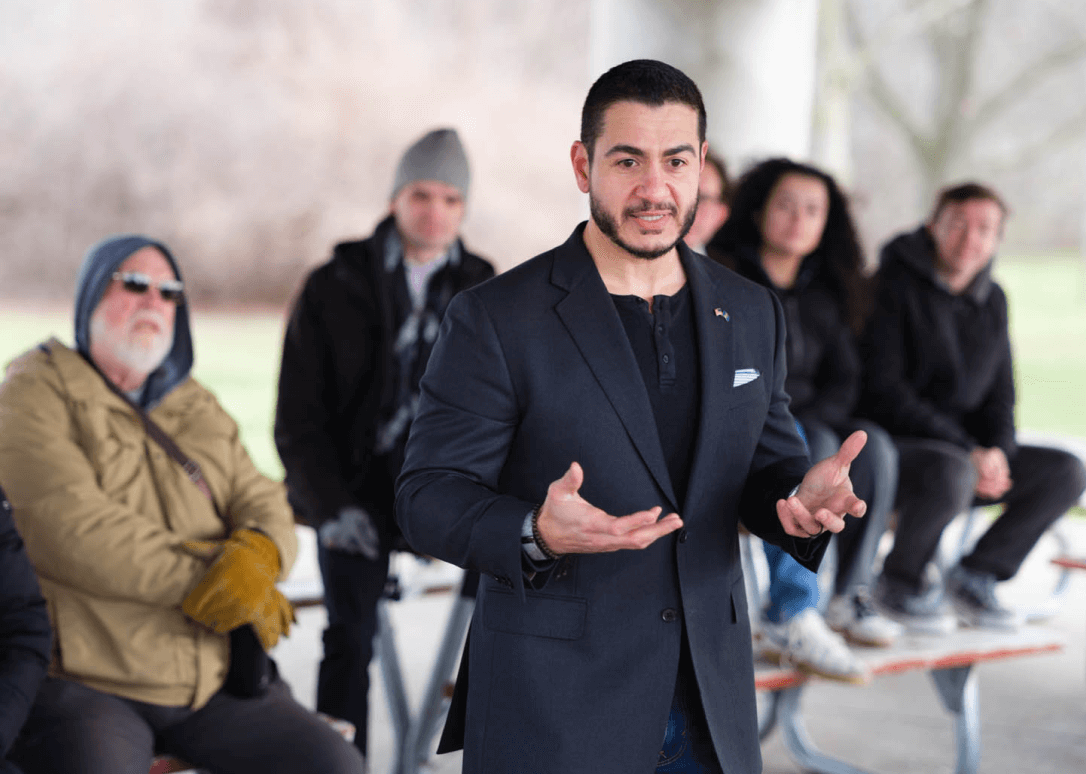
With the Nov. 3 midterm elections just over a week away, political leaders are intensifying their campaigns to secure victories for their parties. President Donald Trump, who is not on the ballot, has also stepped up his campaign appearances, recently intensifying his attacks on Michigan Democratic Senate candidate Abdul El-Sayed over his Muslim identity.
Speaking at a campaign rally in Port Huron, Michigan, on Sunday, Trump called El-Sayed a “jihadist” and questioned his loyalty to the United States. He also accused the Democratic candidate of supporting terrorist-designated organizations. The remarks drew criticism from Bishara Bahbah, a former Trump ally who helped lead the president’s outreach to Arab American voters.
“I’m here to keep a jihadist Muslim Brotherhood member from becoming a United States senator,” Trump said.
El-Sayed has repeatedly denied having any ties to the Muslim Brotherhood, and there is no evidence that he is affiliated with the group. Some branches of the Muslim Brotherhood have been designated as terrorist organizations by the U.S. government. Republicans have pointed to a 2012 social media post by El-Sayed’s half-sister, Eman Abdelhadi, who described her family as having longstanding connections to the movement.
READ: Abdul El-Sayed hits back at Trump’s ‘jihadist’ remarks, defends Muslim faith in Senate campaign (October 19, 2026)
El-Sayed was born in the United States to Egyptian immigrant parents who divorced when he was young. He was raised by his father.
Trump also suggested that El-Sayed should undergo security screening before entering the Senate.
“He will be the only senator who would have to go through a metal detector before he’s allowed to go into the Senate. I want him to have a metal detector,” Trump said.
The remarks come as El-Sayed faces Republican candidate Mike Rogers in a closely contested Michigan Senate race that could help determine control of the chamber.
Trump also claimed that El-Sayed wanted to impose Shariah law in the United States.
“He wants our country to go to Sharia law,” Trump said, adding that Michigan voters would defeat “Abdul Mohammed El-Sayed” on Election Day. Trump has repeatedly referred to the candidate as “Mohammed” while criticizing him.
Meanwhile, Bahbah, who helped lead Arab American outreach for Trump’s 2024 presidential campaign, condemned the president’s remarks.
“The remarks are out of line and crazy. I mean, no sane individual would say these things,” Bahbah said.
“The president of the United States saying that about a person because of his religion, that is just not acceptable. And people are going to remember that on Nov. 3,” he added.
Bahbah played a significant role in Trump’s 2024 outreach to Arab American voters in Michigan, where dissatisfaction with the Biden administration’s handling of the war in Gaza contributed to Trump’s gains in communities such as Dearborn, which has a large Arab American population.
The remarks come amid concerns about discrimination against Muslim Americans. A September 2026 Pew Research Center survey found that 59% of Muslim Americans said there was a great deal of discrimination against Muslims in the United States. The survey also found that 34% said someone had expressed support for them in the past year because of their religion.
READ: Abdul El-Sayed faces Medicare for All, citizenship attacks (October 7, 2026)
Democratic Sen. Bernie Sanders appeared alongside El-Sayed at a rally in Grand Rapids, Michigan, where he accused Trump of using Islamophobia to distract voters from issues such as health care, housing and income inequality.
“All they can do is foment hatred and divisiveness,” Sanders said.
El-Sayed, a former Detroit health official, has repeatedly rejected questions about his loyalty to the United States and Trump’s allegations about his religious and political affiliations.
“I don’t even care that he remembers my whole name because he can just go on and call me ‘senator’ after November. I will be Senator Muhammad to you, bro,” El-Sayed said at the Grand Rapids rally.
At a campaign event last week, El-Sayed said the U.S. Constitution protects the right to practice any religion or none at all, arguing that a candidate’s faith should not be treated as evidence of divided loyalties.
“I’m not running to be a Muslim senator. I’m running for U.S. Senate and happen to be Muslim,” he said.