



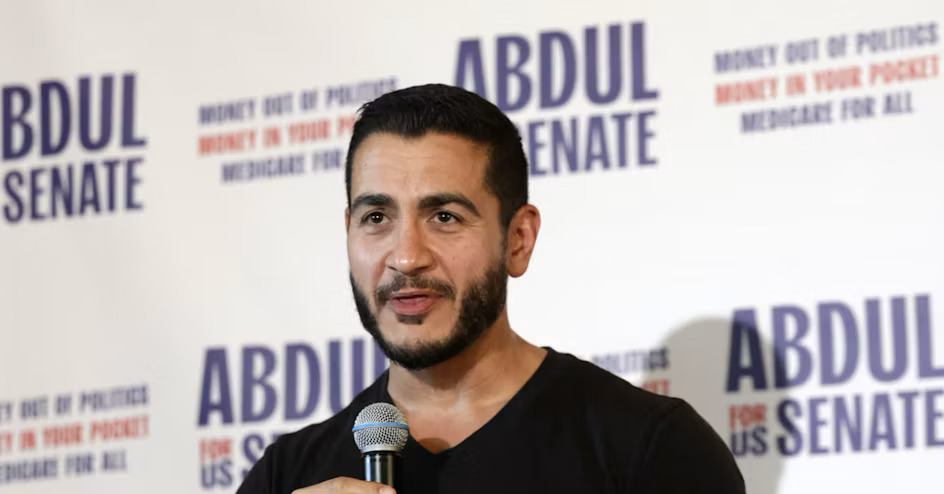
Michigan Democratic Senate candidate Abdul El-Sayed is facing renewed criticism from conservative commentators over his support for Medicare for All and a disputed claim about whether he has held Egyptian citizenship.
The attacks come as the Michigan Senate race enters its final weeks before the November 3 election. El-Sayed, a former Detroit and Wayne County public health official, is running on a platform that prominently includes Medicare for All. His campaign website lists the policy among his central priorities and says he wants to expand government-backed health coverage.
READ: Abdul El-Sayed’s sister faces backlash over being ‘Anti-American’ on X (August 14, 2026)
Criticism over Medicare for All
A video posted by social media influencer Priya Patel criticized El-Sayed’s healthcare proposal, describing him as a “socialist jihadi” and accusing him of seeking to eliminate private health insurance. The video argues that a single-payer system would shift healthcare financing to the federal government and increase taxes.
The characterization in the video is political rhetoric rather than an independently established description of El-Sayed’s ideology. El-Sayed has publicly promoted Medicare for All, saying at an August rally at the University of Michigan that the system would separate health coverage from employment and reduce out-of-pocket costs.
El-Sayed’s campaign website also identifies Medicare for All as one of his three major priorities, alongside getting money out of politics and putting money back into Michiganders’ pockets.
What the CBO analysis says
The video cites a Congressional Budget Office analysis to argue that a single-payer system would substantially increase federal healthcare spending. That portion is broadly consistent with CBO’s 2020 analysis, although the figures need context.
The CBO examined five illustrative single-payer options rather than El-Sayed’s specific campaign proposal. It estimated that federal subsidies for healthcare in 2030 would be $1.5 trillion to $3 trillion higher than under current law. At the same time, the CBO estimated that total national health expenditures could range from a $700 billion decrease to a $300 billion increase, depending on the design of the system.
Canadian healthcare wait times
The video also points to Canadian healthcare waiting times as an argument against government-run healthcare. A 2025 Fraser Institute survey reported a median wait of 28.6 weeks from a general-practitioner referral to treatment in Canada. The study reported median waits of 49.9 weeks for neurosurgery and 48.6 weeks for orthopedic surgery, and estimated that 1.4 million procedures were waiting to be performed.
However, those figures come from a Fraser Institute survey of Canadian physicians and describe Canada’s healthcare system rather than demonstrating what a particular U.S. Medicare for All proposal would produce.
Questions over El-Sayed’s wife’s practice.
READ: Abdul El-Sayed highlights Karnataka roots of his wife, criticizes Pakistan democracy (August 31, 2026)
The video also alleges that El-Sayed’s wife, psychiatrist Sarah Jukaku, does not participate in Medicare or private insurance. Reporting by the Michigan Public says Jukaku operates a private Ann Arbor psychiatry practice that does not accept Medicare, Medicaid or private insurance and that she opted out of Medicare in 2025. The issue has been used by critics to accuse El-Sayed of hypocrisy while advocating Medicare for All.
The citizenship controversy
The citizenship issue has generated a separate controversy.
Nalin Haley, son of former South Carolina Gov. Nikki Haley, wrote on X that “Dual citizens should not be allowed to run for office in the United States,” adding that Americans should not have another country as a home. The post came after another X account claimed that El-Sayed had admitted to having Egyptian dual citizenship.
There is evidence that El-Sayed previously described himself as a dual citizen. The Washington Free Beacon reported in October that previously unpublished video from a 2016 medical conference showed El-Sayed saying, “I carry dual citizenship,” while discussing his childhood trips to Egypt. The same report noted that an academic résumé from 2014 had listed his citizenships as “USA, Egypt.”
El-Sayed’s campaign disputes that he ever legally held Egyptian citizenship. Campaign spokeswoman Roxie Richner previously told the Free Beacon that El-Sayed was “not a dual citizen by any verifiable metric and never has been.” She said he had been told as a child that his grandfather had pursued Egyptian citizenship for him because his parents were born in Egypt, but that El-Sayed and his family later could not find documentation confirming it.
The available reporting therefore establishes that El-Sayed has publicly described himself as a dual citizen in the past, while his campaign now disputes that he was legally an Egyptian citizen. The statements alone do not independently establish his current legal citizenship status.
The controversy is unfolding in a closely watched Michigan Senate contest between El-Sayed and Republican Mike Rogers. Recent national coverage has focused on the candidates’ sharply different approaches to healthcare and other economic issues as the November election approaches.