



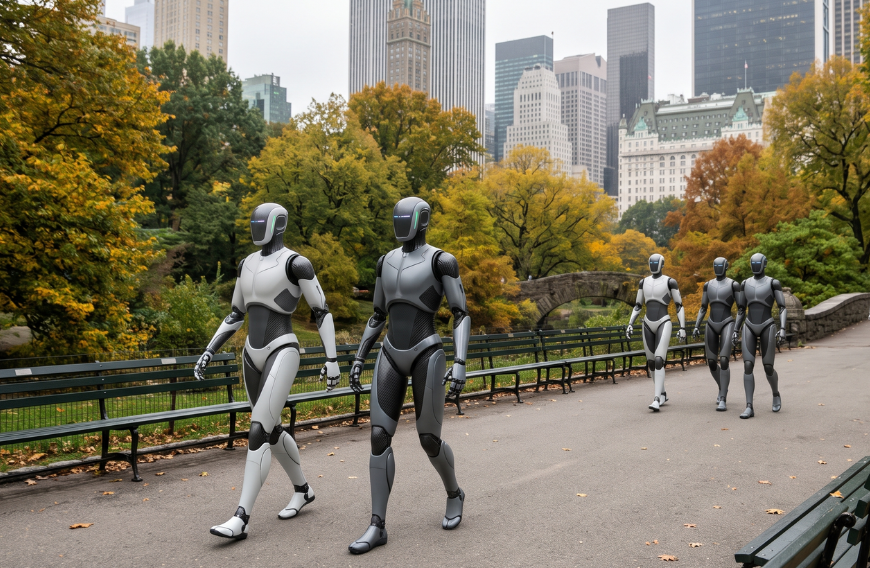
A humanoid robot, developed by California-based technology company Faraday Future, attracted attention at Brooklyn Bridge Park over the weekend as it walked among visitors.
The life-size robot, priced at $89,000, was seen moving around the waterfront park, located between the Brooklyn and Manhattan bridges. It sang to children and danced with strangers as visitors interacted with it and posed for photographs against the Manhattan skyline. A group of about 12 women visiting from Argentina also stopped to take pictures with the robot.
The outing was intended to help the robot develop its interaction and nurturing skills, which could potentially support future applications in child care, education and companionship. Developers have suggested that such robots could eventually serve as babysitters or teachers, although the machine remains in development. According to its developers, exposure to real-world environments could help improve its movement, navigation and ability to interact with people.
According to a report by the New York Post, the robot was operated remotely by Hong Rao, chief technology officer of Faraday Future, using a small remote control. The demonstration provided an opportunity to observe how people responded to a humanoid machine in an everyday public setting.
READ: Humanoid robot crashes after Beijing sprint (August 20, 2026)
Faraday Future introduced five new robot models across nine configurations in September, bringing its reported portfolio to 11 models and 24 products. The full-size FF Futurist Standard humanoid robot is priced at approximately $89,900, while the more advanced Futurist Ultra model costs around $129,900, according to figures cited in the report.
Faraday Future has also outlined plans to expand its U.S. robotics manufacturing operations, although its proposed production timelines and commercial targets remain subject to implementation.
The public demonstration also raises questions about the readiness of humanoid robots for environments involving children and other potentially vulnerable users.
Although robots can be designed to recognize instructions, navigate their surroundings and respond to human interactions, their ability to operate safely and reliably in unpredictable situations remains an important consideration. Remote operation during a public demonstration also differs significantly from fully autonomous performance.
READ: Chinese startup Unitree unveils ‘Superman’ robot, faster than Usain Bolt (August 18, 2026)
The prospect of introducing robots into homes, schools and workplaces has prompted broader discussions about safety, privacy, accountability and the potential impact of automation on employment.
Brooklyn Bridge Park has previously hosted humanoid robots interacting with children. Footage from March showed a Unitree G1 robot playing with children at the same location.
As companies race to develop life-size robots designed to make everyday tasks easier, concerns are also growing about their potential misuse. German police launched an investigation into two teenagers earlier this month over allegations that they controlled a robot that groped a 16-year-old girl. The teenagers are suspected of livestreaming the incident on social media and commenting on it.
For now, Faraday Future’s latest demonstration offers a glimpse into the evolving relationship between humans and machines. Whether humanoid robots can eventually become dependable caregivers, teachers or companions will depend on further technological progress, rigorous safety testing and public acceptance.