



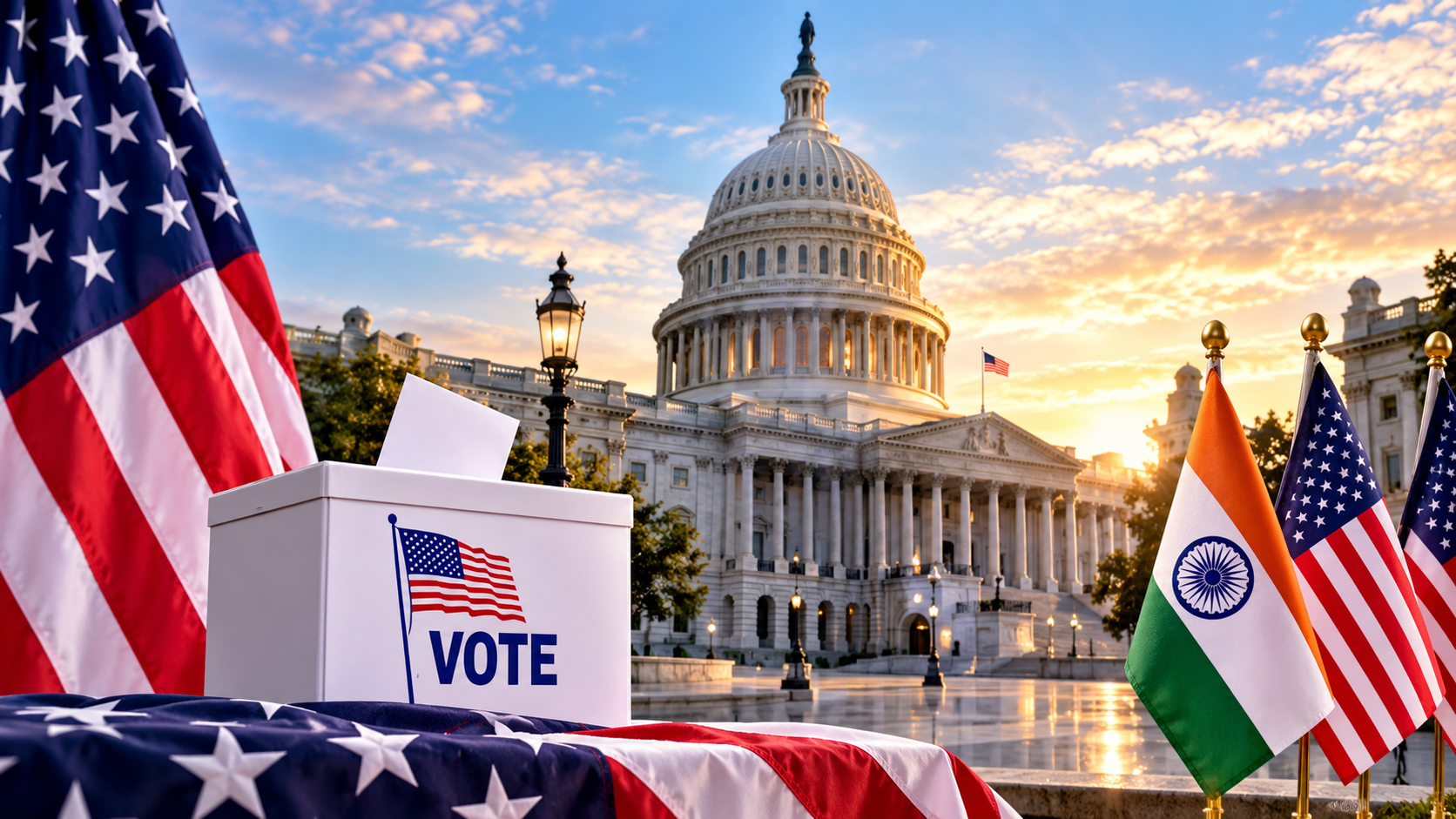
Indian American candidates are seeking to strengthen their presence in Congress and state legislatures, while established political leaders continue to shape Democratic Party contests through endorsements and grassroots organizing.
Indian Americans are entering the 2026 U.S. midterm elections with a growing political footprint, even as the community faces setbacks in some of its most prominent congressional races.
The Democratic Party, which has historically been home to several high-profile Indian American lawmakers, is witnessing a changing political landscape. While established members of Congress continue to seek reelection, new candidates are emerging in competitive districts, and Indian American political leaders are increasingly involved in supporting candidates beyond their own community.
READ: Anti-Indian rhetoric puts Republicans at risk of losing Indian American voters ahead of midterms (October 26, 2026)
The developments highlight a broader shift in Indian American political participation — from securing representation in elected office to influencing the wider electoral process through endorsements, fundraising and voter mobilization.
Top 10 Indian Americans to watch in the 2026 elections:
-
Ro Khanna (California): The Democratic congressman is seeking reelection, maintaining a national profile on technology, artificial intelligence and economic policy.
-
Pramila Jayapal (Washington): The Democratic congresswoman is seeking reelection and remains a prominent progressive voice on immigration, health care and economic policy.
-
Ami Bera (California): The Democratic congressman is seeking reelection, continuing his work in Congress, including on foreign policy.
-
Suhas Subramanyam (Virginia): The Democratic congressman is seeking reelection to represent Virginia’s 10th Congressional District.
-
Amish Shah (Arizona): The Democratic nominee is challenging Republican Jay Feely for Arizona’s 1st Congressional District.
-
Pia Dandiya (Florida): The Democratic nominee is contesting Florida’s 22nd Congressional District against Republican Casey Askar.
-
Vivek Ramaswamy (Ohio): The Republican nominee is running for governor against Democrat Amy Acton in one of the country’s closely watched statewide contests.
-
Saritha Komatireddy (New York): The Republican candidate is challenging Democratic incumbent Letitia James for state attorney general.
-
Aruna Miller (Maryland): The incumbent lieutenant governor is seeking a second term on the Democratic ticket with Gov. Wes Moore.
-
Nithya Raman (Los Angeles): The City Council member is challenging incumbent Mayor Karen Bass in the city’s Nov. 3 mayoral election.
Congressional setbacks reshape Indian American representation
Indian American representation in the U.S. House of Representatives is expected to decline following the primary defeats of two prominent Democratic lawmakers.
Rep. Raja Krishnamoorthi of Illinois lost the Democratic primary for the state’s open U.S. Senate seat to Lt. Gov. Juliana Stratton in March 2026.
Krishnamoorthi, who has represented Illinois’ 8th Congressional District since 2017, had sought to succeed retiring Sen. Dick Durbin. His defeat ended his bid for a higher office and removed him from the November congressional election cycle.
In Michigan, Rep. Shri Thanedar lost the Democratic primary for the state’s 13th Congressional District to state Rep. Donavan McKinney in August. McKinney’s victory marked a significant political setback for Thanedar, who had represented the Detroit-area district since 2023.
The two defeats mean that the number of Indian American members of Congress could fall from six to four, assuming the remaining lawmakers retain their seats in November.
The outgoing Indian American congressional delegation includes:
- Rep. Ami Bera of California
- Rep. Ro Khanna of California
- Rep. Pramila Jayapal of Washington
- Rep. Suhas Subramanyam of Virginia
All four are Democrats seeking to retain their congressional seats.
Bera, who has served in Congress since 2013, is the longest-serving Indian American member of the House. Khanna, Jayapal and Subramanyam have also established influential positions within the Democratic Party.
The defeats of Krishnamoorthi and Thanedar, however, do not necessarily indicate a decline in Indian American political participation. Instead, the community’s influence is increasingly visible in competitive races, state-level politics and electoral endorsements.
Amish Shah and Pia Dandiya emerge as potential Democratic gains
Two Indian American Democratic candidates are attracting attention ahead of the November 3 midterm elections.
Amish Shah, a physician and former Arizona state representative, is running for Congress in Arizona’s 1st Congressional District. Shah, who previously contested the seat in 2024, is seeking to defeat Republican candidate Jay Feely, a former National Football League kicker who has received President Donald Trump’s endorsement.
The race is considered important to Democrats’ efforts to regain control of the House of Representatives.
In Florida, Pia Dandiya is contesting the 22nd Congressional District against Republican Casey Askar. Dandiya, a former high school principal and education-focused policy leader, has centered her campaign on education and affordability. Her background in public education has become a key element of her campaign messaging.
Both candidates are viewed as having favourable prospects, although the outcomes will depend on voter turnout, campaign dynamics and the broader national political environment.
READ: Obama comes in support of Democrats ahead of midterm elections (October 25, 2026)
Their campaigns illustrate how Indian American candidates are increasingly competing in districts where their electoral prospects depend on building coalitions across diverse communities rather than relying solely on ethnic identity.
Indian American political leaders extend influence through endorsements
Beyond their own campaigns, Indian American political leaders are increasingly involved in supporting candidates across the Democratic Party.
Endorsements from established lawmakers can help candidates gain visibility, strengthen fundraising networks and connect with voters in communities where Indian American political organizations have developed a presence.
The influence of these endorsements is particularly relevant in competitive congressional and state legislative races, where local organizing and voter mobilization can play a decisive role.
Indian American political participation is no longer limited to candidates of Indian origin seeking elected office. Community leaders are also supporting candidates from different backgrounds whose policies align with their priorities.
This broader engagement reflects the growing diversity of the Indian American electorate and its increasing participation in mainstream American political life.
However, endorsements alone do not determine electoral outcomes. Candidates must still establish their own appeal among voters, particularly in districts where demographic diversity, local economic concerns and national political issues shape voting behavior.
Aruna Miller’s leadership in Maryland highlights state-level influence
Indian American political representation is also expanding at the state level.
Aruna Miller, Maryland’s lieutenant governor, is one of the most prominent Indian American political figures outside Congress.
Miller, who previously served in the Maryland House of Delegates, became the state’s lieutenant governor in 2023 alongside Gov. Wes Moore.
Her political career illustrates the growing role of Indian Americans in state government, where elected officials influence policies concerning transportation, education, healthcare and economic development.
Miller’s leadership also highlights the importance of state-level political institutions in shaping the community’s broader influence.
While congressional representation attracts national attention, state legislatures and executive offices often provide opportunities for political participation and policy influence at a more direct level.
A changing political landscape
The 2026 midterm elections present Indian Americans with both opportunities and challenges.
The defeats of Krishnamoorthi and Thanedar have reduced the community’s immediate congressional representation. At the same time, candidates such as Shah and Dandiya are seeking to strengthen the community’s presence in the House.
The continued political careers of Bera, Khanna, Jayapal and Subramanyam, alongside Miller’s leadership in Maryland, demonstrate that Indian American influence extends beyond a single election cycle. The community’s growing involvement in endorsements and political organizing also suggests that its role in American elections is evolving.
The November elections will provide a clearer indication of whether Indian American candidates can regain some of the congressional representation lost during the primaries — and how effectively the community can translate its expanding political participation into broader electoral influence.