



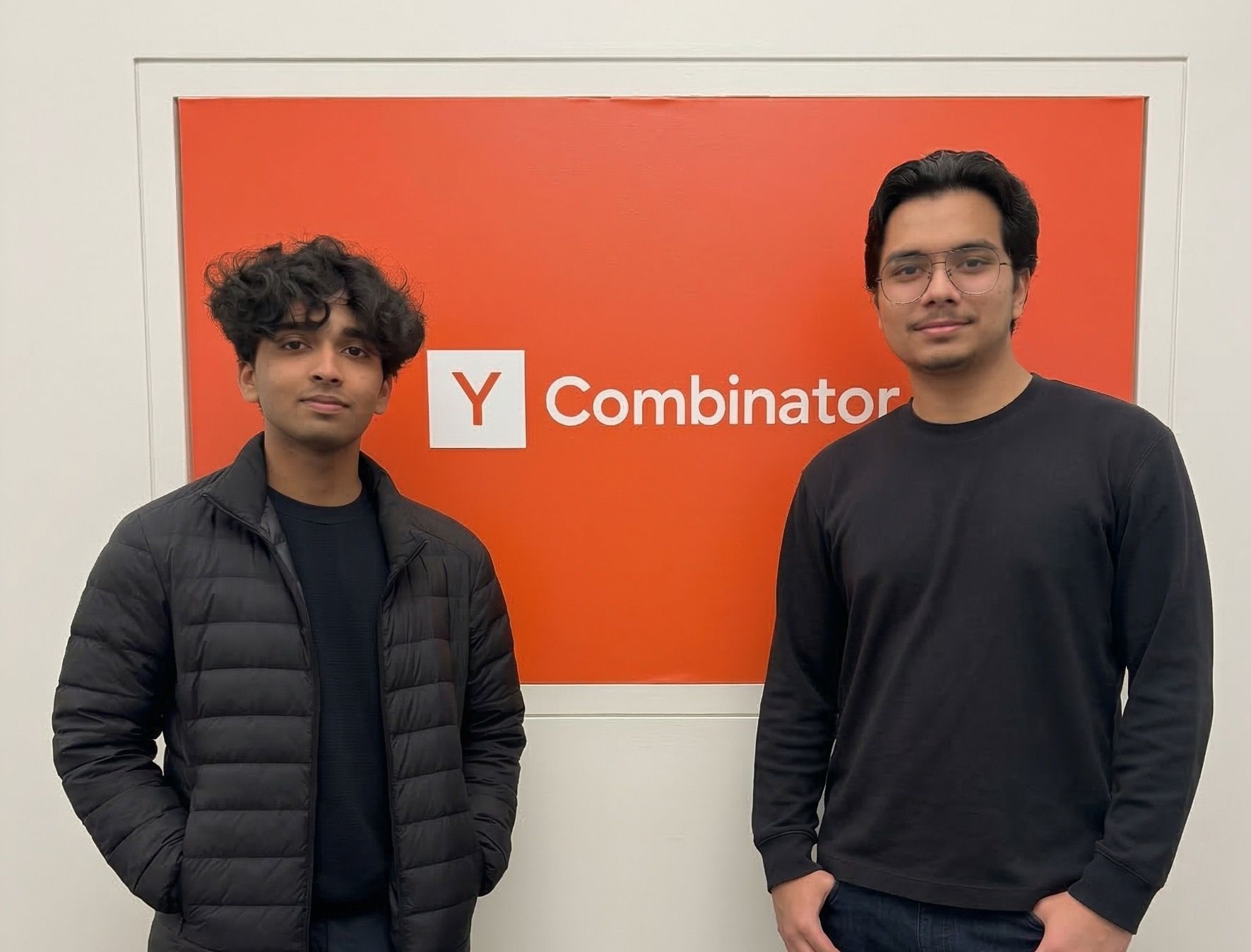
Two 18-year-old entrepreneurs from India are drawing attention in Silicon Valley after raising $1.3 million in seed funding for their artificial intelligence startup Manicule, backed by prominent early-stage investors including Y Combinator.
Naman Bansal and Shreyans Jain, both originally from India, have taken an unconventional route into the U.S. technology industry. Rather than following the traditional Indian path of preparing for competitive engineering entrance examinations and attending a top engineering college, the two chose to skip university and build a company of their own.
Their startup Manicule announced that it had raised $1.3 million through Simple Agreements for Future Equity (SAFEs). The funding round was co-led by Y Combinator and Broom Ventures, with additional participation from technology industry angel investors.
READ: AI startup Papaya joins Y Combinator Fall 2026 batch (September 16, 2026)
Now based in San Francisco, the young founders are building a business around an emerging shift in how companies and their software products are discovered online. As more people turn to artificial intelligence platforms such as ChatGPT, Claude and Google’s AI Overviews instead of traditional search engines, Manicule wants to help software companies become the platforms these AI systems recommend and use.
The company calls its approach Agent Relations, or AgentRel. Instead of simply tracking how often a business appears in AI-generated answers, Manicule works to influence those recommendations and enable AI agents to interact directly with its clients’ products.
“The fundamental unit of software discovery has shifted from the Google search query to the AI prompt,” said Bansal, co-founder and CEO of Manicule.
“Passive tracking dashboards don’t bring in customers. We handle the execution end-to-end so AI models don’t just mention our clients; they are chosen and used.”
From Agra to Silicon Valley
Bansal’s entrepreneurial journey began long before Manicule. At 12, he secured his first paid online writing assignment while working from his bedroom in Agra, India. By 13, he was providing developer relations services to international startups, gaining early experience in technical marketing and helping companies communicate with software developers.
He met Jain at high school when he was 15. The two soon started working together on a digital business that generated $15,000 before they completed secondary school.
Jain had begun learning software development at 14. Instead of pursuing a conventional college education, he joined U.S.-based AI startup Supermemory as a founding engineer. There, he helped build its consumer application and Model Context Protocol (MCP) server, contributing to an open-source tool that attracted more than 100,000 users.
He later brought Bansal into the company to lead growth. Their collaboration at Supermemory eventually became the foundation for Manicule.
The decision to bypass university marks a significant departure from the conventional career path followed by many aspiring technology entrepreneurs in India, where engineering degrees from prestigious institutions are often considered an important stepping stone into the global technology industry.
For the two founders, however, building products, working with startups and gaining practical experience became their preferred route.
What Manicule is building
Manicule is positioning itself in the growing market for AI-driven software discovery. Its initial focus is on developer tools, a market the company estimates at $170 billion.
Traditionally, businesses have relied on search engine optimization (SEO) to ensure their websites appear prominently in Google results. However, the growing use of AI assistants is changing how customers find software products.
Manicule argues that simply appearing in an AI-generated response is no longer enough. Companies also need to ensure that AI agents can understand their products, recommend them and complete tasks using their software.
The startup works with technical companies to improve their visibility across AI platforms by restructuring technical content, API documentation and product research. It also helps businesses redesign documentation and authentication processes so AI agents can independently register, test and use their products.
The company combines automated AI systems with human supervision to handle technical writing, research and content distribution. Its goal is to help clients turn AI-generated recommendations into actual product adoption rather than simply paying for visibility reports.
Co-founder and CTO Jain said the challenge requires more than relying on general-purpose AI models.
“Foundation models struggle with developer tone and technical accuracy,” Jain said. “We treat this as an engineering problem, building custom agent rails internally to bridge the gap between AI automation and technical precision.”
Manicule currently works with technology platforms including Supermemory, Greptile, PromptLayer, Bright Data and Courier.
Y Combinator backs the young founders
The funding also brings Manicule into the portfolio of Y Combinator, one of Silicon Valley’s best-known startup accelerators, which has backed companies including Airbnb, Stripe and Reddit.
Aaron Epstein, a general partner at Y Combinator, said the startup was addressing a fundamental change in how software will be discovered and purchased.
“Manicule is at the frontier of how software will be discovered and purchased going forward,” Epstein said.
“It’s no longer about humans deciding what tools to buy – agents are making these decisions, and strong AgentRel will determine who the big winners will be.”
Manicule plans to use the newly raised capital to expand its engineering capabilities, improve its internal AI automation systems and increase its capacity to serve technology companies.
READ: Former TikTok employees launch AI app to help users pose for better photos (September 15, 2026)
While developer tools remain its initial market, the founders eventually want to take their AgentRel model into other software and technology sectors.
For Bansal and Jain, the $1.3 million funding round represents an early milestone in a journey that began with online work and a school friendship in India.
Now operating from San Francisco, the two young entrepreneurs are betting that as AI agents increasingly influence purchasing decisions, the next major competition in technology will not just be about appearing in search results, but becoming the software those agents choose to use.