



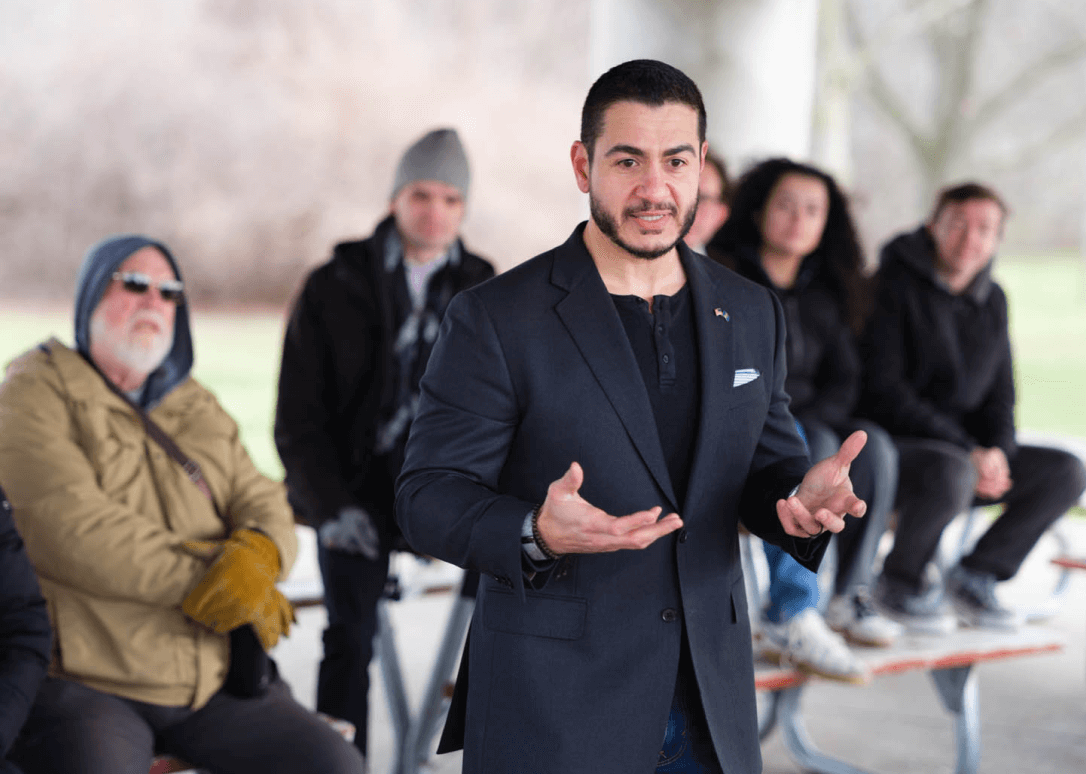
Michigan Democratic Senate candidate Abdul El-Sayed’s campaign said it raised $1.2 million in four hours after Democratic Rep. Haley Stevens endorsed Republican Mike Rogers, as a political feud disrupted the final days of one of the country’s most closely watched Senate races.
El-Sayed’s campaign described the fundraising haul as its second-best day since he won the Democratic nomination in August. Meanwhile, Stevens’ endorsement has intensified divisions within the Democratic Party just days before the Nov. 3 election.
Michigan is a critical state for Democrats, who need to flip several seats to regain control of the Senate. Stevens’ endorsement therefore attracted widespread attention. She appeared alongside Rogers at Perfecting Church in Detroit before announcing her decision in a video posted on social media. She said El-Sayed had made clear that she was no longer welcome in his campaign. Stevens had initially been scheduled to join El-Sayed and Rep. Jim Clyburn, D-S.C., at a get-out-the-vote event at a Detroit church on Sunday.
“And he’s right, and that’s why I am endorsing Mike Rogers for the United States Senate today,” Stevens said.
READ: Why is Michigan Senate candidate Abdul El-Sayed being called ‘mean Mamdani’? (October 30, 2026)
The endorsement marked a reversal of her earlier position. After losing the August Democratic primary, Stevens had endorsed El-Sayed and reiterated her support for him in the days leading up to Sunday’s announcement. The disagreement escalated after Stevens demanded that El-Sayed condemn an advertisement from an outside political group that linked U.S. support for Israel to rising grocery prices. Critics described the ad as antisemitic, but El-Sayed said his campaign was not involved in producing it and rejected its content.
Stevens had also called on her former Democratic Senate primary rival to remove a campaign ad featuring Tucker Carlson. El-Sayed, meanwhile, accused her of continuing to revisit a primary that ended months ago. Asked about Stevens’ decision, El-Sayed said, “At the end of the day, I actually don’t think about Haley Stevens.”
The fallout presents El-Sayed with two challenges: keeping Democratic voters united and ensuring that the controversy does not overshadow his campaign’s closing message on affordability, health care and the cost of living.
Stevens’ decision could give Rogers an opportunity to appeal to African American and Jewish voters, communities with which she has established political relationships. However, the immediate fundraising response suggests that El-Sayed’s supporters rallied behind his campaign. The fundraising total alone does not establish whether Stevens’ endorsement has changed voter preferences. A New York Times/Siena poll released Sunday, conducted before Stevens’ announcement, showed El-Sayed leading Rogers 53% to 42%.
READ: Michigan Senate candidate Abdul El-Sayed faces attacks over Muslim faith as polls show him leading (October 29, 2026)
Stevens has continued to identify as a Democrat and described her endorsement as an “individual choice.” She also said Sen. Chuck Schumer, D-N.Y., “is going to become the majority leader.” Her decision could nevertheless distract Democrats from their broader objective of retaining the Senate seat.
The endorsement also triggered a backlash among Democrats. Stevens’ longtime chief of staff, Justin German, announced his resignation shortly after her announcement. In a statement, he said, “We are shocked and heartbroken by Congresswoman Stevens’ decision to support Mike Rogers.”
Several House Democrats have called for Stevens to be removed from their caucus, and some lawmakers have already removed her from their member group chats.
President Donald Trump welcomed Stevens’ endorsement, although he had called her a “Radical Left Socialist” months earlier. Trump also said he would like her to join the Republican Party. In a Truth Social post, he said, “Her following is huge, and the level of respect from the People of Michigan, especially our African American and Jewish populations, is virtually unparalleled.”
With control of the Senate at stake, the question is whether Stevens’ intervention will further strain party unity or reinforce El-Sayed’s argument that he represents a break from the political establishment. As he put it, “Because you know what? I’m just less interested in the politics of it all than I am in the policy of it all.”