



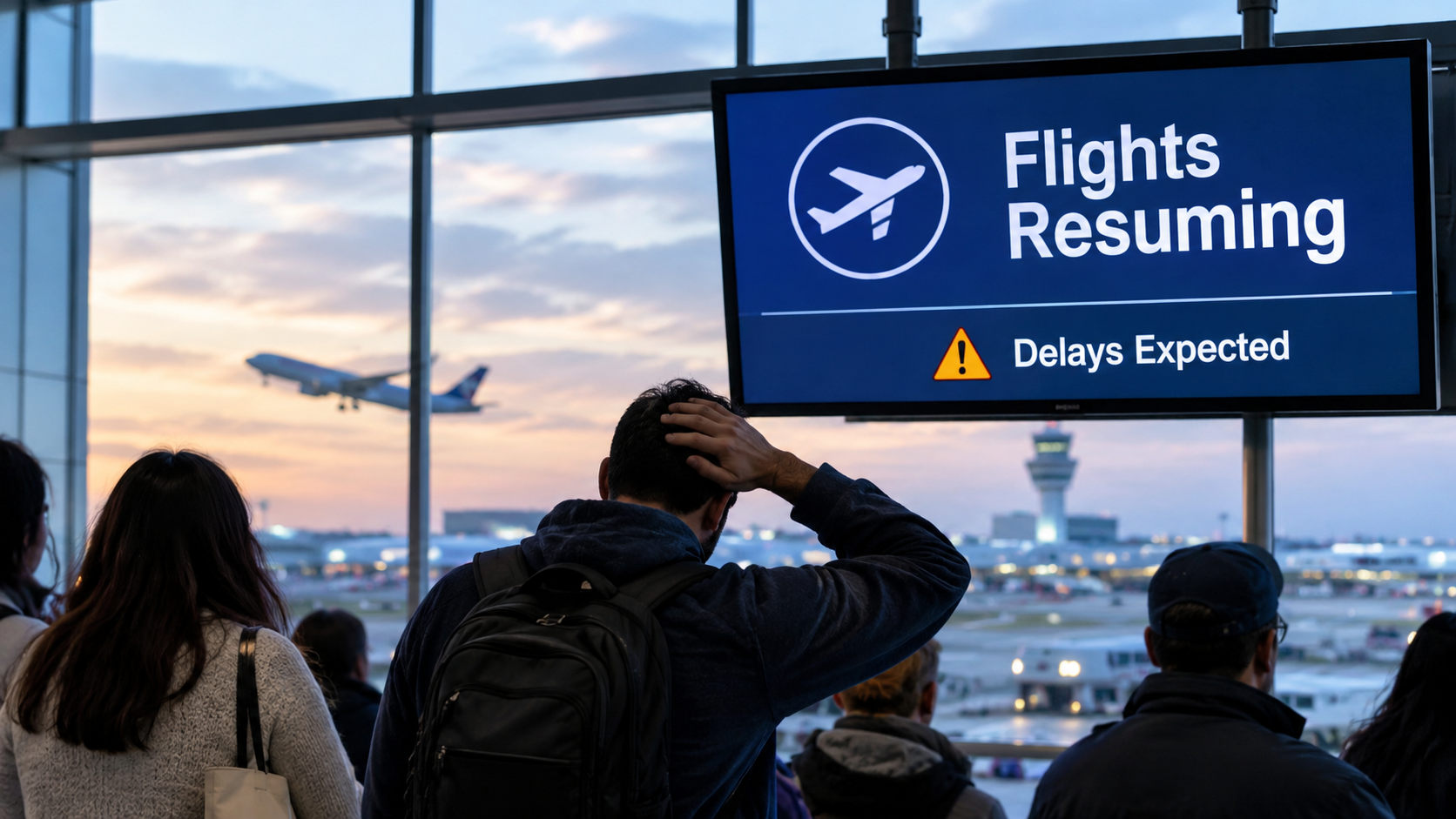
Domestic flights across the United States have resumed after federal aviation officials lifted a nationwide ground stop triggered by a telecommunications outage. However, thousands of passengers continued to face delays, cancellations and uncertainty on Saturday as airlines struggled to recover from the disruption.
The Federal Aviation Administration (FAA) halted domestic departures for more than four hours on Friday, citing safety concerns linked to a telecommunications outage. The grounding began at around 4 p.m. ET and affected air travel across the country, leaving passengers stranded at airports and forcing airlines to deal with widespread scheduling problems.
Transportation Secretary Sean Duffy blamed the disruption on outdated air traffic control technology and overloaded routers, raising fresh concerns about the reliability of the country’s aviation infrastructure.
Homeland Security Secretary Markwayne Mullin also pointed to ongoing FAA updates to aging systems as the reason behind the halt. He clarified that the incident was not caused by a threat to the United States and had no connection to the Microsoft outage that disrupted services earlier this week.
Although flights have been allowed to depart again, the impact of the grounding is far from over. More than 15,000 flights across the US were delayed or canceled on Friday, while approximately 3,000 more were expected to face disruptions on Saturday.
Passengers reported long queues at airports, missed connections and overnight waits, with some left sleeping on airport floors as they tried to secure alternative flights. The disruption has also extended beyond the United States, affecting international routes connecting American cities with Europe and Asia.
READ: FAA telecom outage disrupts flights across Northeast, affecting Newark, NYC airports (
Several major international airports reported delays and cancellations involving flights to and from the US on Saturday. Amsterdam’s Schiphol Airport reported delayed arrivals from Philadelphia and Atlanta. Flights from Miami and New York to Madrid’s Barajas Airport were also affected.
At Paris Charles de Gaulle Airport, flights arriving from Dallas and Chicago were canceled, while several others faced delays. Frankfurt Airport also reported cancellations involving flights to Atlanta and Detroit.
In South Korea, Incheon International Airport reported delayed arrivals from Honolulu and Los Angeles. Flights departing for Minneapolis and Seattle were also running behind schedule.
The disruption has also affected transatlantic travel, with passengers flying between the United Kingdom and the United States warned about further delays and cancellations as airlines work through the backlog.
Duffy cautioned that the ripple effects could continue for several days, even though the nationwide ground stop has ended. He also warned that similar disruptions could happen again unless the country’s air traffic control infrastructure receives major upgrades.
Calling on Congress to provide funding for improvements, Duffy said the recovery would be gradual. He also expressed confidence that the incident would not affect Thanksgiving travel, which is expected to bring millions of Americans to airports in the coming weeks.
The incident has renewed scrutiny of the FAA’s aging technology and the need to modernize systems responsible for managing air traffic across the country. While officials have restored normal flight departures, passengers are likely to face continued uncertainty as airlines work to get their schedules back on track.