



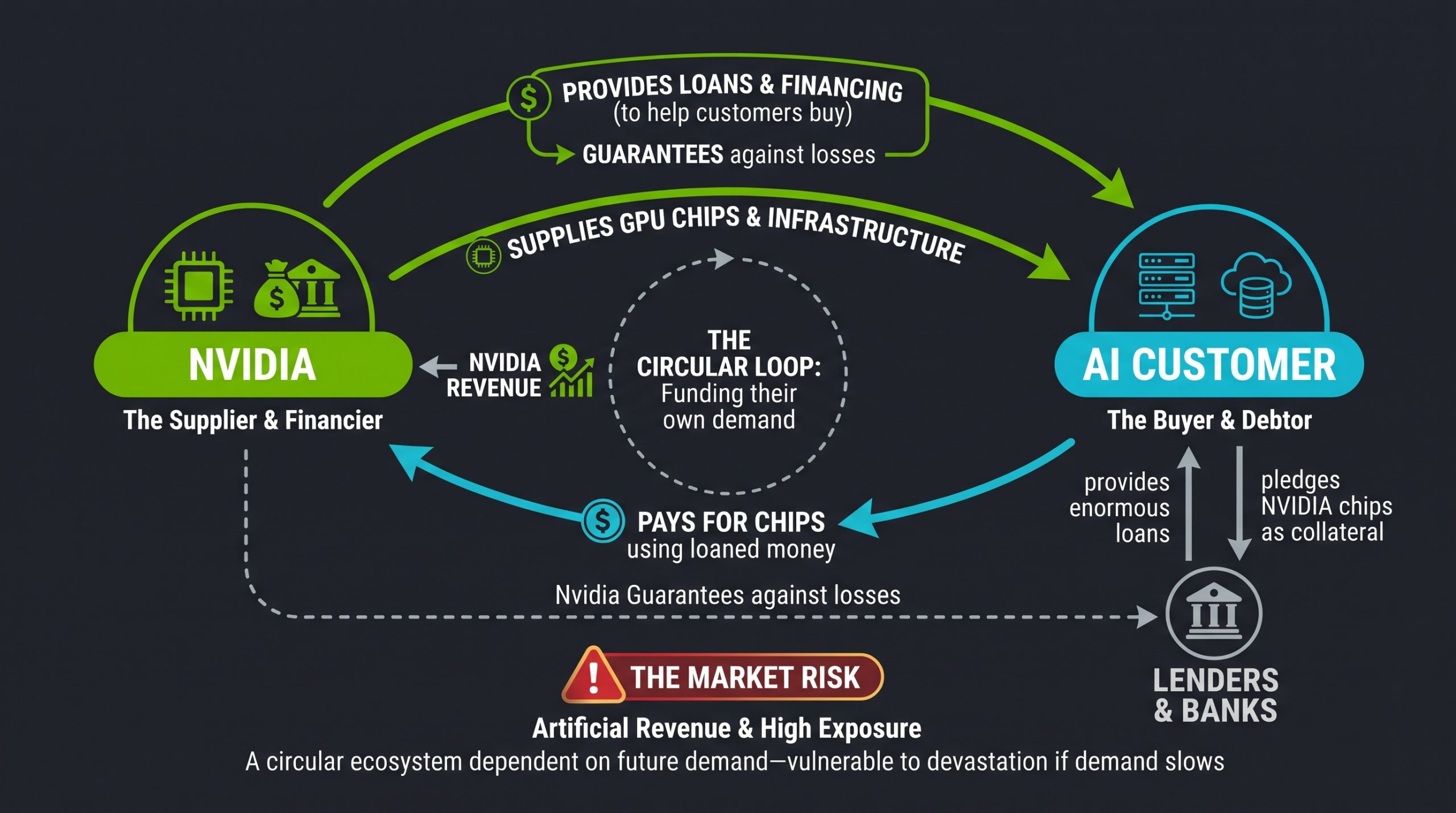
AI is entering a self-reinforcing doom loop in which the companies building the technology must continually spend more to stay ahead, even as the returns on that investment remain uncertain. This is reminiscent of the CDO crisis that caused the market crash in 2008
Five major technology players are committing as much as $828 billion to AI infrastructure, with several already experiencing negative free cash flow, raising a fundamental question: What happens when the infrastructure investment grows faster than the economic value AI actually creates?
To make matters worse the financial relationships between the tech giants is beginning to cause alarm. The lines between vendors and investors are becoming blurred and investors need to be aware. The recent investment by Nvidia in Meta’s stock offering (while Nvidia also supplies Meta with chips) is raising questions.
Investment, borrowing, purchasing and reported revenue are becoming difficult to separate from one another in these circular deals. When a company invests in a customer who then uses that capital to purchase the investor’s products, how much of the resulting growth represents genuine market demand and revenue?
Imagine a company called ChipCo that manufactures advanced AI processors. It wants to sell $100 million worth of chips to a startup called DataCloud, which operates data centers. The problem is that DataCloud does not have enough money to purchase the processors. ChipCo therefore provides DataCloud with a $100 million loan, or arranges financing through another lender with a guarantee that protects the lender against losses. DataCloud uses that money to purchase $100 million worth of ChipCo processors.
READ: Sreedhar Potarazu | AI is the mirror. The Sutras are the questions. Socrates is still asking. (September 21, 2026)
ChipCo now reports $100 million in sales. Its investors see growing demand, its share price benefits, and its production forecasts increase. DataCloud reports an expanding infrastructure business and promises to generate revenue by renting computing capacity to AI companies.
But consider what actually happened. The money did not originate from an independent customer purchasing computing services because it had a demonstrated need. It originated with the company selling the equipment, or with financing supported by that company. The transaction has created a sale, but it has also created a corresponding financial obligation and a dependence on future demand.
Now imagine that DataCloud cannot find enough customers willing to rent its computing capacity. It cannot repay its loan. ChipCo may have to absorb the loss, honor its guarantee or purchase unused computing capacity. Meanwhile, it has already expanded manufacturing to meet what appeared to be rapidly growing demand. It is now exposed on both sides of the transaction. It has lost a customer and potentially its financing investment, while facing an inventory of expensive processors for which there may no longer be sufficient demand.
This is the fundamental vulnerability of circular financing happening in AI. It can make an industry appear to be growing faster than the underlying economics justify.
Chip manufacturers like Nvidia flush with cash are not only selling processors. They are becoming investors, lenders, guarantors and, in some cases, customers of the very companies purchasing their products.
What makes the Nvidia story particularly troubling is the financing architecture that was being built behind the AI boom, and the role played by Jensen Huang’s son-in-law, Nico Caprez. A former investment analyst and management consultant, Caprez became one of Nvidia’s key dealmakers, overseeing relationships with emerging cloud providers and arranging financing that helped these companies purchase Nvidia’s own chips. He helped expand Blackstone’s GPU-backed credit facility for CoreWeave from $2.3 billion to $7.5 billion and worked on arrangements to provide credit support to Australia’s Firmus for an estimated $15 billion-plus in Nvidia hardware.
READ: Sreedhar Potarazu | AI is burning through free cash flow (July 25, 2026)
The underlying concern is that Nvidia was increasingly helping finance the very customers whose purchases generated its revenue, while using its chips as collateral for enormous loans. In effect, Nvidia was becoming not just the supplier of the AI infrastructure but also a financier and guarantor of the ecosystem buying it. Questions about how these guarantees were valued, who ultimately carried the risk, and whether the projected demand justified the debt reportedly became a source of internal concern, including for the company’s finance leadership.
Another example involving Meta illustrates the complexity. Nvidia, AMD and Broadcom committed a combined $5 billion as cornerstone investors in Meta’s $25 billion stock offering. Meta is one of the world’s largest buyers of computing infrastructure. Its suppliers are therefore investing in a company that will spend substantial sums purchasing the technology they produce. This raises the possibility that suppliers are using their financial resources to maintain access to a strategically important customer.
The relationships extend beyond equity investments. Nvidia is a major shareholder in CoreWeave, a data-center operator that is also a substantial Nvidia customer. Nvidia has additionally committed to renting CoreWeave’s unused computing capacity through 2032. In another arrangement, Nvidia has provided a $105 billion backstop for a major data-center project being developed in Ohio for OpenAI by SoftBank’s SB Energy.
These arrangements create a concentration of risk that traditional measures of revenue growth and market demand may not adequately capture.
The problem becomes more serious when debt enters the picture. Smaller AI infrastructure companies are borrowing heavily to purchase processors and construct data centers, often relying on long-term contracts and guarantees from larger technology companies to secure financing. The apparent strength of these arrangements depends on the continued ability of the AI ecosystem to generate sufficient demand for computing capacity.
Revenue can be recognized from equipment sales even when the underlying purchase is supported by supplier financing. A customer may report expanding operations because it has access to borrowed capital, while the supplier reports increasing sales because it has effectively helped finance the purchase. In more aggressive arrangements, money can circulate through related transactions and return to the original company, creating the appearance of commercial activity without an equivalent increase in independent demand.
Conventional financial statements may not adequately communicate the economic dependence behind the transactions. Investors need to understand not only how much equipment has been sold, but who financed the purchase, who ultimately bears the credit risk and whether the end customer is generating enough revenue to pay for the computing capacity. The danger is that the entire system can reverse direction at once.
Suppose AI companies discover that they have built more computing capacity than customers are willing to purchase. Data-center operators begin experiencing lower utilization. Their revenues fall, making it harder to service debt. Lenders become reluctant to finance additional construction. Companies that had been counting on future demand delay purchases or cancel expansion plans. Chip manufacturers then face declining orders, while their investments, loans and guarantees to infrastructure companies become increasingly vulnerable.
READ: Sreedhar Potarazu | China’s open weight could break the trillion-dollar AI model (July 18, 2026)
There is an additional complication. Advanced processors are expensive assets, but their economic value depends on performance, technological progress and the availability of newer generations of chips. If demand weakens, used processors may flood the market at discounted prices. This depresses the value of existing equipment precisely when companies and lenders need those assets to retain their value.
The consequences would not be limited to one company. A financing problem at a data-center operator could affect its lenders, its chip suppliers, its cloud customers and the AI companies relying on its infrastructure. The same relationships that accelerate growth during an expansion can transmit losses throughout the ecosystem during a contraction.
There is a historical parallel worth considering. During the telecommunications boom of the late 1990s, equipment manufacturers helped finance customers that were purchasing their networking infrastructure. This supported sales and encouraged further investment in capacity. When demand failed to meet expectations, the industry was left with excess infrastructure, deteriorating equipment values and significant financial losses. The technology was real, and the long-term transformation of communications was profound. The financial assumptions supporting the initial expansion were not.
The AI revolution could face a similar distinction between technological success and financial failure. The real test is whether independent customers are willing to pay enough for AI services to support the entire chain of investment, borrowing and infrastructure development.
Investors should therefore look beyond the headline numbers. They should examine the quality of revenue, the extent of supplier financing, guarantees and long-term purchase commitments, the concentration of customers, and the ability of companies to generate cash from actual operations rather than financial arrangements between ecosystem participants.