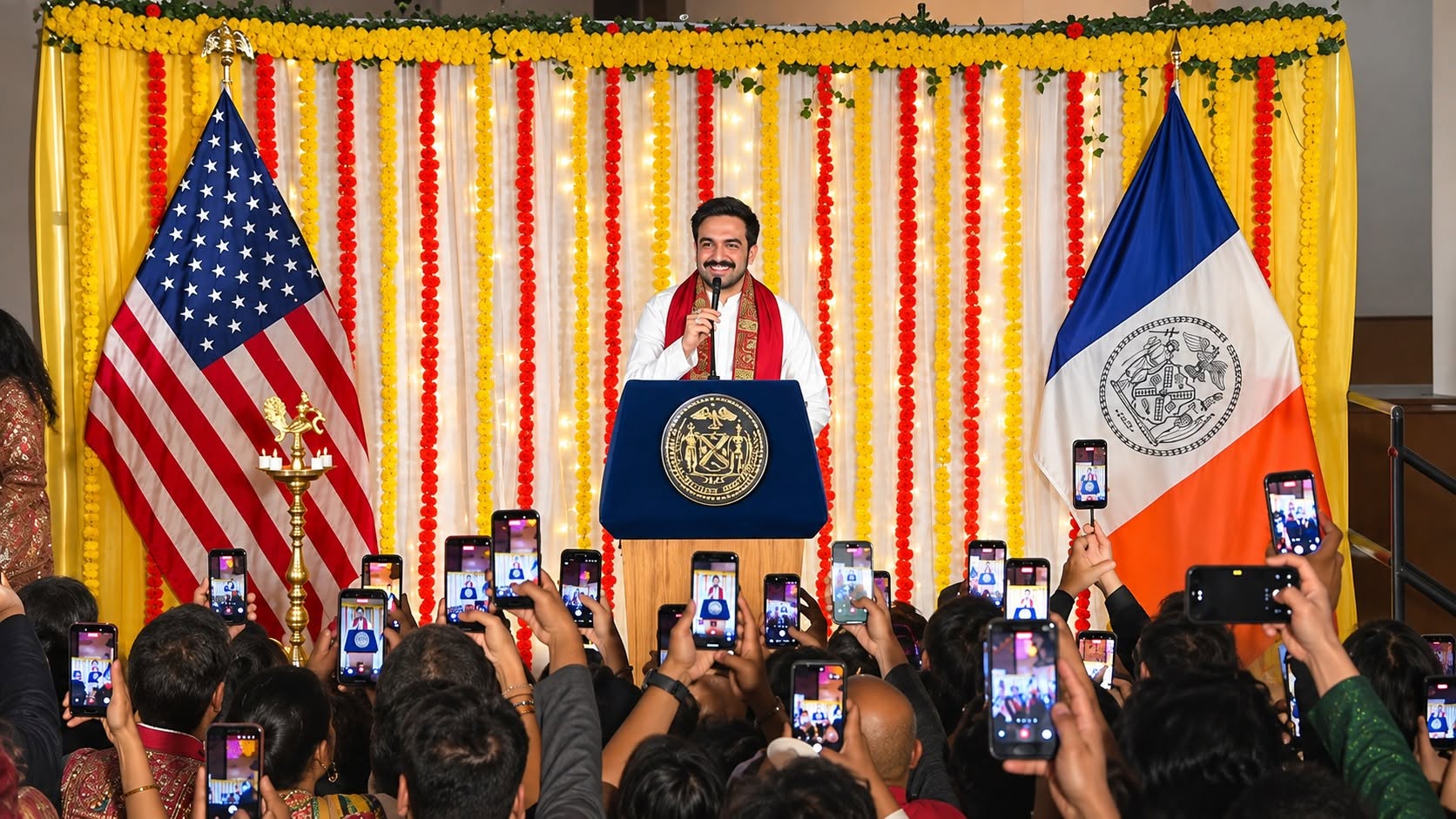
New York City Mayor Zohran Mamdani celebrated Diwali with community leaders, elected officials and residents in Queens on Tuesday evening, delivering a powerful message of religious harmony, cultural pride and belonging while calling for the rejection of hatred and division.
Addressing the gathering at the New York Hall of Science, the city’s first Indian American mayor drew on his multicultural upbringing, the wisdom of Hindu traditions and the many ways Diwali is observed across New York’s immigrant communities.
Dressed in a traditional white kurta with a red patterned stole draped over his shoulders, Mamdani spoke warmly about the Festival of Lights, connecting its enduring message to the challenges confronting society today.
Against a backdrop of rising religious intolerance and discrimination, he warned against the growing influence of divisive politics.
“This past year alone we’ve seen our Hindu temples targeted. We’ve seen leaders at the highest levels of our federal government target Sikhs,” he said. “And we have watched as hate that was once relegated to the margins of society has come to sit at the heart of campaigns for statewide office.”
In one of the evening’s most emphatic moments, Mamdani directly addressed immigrants and others whose sense of belonging has been challenged.
“And so to anyone who’s been told to go back home, whose belonging has been questioned, let me say unequivocally, you are home. New York City is your home.”
He added, “And the light of this city will always be brighter than those who seek to plunge us into darkness.”
The Mayor’s message of inclusion was deeply rooted in his own family background and understanding of religious diversity.
“The South Asian diaspora is a community made of many stories,” he said. “As the son of a Punjabi Hindu mother and a Gujarati Ugandan Muslim father, I grew up knowing that our shared heritage was never a single language, faith or affiliation.”
He acknowledged the influence of his mother’s family and the teachings that shaped his worldview.
“From an early age, my mother’s family taught me how much beauty and wisdom lives in Hinduism,” Mamdani said.
“It’s a faith whose oldest scripture teaches us that there are many roads to satya [truth] and that the same light lives in every one of us whether we pray in a mandir, a masjid, gurdwara or nowhere at all.”
Invoking the Ramayana and Mahabharata, he described their enduring lessons about relationships, duty and moral responsibility.
“The Ramayana shows us the brother, the wife, the husband and the friend that we aspire to be,” he said. “The Mahabharata shows us what families are really like where even the bravest heroes and wisest gods stumble and where one’s dharma must come before one’s loyalty.”
He connected the wisdom of these epics to movements for justice, citing Mahatma Gandhi’s Salt March and Dr. Martin Luther King Jr.’s March on Washington.
Mamdani also highlighted the remarkable diversity of Diwali observances across New York City, offering vivid examples of customs carried across generations and continents.
In Kensington, Bengali families light 14 lamps to honor their ancestors. Guyanese and Trinidadian families in Ozone Park and Queens Village remember forebears who crossed the Kala Pani to the Caribbean. Sikh families in Richmond Hill commemorate Bandi Chhor Divas, while Nepali families in Jackson Heights celebrate Tihar.
READ: Mayor Zohran Mamdani disbands controversial NYPD protest unit (November 16, 2026)
He described Tamil families on Staten Island rising before dawn for traditional oil baths and Gujarati families in Bellerose creating colorful representations of Goddess Lakshmi’s footsteps.
The celebration included a symbolic lighting of battery-powered diyas, bringing attendees together in a shared expression of hope and unity.
“This is what home looks like,” Mamdani told the audience.
Concluding his address, he reflected on the personal significance of hosting the event.
“It is truly the honor and the privilege of a lifetime to host all of you here and to be here as the first Indian-American mayor in the history of our city,” he said to applause.
“As someone who grew up celebrating Diwali with my family to now be able to celebrate it with our city as the mayor is a gift that I will never grow tired of saying thank you for.”
Jagpreet Singh highlights Sikh traditions and collective liberation
Earlier, Jagpreet Singh, First Deputy Commissioner of the Mayor’s Office of Mass Engagement (OME), spoke about Bandi Chhor Divas, commemorated by Sikhs around the time of Diwali.
He recounted the story of Guru Hargobind Sahib, the sixth Sikh Guru, who secured the release of 52 fellow prisoners when he was freed from captivity under Mughal Emperor Jahangir.
Singh described how the Guru refused to accept freedom for himself unless the other prisoners were also released, illustrating the Sikh principle of collective liberation.
“The guru left us Sikhs with an ethos that we practice to this day,” Singh said. “The idea that liberation isn’t just individualistic, it’s communal. The idea that liberation is a practice. And the idea that no one is free until we are all free.”
He connected that philosophy to the work of the Mayor’s OME, emphasizing the importance of empowering New Yorkers, strengthening neighborhoods and addressing inequality.
Shonita Joshi recalls childhood Diwali celebrations in India
Shonita Joshi, Events Lead at the Mayor’s OME, welcomed guests with personal memories of growing up in Pune, India.
She recalled festivities at her father’s watch store, where family members and employees gathered after work to share sweets and enjoy fireworks late into the night.
Those childhood experiences, she said, taught her that Diwali was fundamentally about caring for one another.
“Diwali is celebrated for many reasons and across the various traditions a clear message shines through: the victory of good over evil, knowledge over ignorance and inner light over spiritual darkness,” Joshi said.
She explained that her office seeks to bring the same spirit of knowledge, connection and accessibility to city government.
Looking around the room filled with organizers, labor leaders, artists and residents, Joshi praised their contributions.
“You do it by building a movement that is rooted in community, care, and love,” she told attendees.
Aminta Kilawan-Narine celebrates immigrant heritage and inclusion
Aminta Kilawan-Narine, Executive Director of the South Queens Women’s March, delivered an impassioned address celebrating Indo-Caribbean heritage, immigrant resilience and religious freedom.
Identifying herself as a proud Hindu, working mother and first-generation daughter of immigrants from Guyana, she spoke about Diwali’s deeply personal significance.
“For generations, South Asian and Indo-Caribbean immigrants have helped to build New York City,” she said, highlighting neighborhoods including Richmond Hill, Jackson Heights, Flushing, Hollis and Jamaica.
She recalled how immigrant families preserved their cultural and religious identities despite colonization, displacement and discrimination.
Reflecting on raising her twin toddlers, Kilawan-Narine expressed hope that future generations would grow up in a city where their heritage is celebrated, their faith respected and their opportunities are not limited by their names or skin color.
She also warned about threats facing immigrant families and urged people to resist efforts to divide them.
“As Hindus, we must ensure that our faith is never weaponized to spread hatred,” she said.
Invoking the Sanskrit principle “Vasudhaiva Kutumbakam,” meaning the world is one family, she emphasized the universal message of the Festival of Lights.
“Diwali’s light belongs to people of every faith and of no faith,” she declared.
“A Diya loses nothing when you light another Diya. Together, they illuminate the entire room.”
Kilawan-Narine praised Mamdani’s leadership and the significance of having a mayor whose immigrant background reflects New York City’s diversity.
“Working-class immigrant communities are not outsiders. They are the very fabric of New York and they are a force to be reckoned with,” she said.
New York Hall of Science hosts Diwali celebration
Lisa Gugenheim, President and CEO of the New York Hall of Science, expressed pride in hosting the first Diwali reception of Mamdani’s mayoralty.
She described the institution as a place where people from different backgrounds come together to learn, explore and strengthen their connections.
Drawing parallels between the festival’s symbolism and the museum’s educational mission, she highlighted the triumph of knowledge over ignorance and hope over despair.
“I believe humbly that there’s no better place in New York to honor those values than right here in this building, the Cathedral of Science as it’s called,” she said.
Gugenheim praised the city’s cultural and educational landscape, where people from different nations and backgrounds enrich one another’s lives.
The evening featured performances by the Navatman Music Collective and The Sa Dance Company, along with music by DJ Omar, adding to the festive atmosphere.