



Industry leaders explore generative AI-driven transformation in business, cybersecurity, and education — while weighing the ethical and geopolitical implications of China’s DeepSeek.
Generative AI has been a buzzword since OpenAI launched its chatbot in 2022. The hype reached a peak two weeks ago with the emergence of DeepSeek, a low-cost Chinese alternative that some view as a geopolitical threat. What does the future hold for generative AI? That question was the focus of a panel discussion at the American Bazaar’s InnovateAI event in Vienna, VA, on January 31, 2025, where experts explored its transformative potential and ethical challenges.
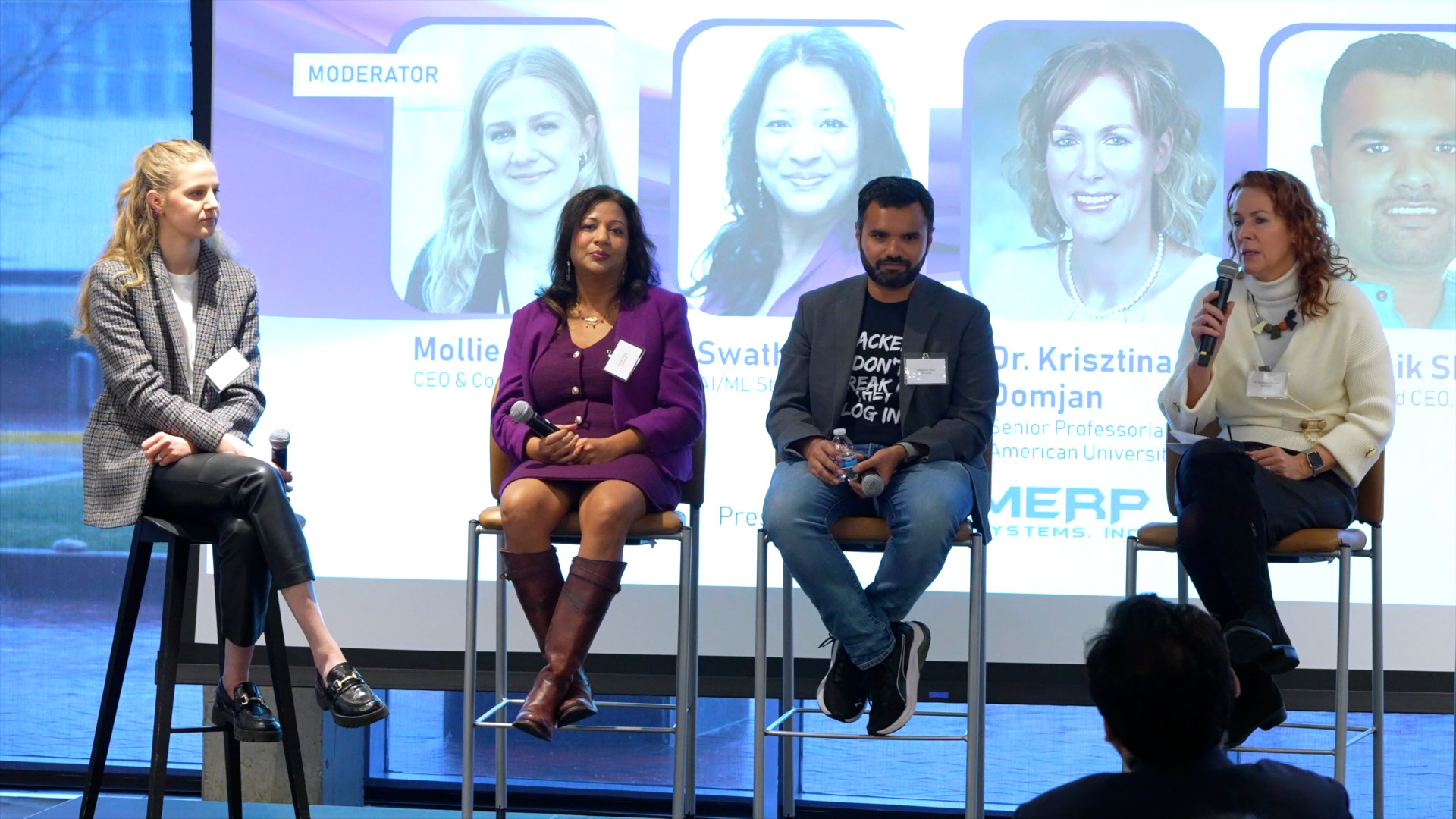
Moderated by Mollie Breen, CEO and co-founder of Perygee, the panel featured AI/ML strategy architect Swathi Young, Securify founder and CEO Bhaumik Shah, and Dr. Krisztina Domjan, a senior professorial lecturer at American University in Washington, DC.
They explored, among other issues, AI-driven business transformation, challenges and opportunities presented by AI across various sectors, from enterprise operations to education and cybersecurity, and concluded that the key to successful adoption lies in education, responsible implementation, and fostering an open mindset toward innovation.
Young, an expert in AI integration, emphasized the critical importance of defining a clear use case before deploying AI.
“What hair-on-fire problem are you trying to solve with AI?” she asked, underscoring that organizations often fail when they neglect to identify specific goals before implementing AI solutions. Young distinguished between traditional machine learning and generative AI, noting that the latter, while powerful, requires significantly more computing power and should be carefully deployed for predictive tasks.
For example, she cited a case study involving predictive maintenance for one of the largest passenger rail networks in the United States. By narrowing down what they were predicting — whether it was wheels, specific components, or entire passenger cars — service disruptions were prevented by anticipating repairs in advance, she said.
Young also stressed the importance of responsible AI, particularly in regulated industries like finance and healthcare, where compliance with legal frameworks such as HIPAA is essential.
“Building responsible AI does not lie just with data scientists and technologists, it’s a cross-functional responsibility, bring your HR and legal and everyone into the conversation” to ensure responsible deployment.
Polarizing role in education
While businesses are increasingly embracing AI, the education sector presents a more complex and nuanced landscape. Domjan, an academic leader, highlighted the resistance among faculty members to incorporating AI into their teaching methods.
She pointed out that some faculty believe AI doesn’t apply to their discipline, while others have formed tribes—those who embrace AI and those who reject it outright. The divide, she said, is exacerbated by a lack of institutional incentives for educators to engage with AI tools.
In an attempt to bridge this gap, Domjan surveyed faculty members on what would encourage their participation in AI-focused professional development. The requests were simple: gift cards, badges like in the Boy Scouts, or even just free coffee and lunch. However, with universities facing budget cuts and declining enrollment, even these modest incentives remain difficult to fund.
READ: Next frontier of AI: Explainability, ethics, and the future of intelligent systems (February 4, 2025)
Another challenge, Domjan noted, is the lack of AI literacy among faculty members. “When you say generative AI, many educators immediately think of ChatGPT and students using it to complete assignments. They don’t realize AI tools can enhance personalized learning and improve engagement.”
“When you say generative AI, they think about ChatGPT, and they think about students writing their homework with ChatGPT, and then they can’t even imagine what else is out there.”
She advocated for more industry partnerships to demonstrate how AI can be effectively integrated into the classroom.
Expanding influence in cybersecurity and fintech
Shah, a technology strategist, painted an optimistic picture of AI’s potential across industries, particularly in cybersecurity and financial technology.
Stating that the AI breakthroughs we’re witnessing now are as significant as the rise of Amazon, Google, and Meta during the internet boom, he predicted that companies that successfully adopt AI will lead the next wave of innovation.
The Securify CEO highlighted cybersecurity as a prime area for AI-driven transformation.
“[Right now]… you have a threat and then it takes hours or days for someone to detect and respond to it, with AI we can probably bring it down to seconds or milliseconds or maybe sometimes you can detect even the breach before it happens,” he said.
In the financial sector, AI-powered fraud detection is revolutionizing the industry, Shah said, adding that his company is working with fintech firms to analyze real-time transactions, identifying fraudulent activity instantly based on multiple parameters.
Beyond these industries, Shah noted the broader impact AI is having on cloud computing and automation. He noted that many cloud-based startups are still operating with less than 50% AI integration. There is a shift occurring where AI is automating everything from access control to identity management, reducing the need for manual oversight.
DeepSeek AI
The panel also discussed the new kid on the block, the Chinese DeepSeek, which has stirred waves across the AI community, raising questions about technological advancements, ethical considerations, and geopolitical implications.
Young shared her initial impressions upon testing DeepSeek. “It was exciting when I downloaded it over the weekend and started playing around with it. I compared it by giving the same prompts to ChatGPT and DeepSeek,” she explained.
Young, who previously worked on reinforcement learning projects for a United Nations-led startup, was particularly interested in how DeepSeek approached lesser-labeled datasets. “The nerd in me wanted to download some research papers and read what was different [from ChatGPT and other language models].”
She said, traditionally, we thought AI innovation had to happen at the server or GPU level, but now we’re seeing it happen at the mathematical model level, a different sort of breakthrough.
Perhaps the most enticing aspect of DeepSeek AI, Young pointed out, is its affordability, with their API costing a fraction of OpenAI’s ChatGPT API cost. For enterprises that are highly concerned about the cost per million tokens, DeepSeek becomes an attractive option, she said.
Yet, despite the excitement around cost-effectiveness and performance, serious ethical concerns surfaced. Young said she quickly discovered that DeepSeek exhibited notable censorship, particularly on sensitive topics such as China’s political history. When she asked questions about Tiananmen Square or Taiwan, it completely refused to answer, Young said.
READ: Highlighting the challenges in cybersecurity innovation: In conversation with Securify’s Bhaumik Shah (January 29, 2025)
This raised alarms for Young, who underscored the importance of ethical AI.
She also pointed out the potential risks of data privacy. If one is using their APIs instead of hosting it locally, you don’t know where the data is going or how it’s being utilized in China.
Echoing similar concerns, Shah predicted that DeepSeek AI might struggle to gain traction in the U.S. “There’s obviously a trust issue. I don’t think it’s going to be widely adopted in the U.S. any time… It’s going to take time.”
Reflecting on market reactions, Shah noted, “We saw the reaction on Wall Street when the news broke. I think it was a bit overreacted.” The AI businesses in the U.S. are still going to outperform and maintain a majority stake in enterprise AI adoption, he said.
Despite ethical and regulatory concerns, DeepSeek’s technological prowess remains undeniable. Domjan said she conducted her own testing of the model. “When DeepSeek arrived, I started playing with it using the same prompts I give to ChatGPT. It scored just as well,” she observed.
Dojman specifically tested its ability to act as an AI mentor, guiding students through complex tasks. “It worked just fine,” she said.
As for the controversies surrounding copyright and data usage in AI models, Dojman found the debate reminiscent of popular media portrayals. She said the whole argument about who stole what and who copied what reminded her of the HBO show “Silicon Valley”.
“I just thought this is the real version [of “Silicon Valley”]… I’m curious to see where it will go,” she said.
AI in the workplace
Shah noted that AI adoption in the professional world has accelerated dramatically. He said that, at Securify, he actively encourages teams to use AI because tasks like reading long reports can be expedited with AI tools, freeing employees to focus on high-value, creative work.
He challenged the common fear that AI will replace jobs. “I don’t think it’s human versus AI, it’s more of a human plus AI.”
Young underscored the importance of AI fluency in career advancement. “You would have heard this saying, ‘AI is not going to take your job, but those who know AI is going to take your job,” which is very true.”
Advising professionals to take proactive steps in AI adoption, she predicted a major shift in AI adoption over the next decade. “It will be just another tool in the toolbox, but 20 years is where it’s going to really shift” as innovation catches up with societal adoption, she said.