



The day I was born was Mother’s Day in 1965, and perhaps because of that I have always carried the feeling that life begins with certain alignments long before we are capable of understanding them. Some people call those moments coincidence. Others call them luck. I have increasingly come to think of them as serendipity, not in the shallow sense of random fortune, but as evidence that there are invisible patterns operating beneath the surface of human existence.
The word serendipity, is my favorite word in the English language and itself has an unusual origin. It was coined in 1754 by Horace Walpole after reading the Persian tale The Three Princes of Serendip. In the story, the princes repeatedly discover things they were not intentionally seeking because they possess a heightened awareness of the world around them.
Walpole used the term to describe accidental discoveries made through insight and observation. Over time, the meaning drifted toward “fortunate accident,” but that definition has always felt incomplete to me because true serendipity does not feel random. It feels as though life occasionally reveals a hidden order that was present all along.
READ: Confusion in the Matrix: What we can learn from not knowing what we do not know (
That idea has appeared in many forms throughout history. Carl Jung described such moments as synchronicity, meaningful coincidences that cannot be explained solely through cause and effect. Albert Einstein once remarked that coincidence is God’s way of remaining anonymous. Joseph Campbell believed that when individuals move toward their deeper purpose, unseen forces begin opening paths that previously did not exist. These observations endure because most people, if they live long enough and pay close enough attention, eventually encounter moments that resist purely rational explanation.
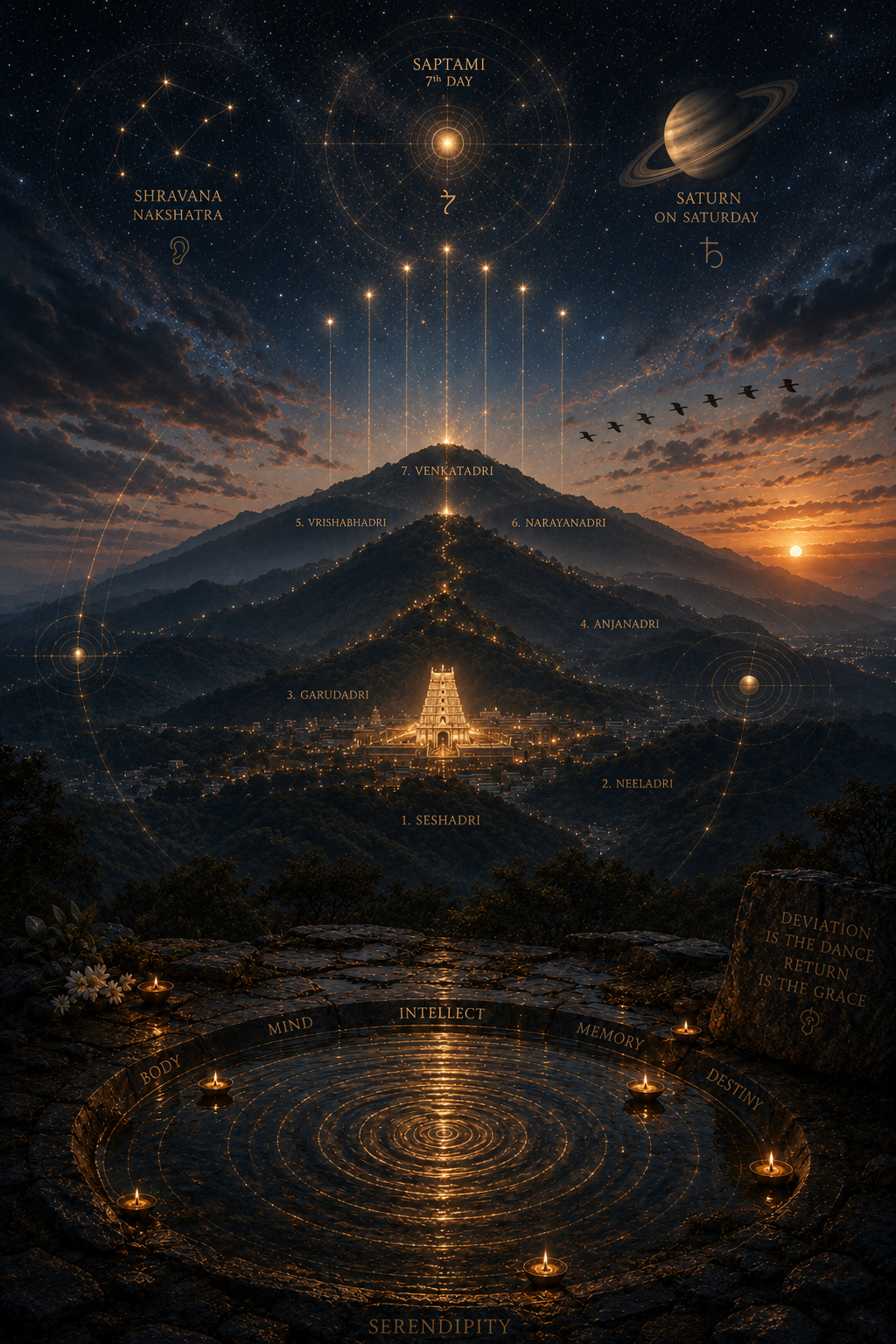
This year we witness another unusual alignment today . In the Hindu calendar today is the rare convergence of Saptami (seventh day of lunar fortnight) Shravana Nakshatra, and Saturday all symbolic individually for Lord Balaji, (the deity revered by billions of people across the world) that all converge today May 9 a unique serendipity.
I do not interpret such alignments superstitiously, nor do I view them as proof of divine intervention in the simplistic sense. What I feel instead is something more subtle. Human beings survive not only through logic, but through meaning. Certain moments carry emotional and spiritual resonance that cannot be fully measured yet still feel undeniably real.
As I have grown older, I have realized that serendipity is often most visible only in retrospect. When we are young, life appears linear. We imagine ourselves moving steadily forward through ambition, achievement, and planning. With time, however, life begins to resemble orbit rather
than trajectory. We drift away from our origins believing we are escaping them, only to discover years later that we have been circling the same emotional centers all along.
For me, one of those centers has always been my mother.
I lost her when I was only in my thirties, and I cannot honestly say that I ever recovered from that loss. Time changes grief, but it does not erase it. Some absences become permanent structures within the psyche. They alter the way one experiences memory, attachment, and even success itself. There are moments in life when achievement feels strangely incomplete because the person who would have understood its meaning most deeply is no longer present to witness it.
And yet even loss participates in serendipity because grief has its own strange gravity. The older I become, the more I realize that life repeatedly returns us to the people and experiences that formed us. We may spend decades pursuing reinvention, but eventually we find ourselves confronting the same truths from different angles. Certain emotional coordinates remain fixed no matter how far we travel from them.
READ: Can doctors be sued for not using AI? (
Maybe the deeper meaning of serendipity we often describe as coincidence may actually be moments in which alignment briefly reasserts itself within our lives. Many philosophical and spiritual traditions suggest that human suffering begins when the body, mind, and intellect drift out of coherence with one another, when emotion moves in one direction, desire in another, and discernment loses its ability to stabilize the whole. In Hindu philosophy, the intellect, or buddhi, serves as the organizing force that keeps the inner world aligned with higher purpose rather than temporary impulse.
When that alignment weakens, life begins to fragment both internally and externally. Yet serendipity often appears precisely during moments of return, when scattered experiences suddenly reveal hidden continuity and life momentarily feels ordered again. What appears accidental may in fact be the restoration of alignment between the inner and outer worlds. The body, mind, and intellect begin moving again around the same center, much like celestial bodies returning to gravitational balance after periods of drift.
That is why certain encounters, losses, realizations, or symbolic convergences feel so emotionally powerful; they resonate because they reconnect us to something essential that had become obscured beneath distraction, ambition, grief, or suffering. In that sense, serendipity is not merely fortunate timing but evidence of an underlying coherence that continues drawing us back toward ourselves even after life’s inevitable deviations.
Hindu philosophy has always understood time differently from the modern Western world. Time is not viewed as a straight line moving cleanly toward progress, but as a cycle of creation, preservation, destruction, and renewal. That understanding feels profoundly true to human experience because life rarely unfolds in orderly sequence. We revisit old wounds. We rediscover forgotten truths. We lose ourselves repeatedly and spend years attempting to recover some essential center. Maybe that is what serendipity really is.
READ: Cigna is the next card to fall as the Affordable Care Act self-destructs (
Maybe it is not the sudden appearance of luck, but the recognition that beneath the apparent disorder of life there remains a hidden coherence. Events speak to one another across time. Moments that once appeared isolated later reveal themselves as connected parts of a much larger pattern.
Today I find myself thinking less about age and more about alignment. I think about my mother. I think about Lord Balaji. I think about the strange convergence of dates, memories, faith, loss, and timing that surrounds this particular day. I think about how life begins in one alignment, moves through years of apparent fragmentation, and somehow continues searching for its original center of gravity. Perhaps that search itself is the deepest form of serendipity.
Not the discovery of something new, but the gradual realization that what appeared scattered was connected from the beginning . Is it serendipity that May 9 is also my birthday?