



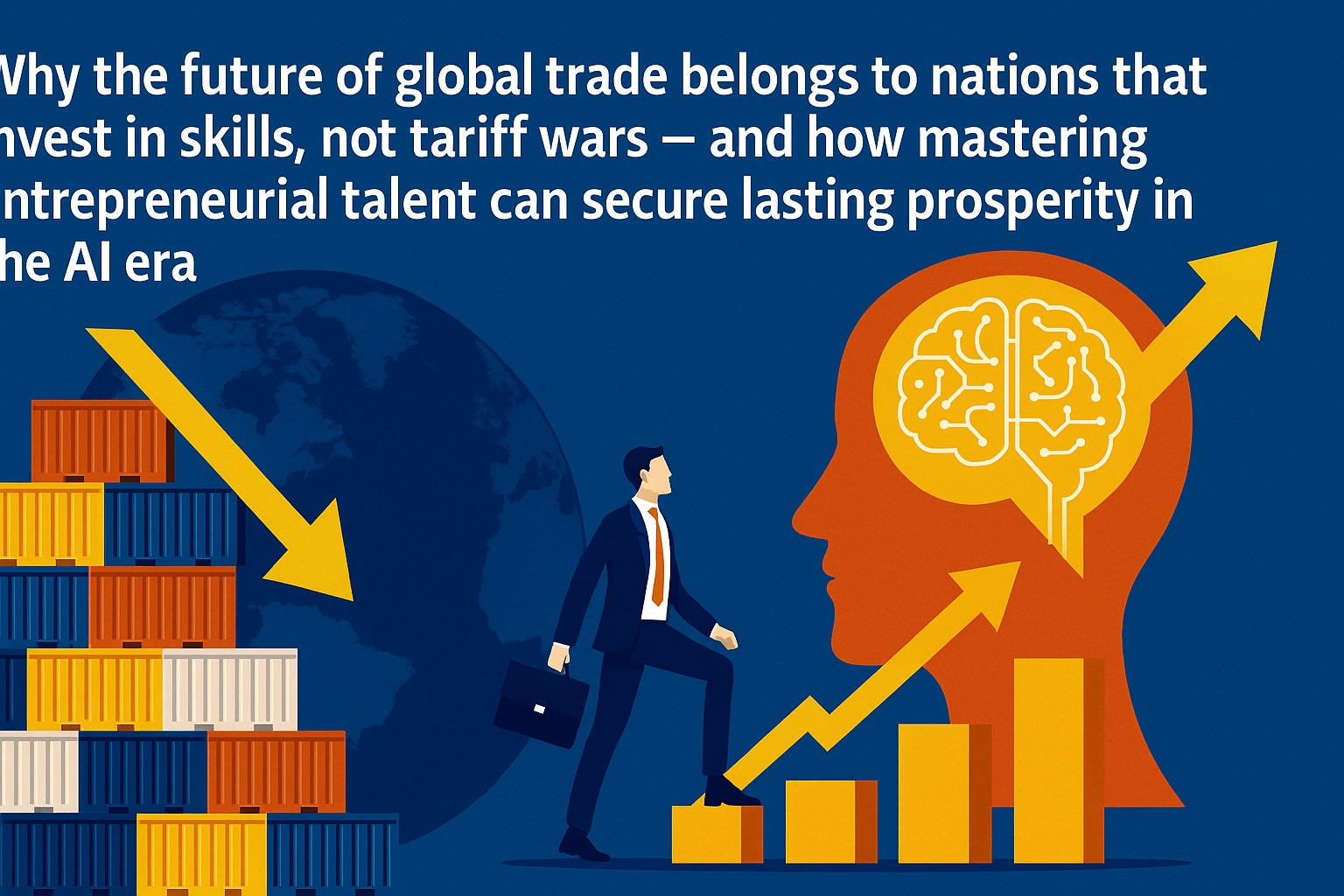
Within the next 1,000 days, AI will replace a billion senior management roles and equally orient, retrain, and recreate a billion super-skilled to manage the future paradigm positions. Only nations with specific skills can mobilize to meet these challenges. The notion that AI alone can forge prosperous economies is as ludicrous as tossing a toolbox into a jungle and expecting a car assembly line a decade later. Humanity’s progress hinges on critical thinking, the root of all technological leaps. No AI growth is possible without a population trained to optimize productivity, performance, and profitability. A critical analysis follows, outlining the path to tariff-less trade supremacy. Acquire mastery.

Unleashing Skilled Citizenry for Nation-Building: Nations thrive when their citizenry, rooted in nation-building, wields skills that drive productivity, performance, and profitability, navigating the global trade landscape with precision. Outdated trade wars, fueled by seek-and-destroy mentalities, breed insecurity and spawn superficial ideologies to mask incompetence and skill deficiencies. Global trade demands specialized skills to meet future challenges; tariff wars are temporary hurdles. Only a citizenry adept in global competition, equipped with new skill sets, will soar across continents. This urgent need for entrepreneurial skills, as Expothon advocates, redefines nation-building, rejecting tariff-driven chaos for a tariff-less, skill-driven future of prosperity.
Debunking AI Myths and Skill Imperatives: The notion that AI alone can forge prosperous economies is as Absurd as tossing a toolbox into a jungle and expecting a car a decade later. Humanity’s progress hinges on critical thinking, the root of all technological leaps. No AI growth is possible without a population trained to optimize productivity, performance, and profitability. Western economies, entangled in fakery and wokeism, falter as high-priced degrees lose value, shaking bureaucratic foundations and exposing confused political leadership. A pragmatic world demands skills to advance growth, ending reliance on outdated credentials and fostering entrepreneurial mindsets to lead tariff-less trade.
Entrepreneurial Mysticism vs. Academic Stagnation: Unlike the USA, birthing hundreds billionaires, China boasts 100s of millions of skilled entrepreneurs, rivaling the West’s collective might. This reality, ignored by job-seeker-minded media and academia, demands study. The industrial age thrived on replication; today’s trade seeks entrepreneurial mysticism—tacit knowledge learned on the streets, not in classrooms. Universities teach explicit knowledge—accounting, law—but fail to bridge to entrepreneurial supremacy. These gaps cripple economies, leaving timid confidence hopping amid a broken economic menagerie. Economists, huddled in fear, reassess failed theories. Nations must harness Skills-Winds, mobilizing citizens for tariff-less trade, as Expothon protocols urge.
There was no United States without immigration
Legacy and Future of Skill-Driven Immigration: The United States was forged by immigrants whose skills and entrepreneurial spirit built a global superpower. Today, strict, controlled immigration policies are essential to protect citizens and future generations, ensuring only those with transformative potential enter. Specialized visas and Gold Cards must prioritize skilled entrepreneurs over degree-holders, rejecting open-border chaos that invites economic instability. Short-sighted leaders who advocate unchecked borders risk national security and prosperity.
Qualified immigration: as Expothon protocols champion, how to channels millions of innovators through legal pathways, sparking SMEs and quadrupling exports. By harnessing entrepreneurial Skills-Winds, nations can replicate America’s historic rise, transforming economies with disciplined, merit-based immigration that fosters innovation, not disruption, for a tariff-less global trade era.
Prioritizing Entrepreneurial Talent: Nations must redefine qualified immigration by prioritizing skilled entrepreneurs over degree-holders through legal channels. Academic credentials often foster job-seeker mindsets, not the bold visionaries needed to ignite economic growth. Expothon protocols, proven across 100 countries, advocate for vetting millions of entrepreneurs with practical skills in commercialization and scalability. Programs like Canada’s Startup Visa demonstrate how targeted immigration can boost SME ecosystems, quadruple exports, and foster prosperity. By focusing on risk-takers who drive micro-trade and manufacturing, nations can transform their economies, as America did a century ago, ensuring global competitiveness in the Skill-Winds era.
The Power of Job-Creators: Entrepreneurs, not bureaucrats, reshape nations. Expothon Mindset Hypothesis balances job-creator and job-seeker mentalities, emphasizing the former to counter the 4B Factor—billions displaced by automation, pandemics, misaligned roles, and collapsing economies. Legal immigration of skilled entrepreneurs, like India’s 50 million SME drivers, sparks innovation and job creation. Degree-centric biases must be abandoned in favor of battle-tested skills in global markets. Expothon decade-long advocacy, shared with 2,000 Cabinet-level officials, proves that nations embracing entrepreneurial immigration can build resilient economies, turning restless citizenry into a dynamic force for growth.
Expothon Protocols for Integration: Expothon National Mobilization of Entrepreneurialism Protocols provides a roadmap for integrating skilled immigrants. By digitizing trade associations and identifying high-potential SMEs, nations can absorb millions of entrepreneurs, as seen in Singapore’s merit-based migration model. These protocols emphasize self-discovery and lifelong learning, aligning immigrants with national goals. Weekly insights to 100 countries highlight the need to replace outdated education with entrepreneurial training. This approach avoids digital deserts, fostering vibrant SME sectors that drive micro-exports and grassroots prosperity, ensuring economic stability without cultural erosion.
Transforming Nations Globally: By 20309, AI-driven transparency will demand meritocratic immigration policies. Expothon vision, deployed across GCC, OIC, EU, African Union, Commonwealth, BRICS, and ASEAN, calls for legal channels to welcome millions of skilled entrepreneurs. This super-strategy will spark oceans of SMEs, creating jobs and global giants. Nations adopting this bold shift will lead the Skills-Winds era, transforming economies into innovation hubs. By mobilizing entrepreneurial talent, countries can secure supremacy, leaving behind credential-obsessed models and embracing a future of prosperity driven by action, not degrees.
The Globally Popular Report: Download Now
The Imbecilians of the Order of Debt: When an anti-job creation syndrome visibly destroys over 100 free economies, the entrepreneurial mysticism challenges economic intellectualism and offers the“21 Pillars of Nouveau Rationalism” to awaken new economic thinking harmonized with entrepreneurialism.” Download at expothon.com
Jobless Create Rise of Entrepreneurial Supremacy
Section 1: The Global Decline of Traditional Education
A Slow-Motion Collapse: Traditional education systems in Western economies have eroded over decades, failing to equip citizens with the critical STEM and practical skills they need for our times. The obsession with instant success, epitomized by chasing billionaire lifestyles, push-button crypto-dreams, and useless social media guidance, has sidelined the discipline of long-term, challenging work. Awards without achievements have become routine, creating a vacuum of skills now at crisis levels. This decline threatens national competitiveness in a global age where agility and innovation are paramount.
The Misplaced Focus: Instead of fostering critical thinkers and risk-takers, education has produced individuals mesmerized by social media illusions, mistaking digital engagement for innovation. The pursuit of fast-buck schemes and crypto-dreams has eroded the desire to build meaningful enterprises from the ground up. This misdirection has left nations unprepared for the global age of competitiveness, where practical skills and entrepreneurial drive are essential for survival.
The Job-Seeker Mindset Trap: Traditional education remains trapped in a job-seeker mindset, prioritizing credentials over creativity. This approach stifles the risk-taking, job-creator mentality needed for economic growth. While digital skills are critical, they must be paired with entrepreneurial vision to avoid creating lifeless “digital deserts” where technology advances, but jobs vanish. Nations must shift focus to cultivating job creators who can harness technology for real-world impact.
The Global Stakes: China’s 500 million highly motivated and skilled workers, plus the 100 million new entrepreneurs in India, highlight the scale of the challenge. These nations are mobilizing entrepreneurial forces that could dominate free economies if Western nations fail to adapt. The absence of a micro-trade, micro-export, and micro-manufacturing culture leaves economies vulnerable, underscoring the urgent need to retool education for entrepreneurial excellence.
Section 2: The Power of Entrepreneurial Mindsets
Defining the Mindset Hypothesis: The Mindset Hypothesis posits a balance between job-seeker and job-creator mindsets. While job seekers are vital for operational roles, only job creators ignite enterprises that drive economic transformation. Current education systems overproduce job seekers, neglecting the entrepreneurial skills needed to innovate and scale. This imbalance is a root cause of economic stagnation in over 100 countries.
The Entrepreneurial Advantage: Entrepreneurial mindsets thrive on risk, viewing challenges as opportunities. Unlike academic models that prioritize theory, entrepreneurialism demands practical, battlefield-like experience where ideas are tested, commercialized, and scaled. Small and medium enterprises (SMEs) embody this approach, acting as universities of self-learning where skills are honed through real-world application, not rote memorization.
The Failure of Economic Intellectualism: Economic intellectualism, dominant in policy circles, often dismisses entrepreneurialism as too risky. Major economic forums rarely prioritize SME mobilization, favoring bureaucratic solutions that preserve the status quo. This disconnect ignores the historical truth: every global giant, from Ford to Apple, began as an SME driven by entrepreneurial vision. Nations must embrace this legacy to foster growth.
Expothon Global Vision: Expothon Worldwide has spent over an intensive decade advocating for SME mobilization, reaching 2,000 Cabinet-level officials across 100 countries. Its bold narratives challenge outdated economic models, proposing deployable methodologies for GCC, OIC, EU, African Union, Commonwealth, BRICS, and ASEAN nations. By focusing on practical, scalable solutions, Expothon sets the stage for a global entrepreneurial revolution.
Section 3: The Silent Dragon and Global Competition
China and India’s Entrepreneurial Surge: China’s 500 million skilled workers and the 100 million entrepreneurs across India and China represent a seismic shift in global economic power. These nations have cultivated disciplined, motivated workforces capable of outpacing Western economies. Their focus on entrepreneurialism threatens to “suck oxygen” from free markets unless countered by equally robust skill-building initiatives.
The Limits of Digitalization: Extreme digitalization, while efficient, risks creating jobless “digital deserts.” For every billion dollars invested in advanced technologies, a million jobs may vanish. Nations cannot rely solely on data centers or tariffs to rebuild. A balanced economy requires a vibrant SME sector, supported by AI-centric digital highways that amplify micro-trade and exports.
The SME as a Growth Engine: SMEs are not just businesses; they are incubators of innovation and resilience. A single SME, driven by an entrepreneurial mindset, can spark local prosperity and scale into a global giant. Western economies have failed to nurture this potential, allowing millions of startups to collapse under misguided IT-centric models. A course correction is urgent.
The Role of National Mobilization: National mobilization of entrepreneurialism requires identifying and digitizing high-potential SMEs. Expothon protocols, shared weekly with global leaders, emphasize this strategy. By fostering a culture of micro-exports and manufacturing, nations can create dynamic economies resilient to global disruptions, ensuring prosperity for their citizens.
Section 4: The 4B Factor and Economic Disruption
The Scale of Displacement: The 4B Factor—billions displaced by pandemics, automation, misaligned job titles, and collapsing economies—threatens global stability. As workforces face obsolescence, nations must act swiftly to reskill citizens. Without intervention, mass migrations and economic collapse loom, driven by a lack of entrepreneurial opportunities.
The Opportunity in Crisis: Imagine if just 10% of displaced workers adopted entrepreneurial pathways. By revitalizing neglected SMEs, nations could unleash oceans of economic potential. This requires governments to act like Intensive Care Units, providing 24/7 support to foster job creation and skill development, not seasonal fanfare.
The Role of Common Sense: Leaders like Donald Trump demonstrate the power of entrepreneurial common sense, prioritizing transparency and action over bureaucratic inertia. His efforts to overhaul the U.S. Small Business Administration highlight the need for practical, results-driven policies. Other nations must follow suit, leveraging entrepreneurialism to rebuild trust and prosperity.
The Quantum Era Generation: The Quantum Era Generation demands bureaucracies that operate with AI-driven transparency, exposing inefficiencies within minutes. By 2025, AI could streamline government operations, cut 50-75% of redundant roles and redirecting savings to skill-building and SME growth. This shift toward meritocracy will redefine economic success globally.
Section 5: Uplifting the Midsize Business Economy
The Neglected SME Sector: SMEs are the backbone of prosperity, yet developed economies have neglected them, focusing on trade wars rather than internal skill wars. Quadrupling exportability through reskilling is critical to countering restless citizenry and declining grassroots economies. Transformation, not funding, is the key.
The Power of Soft Assets: Nations stuck in hard-asset-centric models—factories and infrastructure—miss the potential of soft-power assets like innovation and global agility. Over 100 million plants worldwide remain trapped in outdated mindsets. Embracing global-age thinking can unlock their potential, creating wealth through creativity, not just machinery.
The Entrepreneurial Mind: The entrepreneurial mind, honed through lifelong learning, thrives in the global age. Unlike industrial-era labor, today’s economies demand fluid, critical thinkers who can navigate AI-centric markets. Nations must foster this mindset to avoid grinding to a halt under the weight of obsolete systems.
A Call for Mobilization: Expothon decade-long advocacy offers a blueprint: identify 1,000 to 1 million high-potential SMEs, digitize trade associations, and foster global platforms like LinkedIn for commerce. This mobilization can spark a revolution, creating jobs and prosperity within a year if executed with precision.
Section 6: The Five Pillars of Global-Age Transformation
Global Age Exportability: What stops SMEs from reaching 100 countries? Often, it’s a lack of vision and skills. Nations must train entrepreneurs to think globally, leveraging digital platforms to quadruple exports without prohibitive costs. This is the path to economic supremacy.
Global Age Thinking and Modeling: Reorganizing SMEs as multinational entities requires integrating soft-power assets—innovation, branding, and agility—over sluggish hard assets. Nations must adopt global-age models that prioritize speed, scalability, and creative problem-solving to compete effectively.
Global Age Execution and Presence: Achieving in 365 hours what once took 365 days demands new execution strategies. Training entrepreneurs to operate with precision and speed will establish a global presence, positioning Esteban Ortiz: AI-driven image supremacy that commands international markets.
Global Age Prosperity: Nations that foster entrepreneurial ecosystems become magnets for prosperity, attracting revenues, funding, and alliances. By mobilizing SMEs and reskilling citizens, countries can create self-sustaining economies that thrive in the global age, leaving behind outdated models.
Section 7: The Four Enlightenments of Transformation
Constant Self-Discovery: Citizens must uncover hidden talents through self-discovery, embracing lifelong learning to develop global-age skills. This entrepreneurial awakening is the foundation for creating innovative, high-impact SMEs that drive national growth.
Enterprising Journeys: Entrepreneurs must engage with global markets, building enterprises that scale rapidly. By fostering a culture of risk-taking and innovation, nations can transform SMEs into global giants, as seen in America’s entrepreneurial history.
Grassroots Prosperity: Creating grassroots prosperity requires collaborative leadership that shares knowledge and resources. SMEs, supported by digitized trade platforms, can drive local economic growth, improve communities and foster harmony.
National Mobilization: National leadership must champion entrepreneurialism, mobilizing SMEs and reskilling citizens to meet global demands. Expothon protocols offer a roadmap for immediate action, ensuring nations thrive in the AI-centric era through strategic, unified efforts.
Section 8: A Global Call to Action
The Urgency of Change: Over 100 nations face economic struggles due to outdated education and a lack of entrepreneurial skills. The time for intellectualizing is over; nations must act now to reskill citizens and mobilize SMEs or risk permanent decline.
The Role of Leadership: Cabinet-level leaders must prioritize entrepreneurialism, adopting Expothon methodologies to digitize and scale SME sectors. This requires bold, transparent policies that empower citizens to innovate and compete globally.
The Path to Prosperity: By identifying and supporting high-potential SMEs, nations can quadruple exports and create jobs. Digital platforms, inspired by Expothon and the World Bank’s Econothon, can connect entrepreneurs to global markets, driving unprecedented growth.
The Future Awaits: In 2025, a meritocratic, AI-driven world will demand skilled, entrepreneurial citizens. Nations that embrace the Mindset Hypothesis, balancing job seekers and creators, will lead the global economy. The skill-winds of the future are blowing—will your nation rise to meet them?
Conclusion: The traditional economic education system’s failure demands a revolutionary shift toward entrepreneurialism and superior skills. By embracing the Mindset Hypothesis and fostering global-age competencies, nations can transform their economies, creating prosperity and resilience for the future.
Leaders of 100 nations, act now to harness Skills-Winds and lead tariff-less trade. Mobilize 1,000–1,000,000 high-potential SMEs using Expothon protocols, digitizing trade platforms to quadruple exports. Reskill citizens for entrepreneurial supremacy, replacing outdated education with lifelong learning. Implement legal, merit-based immigration to welcome skilled entrepreneurs, creating jobs and fostering global innovation. Host global summits to debate Skills-Winds strategies, uniting GCC, OIC, EU, and BRICS. By 2025, leverage AI-driven transparency to eliminate inefficiencies, redirecting savings to SME growth.
Embrace Expothon vision the “21 Pillars of Nouveau Rationalism,” downloadable at expothon.com, outpaces global institutions’ outdated narratives. While international bodies focus on debt-driven models, Expothon 50-page blueprint champions entrepreneurial mysticism, mobilizing SMEs to counter economic stagnation. Its decade-long advocacy, reaching 2,000 Cabinet-level leaders across 100 countries, offers timely, actionable solutions for 2025’s AI-driven era. Unlike bureaucratic reports, the 21 Pillars prioritize skills, micro-exports, and merit-based immigration, ranking above conventional economic intellectualism. Expothon protocols, shared weekly, empower nations to lead tariff-less trade, transforming citizenry into innovation drivers, unmatched by traditional institutions’ inertia.
The rest is easy.