



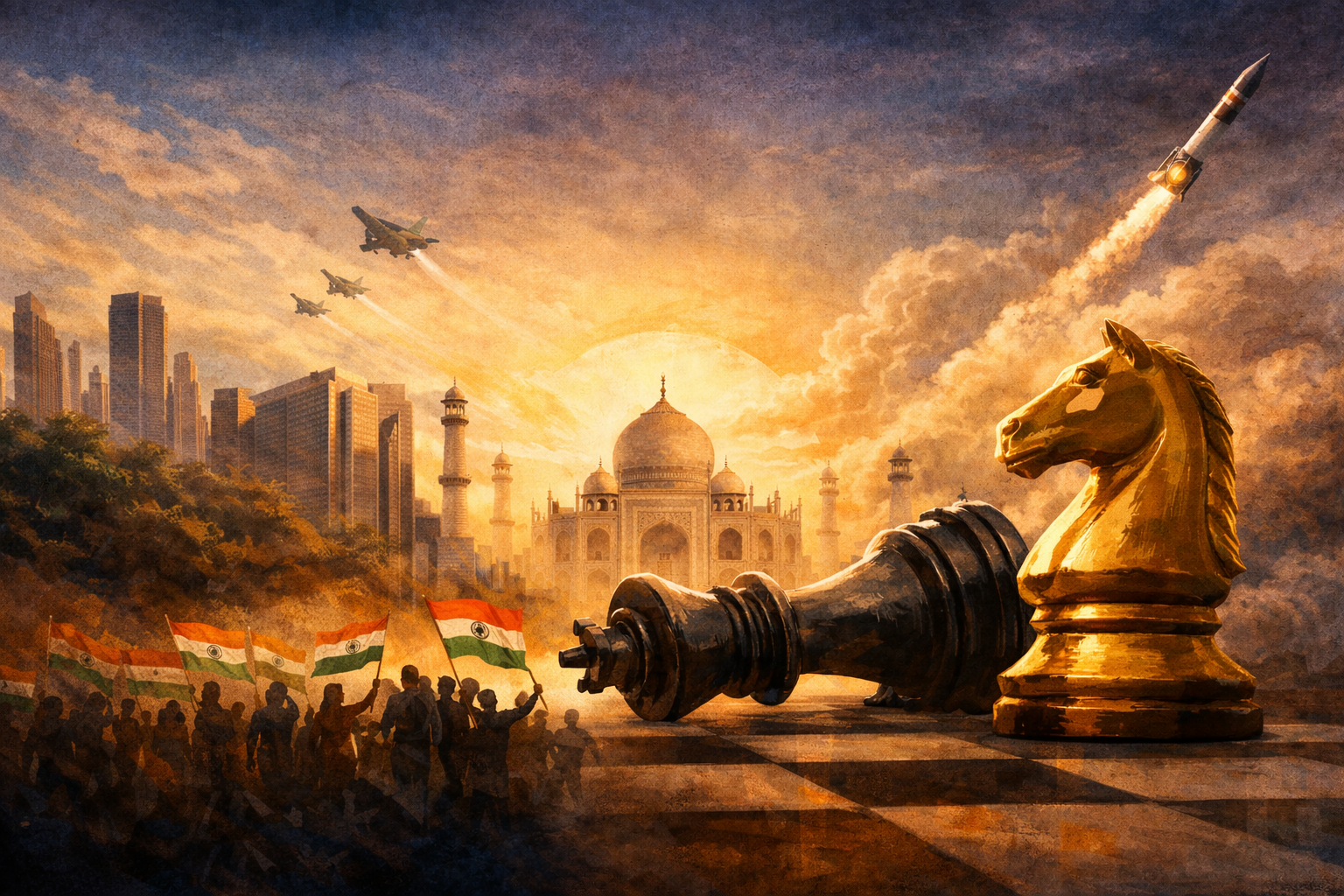
A quiet fatalism has begun to shape India’s strategic debate — the belief that global power is inherently unequal, that the United States and other major powers set the terms, and that realism demands India accept this imbalance with maturity.
In this view, asymmetry is not a condition to be negotiated but a destiny to be internalised.
It is a polished argument, but it is also a profound misreading of how nations rise. It treats power as a static hierarchy, a ledger of GDP, military budgets, and alliance structures, and diplomacy as a mechanical consequence of those numbers.
The strong extract; the weak adjust. Agency becomes illusion. Imagination becomes indulgence. Realism may describe the world, but it does not explain how the world is remade.
The flaw in this passive realism is not that it acknowledges asymmetry — power imbalances are real — but that it freezes them. It mistakes a moment for a map. It confuses the present with the permanent. More damagingly, it denies nations the ability to bend the arc of their own development.
Japan in the 1950s, South Korea in the 1960s, China in the 1980s — none entered the global system with symmetrical power. Yet each used its weakness as leverage. They traded access for technology, markets for manufacturing depth, alignment for industrial upgrading.
They did not accept the hierarchy; they climbed it. Had they embraced the logic now urged upon India — that asymmetry justifies unequal outcomes — their transformations would have been stillborn. Realism without ambition is simply fatalism with footnotes.
India today is not a peripheral petitioner. It is one of the world’s central economic and geopolitical pivots. Its leverage is structural: a vast future consumer market, a globally embedded technology workforce, strategic centrality in the Indo-Pacific, a decisive role in supply‑chain reconfiguration, and democratic legitimacy in an era wary of authoritarian concentration.
READ: Satish Jha | The America that forgot itself (February 13, 2026)
These are not adornments; they are instruments of power. Modern power is not only about size; it is about position in networks. India occupies a rare node — large enough to matter, independent enough to resist, credible enough to attract. To treat it as a supplicant is to misunderstand the architecture of twenty‑first‑century influence.
Yet India’s recent trade and strategic negotiations remain opaque. Ministers project confidence and highlight gains; that is their institutional role. But the role of citizens, analysts, and intellectuals is the opposite: to interrogate state choices, not echo them.
Trade agreements shape farmer livelihoods, manufacturing competitiveness, technological sovereignty, public health systems, and employment pathways. When the terms remain hidden, realism becomes abdication. A democracy cannot outsource strategic judgment to executive discretion alone. Opacity is not strategy; it is a substitute for it.
The real debate is not between optimism and pessimism. It is between two philosophies of statecraft. Passive realism says India is weaker, therefore it must concede. Strategic imagination asks how India can use today’s asymmetry to build tomorrow’s parity.
India’s objective should not be equal outcomes today, but asymmetric gains over time. That requires prioritising technology absorption over tariff cuts, manufacturing depth over short‑term market access, skills transfer over capital inflows, and domestic capability over consumption growth. Trade must become an instrument of structural transformation, not a celebration of incremental exports. The realist school focuses on what India cannot demand; a strategic state focuses on what India must extract.
READ: Satish Jha | India’s technology illusion: Why capability, not rhetoric, determines power (February 7, 2026)
China’s rise offers a lesson India still refuses to learn. China did not negotiate as a passive recipient. It staged access, imposed conditions, demanded technology transfer, and sequenced liberalisation to match domestic capability. It was not powerful; it was purposeful. Its dominance in manufacturing, renewable energy, electric vehicles, batteries, electronics, and critical minerals is not the result of wealth but of negotiation strategy. It treated trade as development policy, not diplomatic courtesy. India’s reluctance to study this lesson — preferring abstract lectures on hierarchy — has cost it two decades.
Why, then, does passive realism persist? Because it is emotionally convenient. It absolves policymakers of responsibility. It absolves analysts of imagination. It converts negotiable outcomes into inevitable fate. It trains citizens to accept structural inferiority as natural. A rising nation cannot afford this mindset.
Power is not a possession; it is a construction. It is built through institutional strength, industrial depth, technological sovereignty, educational excellence, policy consistency, and strategic patience. Every major power once lacked these. Diplomacy’s purpose is not to mirror current distributions of power but to reshape future ones.
READ: Satish Jha | The pendulum of American ideals: From beacon to backlash (February 9, 2026)
India needs a doctrine grounded in leverage rather than deference, development‑centric trade rather than export fetishism, radical transparency rather than strategic opacity, long‑horizon negotiation rather than short‑term optics, and moral confidence rather than defensive modesty. These are not rhetorical flourishes; they are the foundations of a nation that intends not merely to navigate the world but to shape it.
At its core, this debate is not only about geopolitics. It is about who bears the cost of realism. When trade deals disadvantage farmers, weaken small manufacturers, or constrain public healthcare, it is not abstract GDP that suffers. It is the poorest citizens.
A political economy that asks the weakest to absorb the shocks of global asymmetry while the elite capture the gains is not realism; it is injustice dressed as prudence. The true measure of national power is not how deftly a country navigates elite diplomatic salons, but how effectively it expands the life chances of its most vulnerable.
India stands at a civilizational inflection point. It can internalise a doctrine of acceptance — learning to live gracefully within hierarchies — or it can adopt a doctrine of transformation, using each negotiation as a rung on the ladder of ascent.
Realism tells us to understand power; history tells us to build it. Nations that endure adapt. Nations that lead transform. India still has the opportunity to become one of the great architects of the twenty‑first‑century order — not by inheriting the logic of power, but by redefining it.