



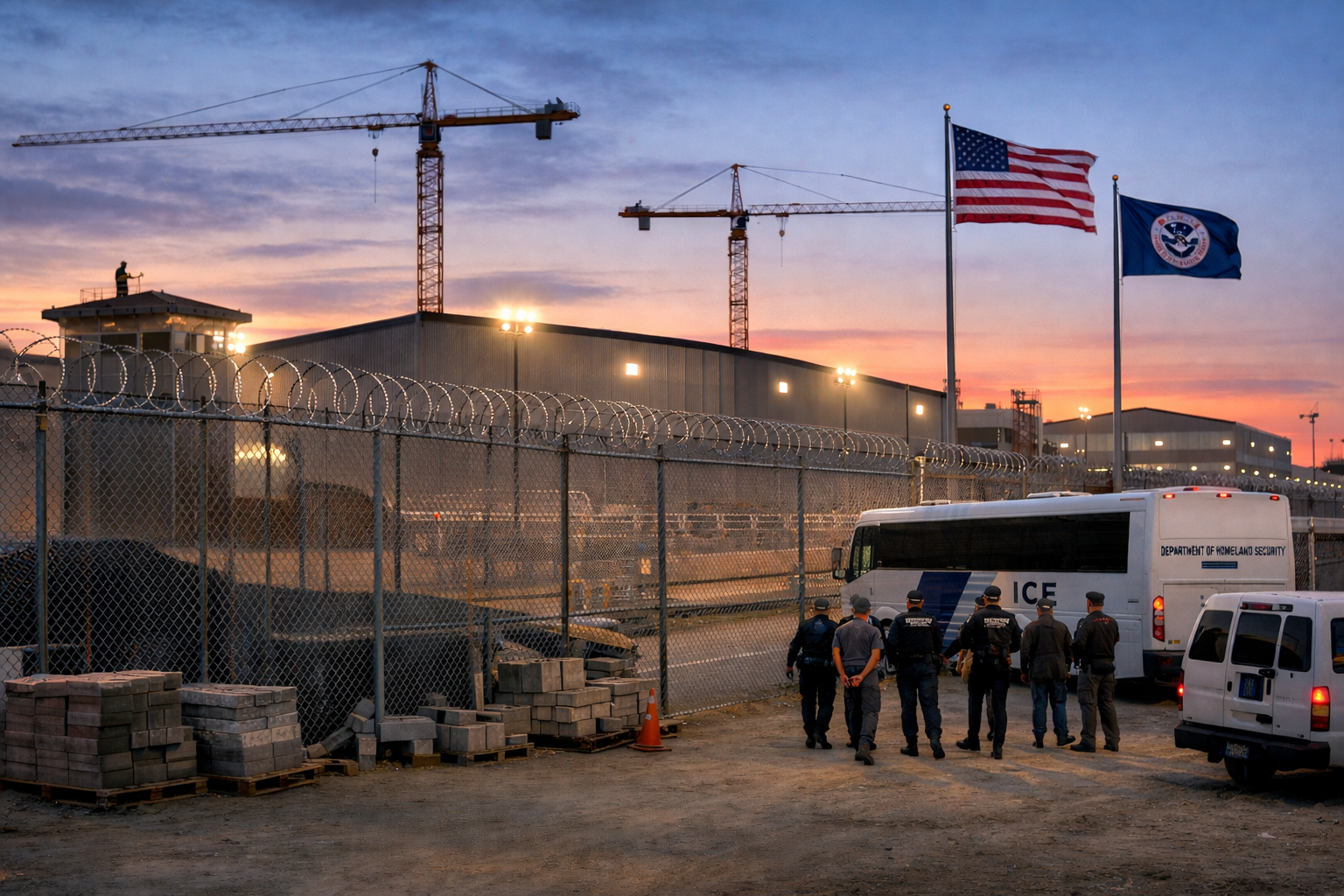
U.S. Immigration and Customs Enforcement is preparing to dramatically expand its detention capacity, with plans to spend an estimated $38.3 billion this year on what officials describe as a “new detention center model” capable of holding close to 100,000 people at a time.
The investment would represent one of the largest single-year expansions of immigration detention infrastructure in modern U.S. history. Agency officials say the funding would be used largely to acquire and retrofit warehouse-style properties across the country, transforming them into large-scale holding facilities.
The money is expected to come from a $45 billion allocation included in the “One, Big, Beautiful Bill” approved by Congress last year. According to internal planning documents and people familiar with the discussions, roughly $38.3 billion of that total could go toward detention-related contracts, construction, and operations.
A newly disclosed memo shows that U.S. Immigration and Customs Enforcement is moving quickly to scale up its detention footprint, outlining plans to acquire what it calls “non-traditional facilities built specifically to support ICE’s needs.”
The document, shared Thursday with the New Hampshire Governor’s Office, details an aggressive expansion strategy that includes purchasing eight large “mega centers,” 16 short-term processing hubs, and 10 additional facilities already used by the agency’s enforcement arm.
The memo surfaced just hours after a Senate hearing in which Sen. Maggie Hassan pressed ICE’s acting director about reports of potential detention growth in her state. The Washington Post first reported on the existence of the memo.
READ: General Catalyst-backed founder Aryaman Behera gets O-1A ‘extraordinary ability’ visa (
According to the document, the Department of Homeland Security envisions a system capable of holding up to 92,600 people across the proposed new facilities.
The processing centers would temporarily house between 1,000 and 1,500 individuals for three to seven days, functioning as intake and transfer points. The much larger “mega centers” would hold between 7,000 and 10,000 detainees at a time, with an average stay of roughly 60 days. These larger sites are described in the memo as the primary facilities where people would remain while awaiting deportation.
The scale would mark a dramatic shift from the current detention landscape. ICE data show that only 21 of the agency’s 220 existing detention centers hold more than 1,000 people. The largest facility now in operation, located in El Paso, averaged fewer than 3,000 detainees in the first weeks of February.
The Department of Homeland Security has also sent Kelly Ayotte an economic impact analysis projecting that the proposed detention site in Merrimack would cost about $156 million to retrofit and $146 million to operate over its first three years.
According to the memo, the spending would not just cover construction and operations. DHS estimates the project would support roughly 1,252 new jobs in the surrounding area, positioning the facility as a potential economic boost for the region even as it draws political scrutiny.
The document also outlines a shift in how U.S. Immigration and Customs Enforcement plans to manage detention going forward. Instead of leasing beds from private prison operators, whose profits have surged in recent years, ICE intends to own more of its detention sites outright and contract out their day-to-day operations.
“This approach,” the memo states, “will ensure the safe and humane civil detention of aliens in ICE custody, while helping ICE effectuate mass deportations.”
If implemented, the new plan would significantly concentrate detention capacity in fewer, much larger facilities, a structural change that is already drawing scrutiny from lawmakers and local officials.