



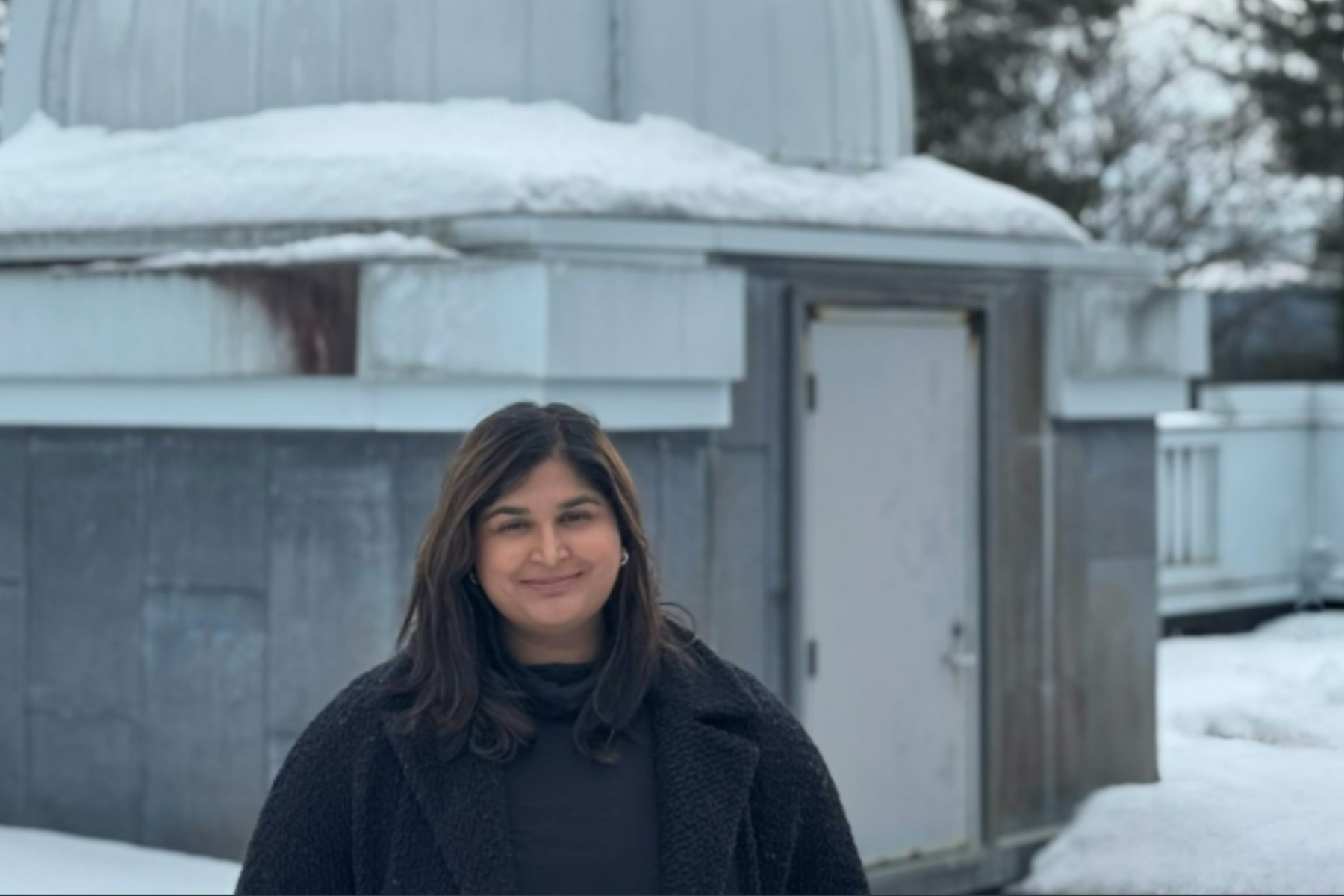
For most, a star is a distant point of light. For Rayna Rampalli, it is a fossil, a chemical roadmap, and a key to understanding why some corners of the Milky Way are teeming with planets while others remain barren.
Rampalli, a doctoral candidate at Dartmouth’s Guarini School of Graduate and Advanced Studies, was recently named a 2026 fellow of the Heising-Simons Foundation’s prestigious 51 Pegasi b Fellowship.
Named after the first known exoplanet orbiting a Sun-like star, the award, the award among the highest honors for early-career planetary scientists, provides $468,000 in grants to pursue novel theoretical, observational, or experimental studies.
The Indian American researcher, who was born and raised in Sacramento, California, credits her family’s heritage and resilience as the bedrock of her academic journey. Her path to the stars began with a BA from Wellesley College, followed by a post-baccalaureate at Columbia University.
Now, as she defends her PhD this April, Rampalli is bridging the gap between “galactic archaeology,” the study of the Milky Way’s history, and the search for new worlds.
Rampalli’s work moves beyond looking at planets in isolation. Instead, she treats the galaxy as a living laboratory. By analyzing “chemical signatures”, the unique elemental compositions found in a star’s light, she can trace where stars were born and how they migrated across the galaxy over billions of years.
Read: Indian American researcher Meha Jain wins inaugural ASU-Science Prize (
“Stars are really a connective framework for me,” Rampalli said. “I’m interested in thinking about them cohesively together, and what that means for how we interpret planet evolution across the galaxy.”
During her three-year fellowship at the University of California, San Diego, Rampalli will build a comprehensive catalog linking these chemical signals to galactic origins.
She is particularly interested in stars that have migrated from the chemically rich galactic center to the sparser outer edges. Her research suggests that a planet’s nature is inextricably linked to the history of the star it orbits.
Beyond the telescope, Rampalli is a vocal advocate for inclusion. As a mentor in Dartmouth’s E.E. Just Program, she works to support students from historically marginalized backgrounds in STEM.
Whether she is practicing yoga or arranging flowers between data sets, her goal remains the same: ensuring the next generation of scientists can see themselves reflected in the stars.
As she moves to California this fall, Rampalli is already looking toward the horizon, preparing to map the vast, multi billion-year history of the place we call home.