



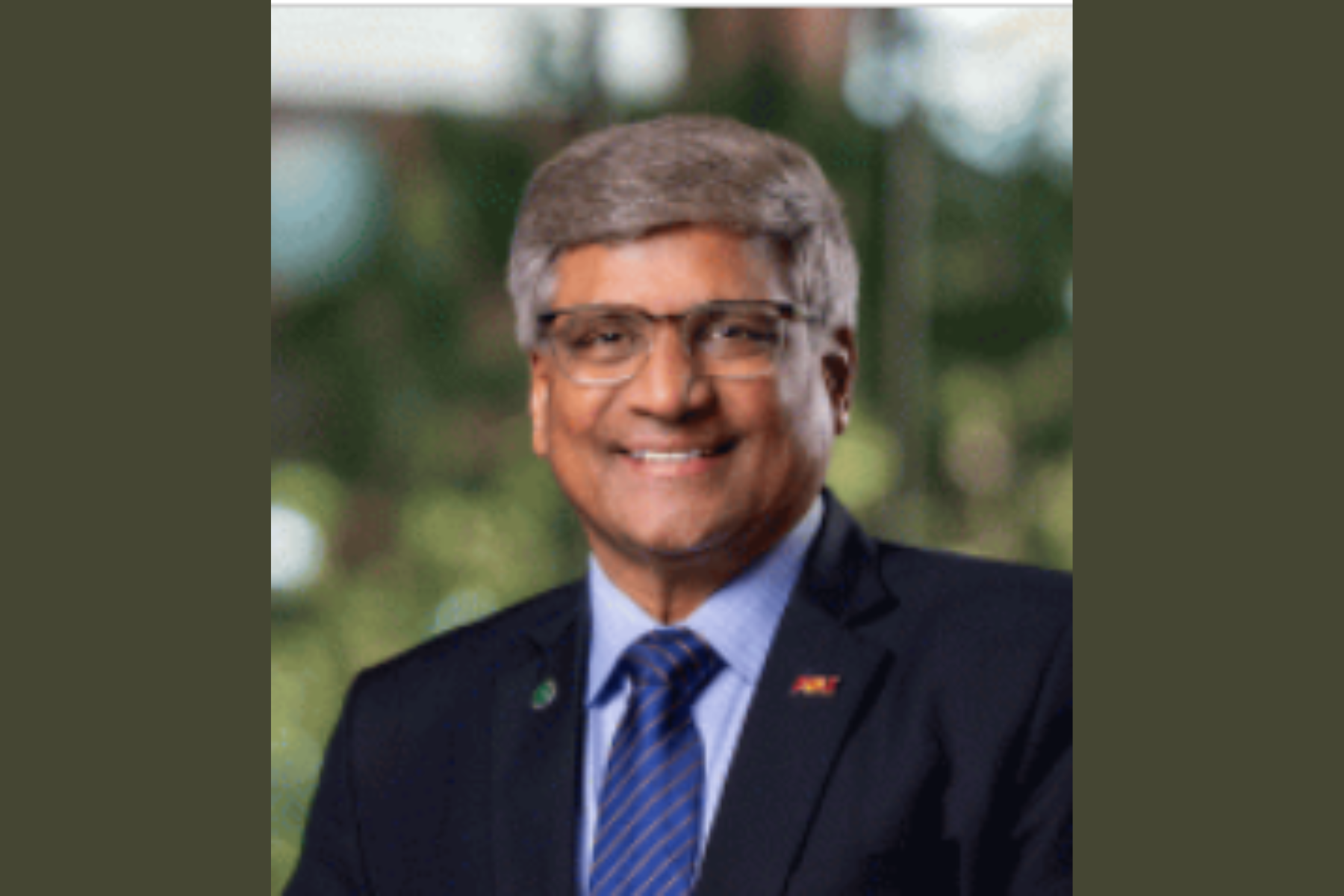
Phoenix mayor Kate Gallego has tapped Dr. Sethuraman Panchanathan, a former federal science chief and veteran researcher, to architect a new roadmap that could turn the Valley of the Sun into a premier global hub for quantum technology.
The “Phoenix Quantum Strategy,” unveiled during Gallego’s State of the City address, seeks to capitalize on the region’s booming semiconductor and bioscience sectors.
Panchanathan, who recently concluded a tenure as the 15th director of the U.S. National Science Foundation (NSF), will oversee the integration of academic research, private industry, and government policy to foster breakthroughs in quantum computing, sensing, and secure communications.
“We have the very best person in the country to lead this,” Gallego said, describing the leader known to colleagues as “Panch” as a visionary who has already shaped the nation’s innovation agenda.
Panchanathan’s journey to the forefront of American science began in Chennai, India. Born into a family that valued scientific inquiry, his father was a professor of electronics and a scientist who studied solar flares Panchanathan recalls being captivated as an 8-year-old by moon rocks brought back by the Apollo missions.
This early spark led him to pursue a rigorous education in India, earning a physics degree from the University of Madras in 1981, followed by a bachelor’s in electronics and communication from the Indian Institute of Science, Bangalore.
Read: Two Indian American students win 2026 Truman Scholarships
He completed his Master of Technology at the Indian Institute of Technology (IIT) Madras in 1986 before moving to North America for his doctoral studies.
His roots in India’s elite technical institutions have remained a cornerstone of his identity; in 2025, he was honored by the Indian government with the Padma Shri for his contributions to science and engineering.
At Arizona State University, where he previously spent over two decades, Panchanathan was instrumental in five-folding the university’s research performance. He is widely recognized for his work in human-centered computing, particularly technologies that assist individuals with disabilities.
The new strategy aims to ensure the Arizona state capital does not just participate in the quantum revolution but defines it. Quantum systems, which utilize the unique properties of subatomic particles, possess the potential to solve calculations that would take today’s most advanced supercomputers millennia to complete.
“ASU and other institutions are an incredible source of talent,” Panchanathan said. He emphasized that the initiative will leverage Arizona’s existing industrial infrastructure to create a pipeline for entrepreneurs and a high-tech workforce.
As Phoenix joins the ranks of top U.S. cities for economic growth, this initiative signals a transition from traditional manufacturing toward the next frontier of physical and digital discovery.