



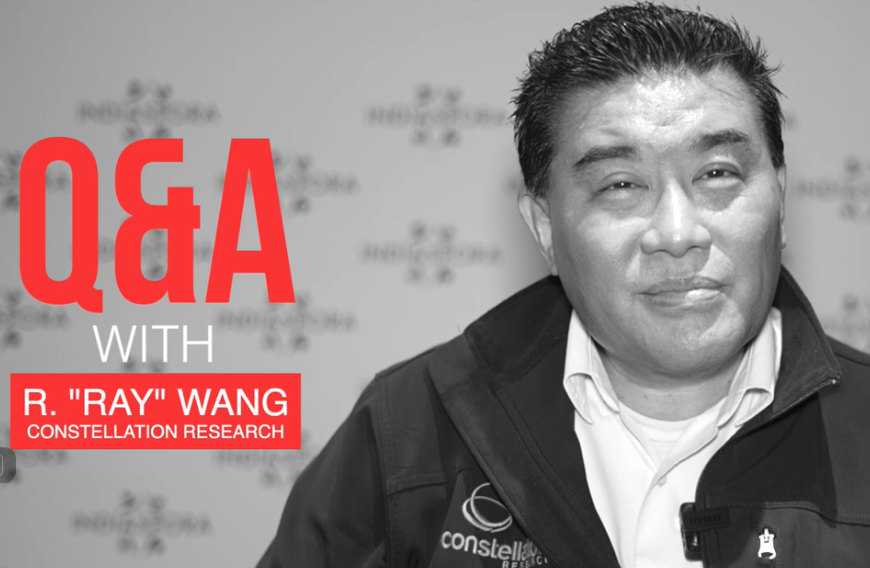
As artificial intelligence continues to dominate global boardroom conversations, Ray Wang, principal analyst and founder of Constellation Research, offered a grounded and nuanced perspective on the pace of disruption, leadership anxieties, and the future of work. Speaking on the sidelines of the Indiaspora Global AI Summit 2026, Wang shared insights drawn from his close engagement with CEOs and global enterprises.
Wang, a prominent Silicon Valley-based analyst, focuses on disruptive technologies, digital transformation, and enterprise software, advising Global 2000 companies on navigating rapid technological change. Wang also hosts the widely followed DisrupTV series, writes the popular blog “A Software Insider’s Point of View,” and is the author of best-selling books including “Everybody Wants to Rule The World.”
In an exclusive interview with The American Bazaar at the backdrop of Indiaspora Global AI Summit 2026, Wang shares candid insights on the realities behind the AI boom, from what CEOs are privately worried about to why the biggest question for companies today is not what to build, but what to avoid.
The American Bazaar: From your vantage point at Constellation Research, what’s one trend everyone is hyping but you’re skeptical about?
Ray Wang: I think the number one trend everyone’s hyping is the rate of change on the loss of AI jobs. I think it really depends on the industry. It’s going to happen. Some are going to take 10 years. Some are going to take one day like Jack Dorsey did with Block. But it really depends on what industry you’re in. If you’re in something in the white-collar job arena that’s heavy on the white collar, that is probably going to go away.
READ: Inside India Philanthropy Alliance’s Giving Day 2026 and the rise of diaspora-led giving (March 26, 2026)
Those are going to go very quickly because what we’re seeing is those are standard operating procedures. Those are things in the back office. That high touch, high human kind of intent contact, those are still going to be around for a while.
You’re not going to lose enterprise salespeople. You’re not going to lose folks that are plumbers, that are physical trades. Those are going to be there. And if you see anything going forward, it’s actually more investment in those types of physical trades and industries.
You speak to CEOs globally, what’s the biggest fear they won’t say publicly about AI?
Well, we had 120 public CEOs and board of directors at a conference last week. And what I can tell you is the one thing about AI they’re most afraid of is not understanding the cost structure of what AI will do. But they’re all ready. They’re all ready for AI and they’re all actively participating. I would say that a lot of the chief AI officers that are there today are now those roles are being placed in the CEO side. The CEOs are acting as chief AI officers and what they’re doing is they’re getting more involved because they understand that that is part of the business strategy going forward.
How has your own thinking on technology changed over the last five years?
I would say the biggest change for me is I value the people component even more now because the individuals you hire, they’re going to be the top-notch folks, otherwise you won’t survive in an AI age. And what I mean by top-notch, it’s they’re really deep in an expertise in an industry, they really understand a craft, they’re passionate about what they do. I think that’s what we’re hiring for going forward.
And you don’t necessarily need 20, 30 years of experience, but what you must do is have that constant ability to learn, and more importantly, have that constant ability to ask questions. That curiosity is going to be more important than anything. We know expertise is a commodity, we know experience isn’t, and what we also have to do is we know that in the future we must train people. If we think about Star Trek and the holodecks that are out there, that training, that mechanism, we’re going to need to do more and more of that because that’s how new hires and new graduates are going to get that experience, the training capability, the simulation. We must give them those opportunities.
What’s one question leaders should be asking about the future, but aren’t?
I think the question to ask in the future is really about if you can build everything at the speed of thought, if you have infinite possibilities, you have to answer what you’re not going to do. That is the number one question every organization must ask because the strategy and the competition for markets is more intense than ever.
READ: War, diaspora and India’s growth: Gita Gopinath outlines global outlook at Indiaspora Forum 2026 (March 24, 2026)
Saudi Arabia and the UAE have been among the largest investors in AI. With the war disrupting the region’s economy, how do you see this affecting the pace and direction of AI investment coming out of the Gulf?
A great question on AI investments is really the impact on the Middle East investment in those areas. I think the most important piece to think about is this is a short-term problem. The Iran conflict will end at some point in time. The Gulf states are going to want to protect their physical infrastructure. So, you see a lot of investments in defense tech and physical infrastructure going forward. But after that, they’re going to double down. This is a once in a generation opportunity to take energy, which is in the industrial age of oil, and convert it to tokens in the AI age. They’re in the best place to do that. And that’s why there’s so much data center investment. That’s why there’s so much investment in what’s going to happen next, which are app ecosystems. So, I’m bullish on the Middle East long-term. I think this is short-term.
There is a growing perception that too much capital is chasing AI — that good money may be going after bad. How do you respond to that concern?
I think a lot of people were experimenting, but if you don’t have a business outcome to the back end of your AI project, then like any other technology project, you’re throwing bad money after good money or good money after bad money. And, you know, I think the important piece is once you know that you’re going to go into a project and you’re going to make that investment, you should definitely commit. And that’s not necessarily bad money if you know what the outcome is going to be and you know the duration you hope to choose to achieve it.
What do you think about the Indiaspora Global AI Summit this year?
It’s always wonderful to be here in India. I’ve been coming here since, I think, 2005. Every time I come back, there’s always another innovation. You see another project. You see the investment in physical infrastructure and digital infrastructure, one of the most dynamic regions and places. But the important part is the diaspora. If you’ve got a diaspora that is coming back, giving back, providing the talent, mentoring, investing in startups, that’s really what you want to be able to see. And I think what MR [Rangaswami] and his team here have done is incredible.