



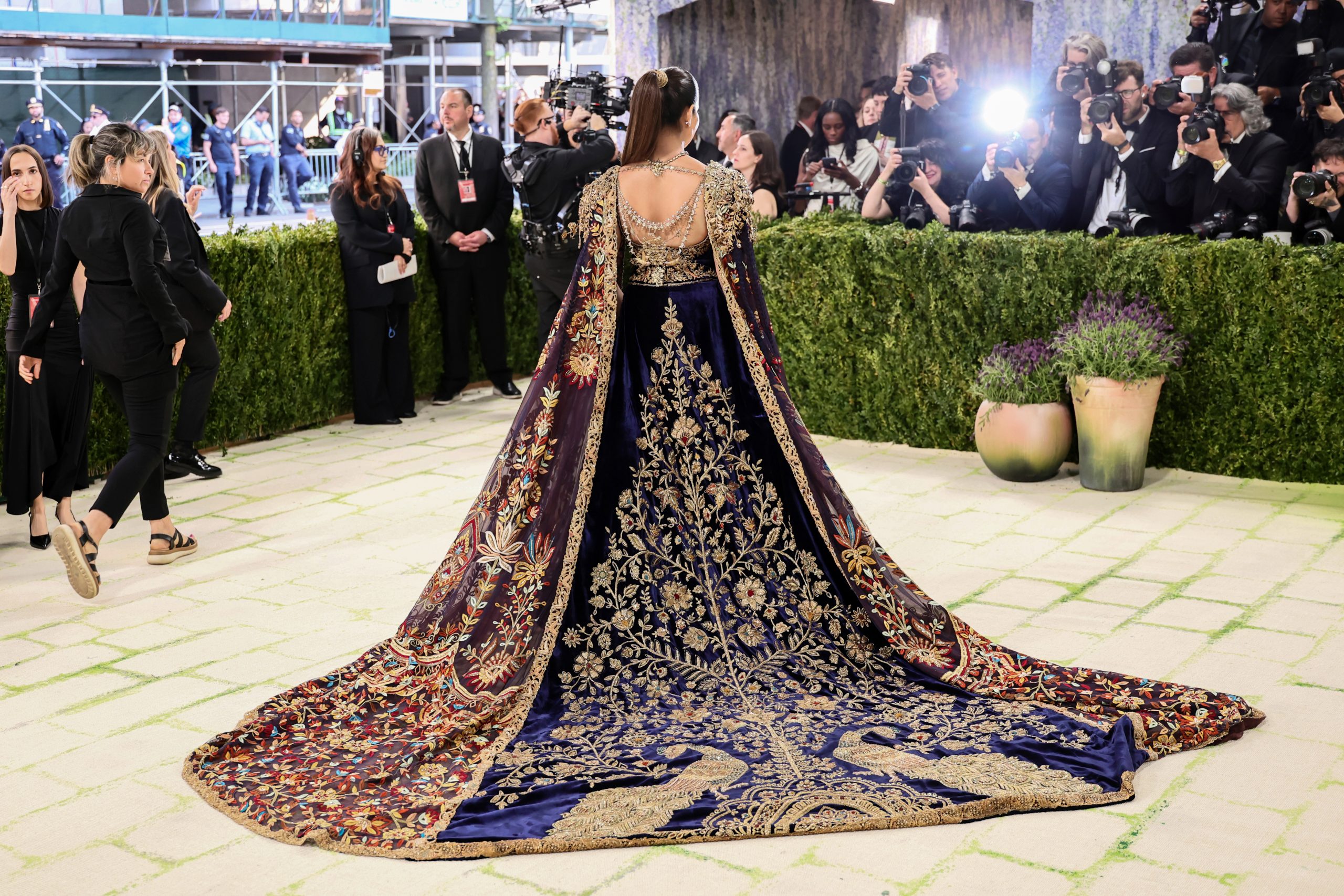
Billionaire philanthropist Sudha Reddy arrived at fashion’s biggest night, not in an expected couture, but in what can easily be called a like a living archive of South Indian heritage.
“South Indian crafts and textiles deserve sustained global visibility, even envisioning their presence at platforms like London and Paris Fashion Week. That became my singular brief to the team—to take the richness of South Indian textile heritage to an international stage. New York was our starting point.” – Sudha Reddy
It’s the quintessential Met Gala rule: shock, awe, surprise, and make a statement. For years, fashion’s biggest names have used the red carpet as a tour de force of creativity. Fashion on the Met Gala carpet has often doubled as both performance art and cultural diplomacy. And if the recent Indian presence at the Met Gala is anything to go by, representation may finally be shifting beyond the predictable markers of token ethnicity and Bollywood glamour.
It could be argued that Diljit Dosanjh helped set that shift in motion at the 2025 Met Gala, where his proudly Punjabi identity and cultural references sparked conversations about regional India stepping onto the global luxury stage. This year may have cemented that transformation altogether.
Sudha Reddy, the billionaire philanthropist, arrived at this year’s biggest night in fashion, not in an expected couture, but in what can easily be called a like a living archive of South Indian heritage.
Reddy is the director of the MEIL Group, a business conglomerate headquartered in Hyderabad, India. She is also the chairperson of the Sudha Reddy Foundation.
Her custom ensemble was created by Bollywood’s darling designer Manish Malhotra in collaboration with Hollywood stylist Mariel Haenn. What made the garment stand out was not just its striking appearance and showcase of fine Indian craftsmanship, but the way it transformed a centuries-old textile tradition from Telangana into a sculptural, museum-worthy fashion piece.
READ: Met Gala 2026 turns into big $42 million event with Bezos, Meta and OpenAI (May 7, 2026)
In an exclusive interview with The American Bazaar, Reddy spoke about her roots, saying, “Hyderabad is my foundation and this ensemble is a translation of that cultural identity into a language that is both global and deeply personal.”
Beyond Bollywood
Titled “The Tree of Life,” the look too inspiration from the Machilipatnam style of Kalamkari, which is one of India’s oldest textile art forms believed to dating back nearly 3,000 years.
While diligent craftsmen, away from the glamor of red carpets and camera spotlights have quietly kept the traditionally alive; the craft hasn’t yet enjoyed a global recognition. Hand-painted using natural dyes and known for mythological storytelling motifs, Kalamkari has remained a regional Indian staple and has survived in craft clusters and temple-adjacent artisan economies.
The past decade also has seen Indian designers bring this art form onto the runways and to the bridal couture market but looks like with this latest sweep, it will be seeing its due on global luxury carpets.
The stunning garment shone at the Met Gala spotlight reimagined in velvet, silk, tulle, zardozi, marodi and metal-work, taking more than 3,459 hours and involving over 90 artisans. So, would it be an exaggeration to say that with this statement piece there may be a larger story unfolding?
“Indian craftsmanship isn’t a legacy confined to history but a living, breathing art form. It was vital to demonstrate that these ancient techniques possess the structural integrity and aesthetic power to lead the global fashion dialogue,” Reddy says.
Reddy also acknowledged the Telangana state’s efforts to recognize this art form, saying, “The Hon’ble Chief Minister of Telangana recently emphasized that South Indian crafts and textiles deserve sustained global visibility, even envisioning their presence at platforms like London and Paris Fashion Week. That became my singular brief to the team—to take the richness of South Indian textile heritage to an international stage. New York was our starting point.”
So, is Sudha Reddy’s outfit symbolic of a coming-of-age moment for Indian fashion on the global stage? Since the rise of Bollywood’s international popularity, Indian fashion on global red carpets has often leaned toward a more widely recognizable image — think saris, lehengas, glittering Bollywood-inspired colors, embroidery, and drapes. But increasingly, designers and celebrities appear to be embracing something more specific and deeply rooted: hyperlocal storytelling. Much like regional Indian cinema has challenged Bollywood’s monopoly on global imagination, regional textile traditions are beginning to carve out their own luxury language.
The outfit was conceived in collaboration with celebrity stylist Mariel Haenn, who has worked with global stars including Rihanna, Pharrell Williams, Gwen Stefani, and Jennifer Lopez. For Haenn, the goal was to push the boundaries of what red-carpet dressing could represent.
“Working with Sudha Reddy and Manish Malhotra on ‘The Tree of Life’ was an exercise in pushing the boundaries of what red-carpet fashion can be,” Haenn told The American Bazaar. “Our goal was to treat this ensemble as a piece of high-concept art by projecting the grandeur of Indian heritage through a cinematic contemporary lens.”
The ensemble itself functioned almost like a visual map of Telangana. Motifs including the Palapitta bird, the Jammi Chettu tree, Tangedu flowers, Surya (sun), and Chandra (moon) were embroidered across the dramatic royal blue silhouette and its sprawling seven-meter train. At the back sat an elaborate sculpted metal installation featuring the Kalpavriksha, or wish-fulfilling tree, handcrafted in brass, copper, and silver.
READ: Met Gala 2026: Who is Mona Patel? Indian American entrepreneur channels Leonardo da Vinci (May 5, 2026)
Speaking about the outfit’s strong cultural connection, Haenn says, “My approach to styling has always been about finding the narrative thread that connects a person to their clothes. With Sudha Reddy, that thread is her incredible commitment to her hometown and the storytelling of her culture.”
The timing of this fashion moment could hardly be more fitting, as consumers and audiences increasingly seek authenticity over generic luxury. And India, with its vast ecosystem of regional weaves, embroideries, and textile traditions, possesses perhaps one of the richest untapped fashion archives in the world.
In many ways, this mirrors what has already happened in entertainment. Regional Indian cinema — from Telugu and Tamil blockbusters to Malayalam storytelling — has steadily reshaped global perceptions of Indian culture beyond Bollywood stereotypes. Fashion may now be entering a similar era, where a craft tradition from Machilipatnam or Telangana can command as much international intrigue as Parisian couture ateliers.
Designer Manish Malhotra told The American Bazaar, “Fashion, for me, has always been about the emotion behind the image. With ‘The Tree of Life,’ we wanted to create something that carries memory and the soul of the craft. It is not merely worn, it is experienced.”
Even the spectacle surrounding Reddy’s look reflected that sentiment. Her monochromatic sapphire-toned jewelry suite, reportedly valued at $15 million, featured the 550-carat “Queen of Merelani” tanzanite alongside rose-cut diamonds and Rajasthan polki pieces, amplifying the ensemble’s theatricality without overshadowing its narrative core.
Yet beneath the grandeur was something more strategic: a deliberate positioning of South Indian craftsmanship within the global luxury conversation. Reddy herself referenced recent calls by Telangana leadership to bring regional textile traditions to international platforms such as Paris and London Fashion Week.