



By Mona Chopra
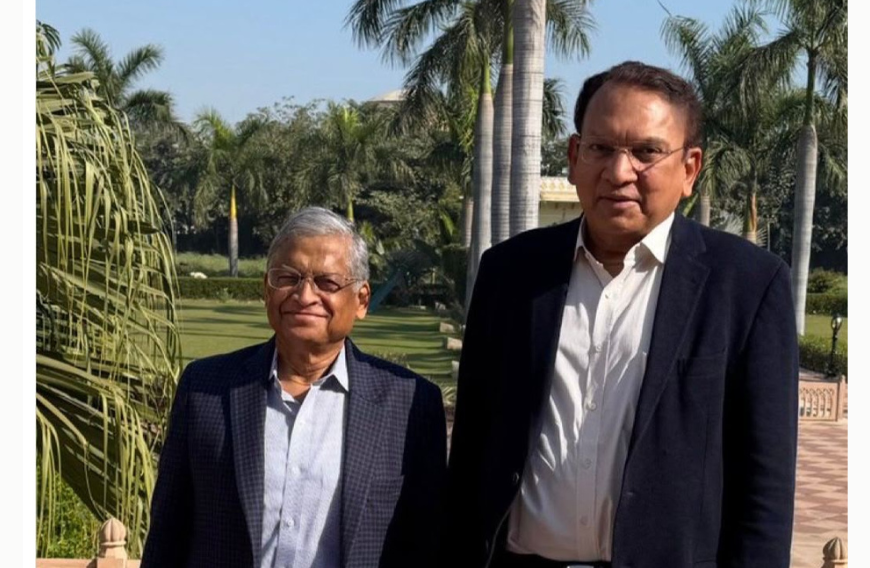
A few weeks ago, in the village of Chandan Chowki near Jaipur, Rajasthan, new hostels opened for children attending Todi Adarsh Vidya Mandir, a Vidya Bharati school built through the vision and generosity of Nand Todi, an industrialist from Pennsylvania. The inauguration drew distinguished guests, including Lok Sabha Speaker Om Birla.
The buildings are impressive. Clean lines. Modern facilities. Large residential spaces. The kind of educational infrastructure that many villagers never imagined would exist in their communities.
Yet the true significance of the event lies not in concrete, steel, or architecture. It lies in the lives that will emerge from those buildings over the next fifty years.
No television cameras arrived from New York. No international celebrity posted about it. No global foundation issued a triumphant press release. Yet for hundreds of children, this may prove more consequential than anything debated this year in Delhi, Boston, Washington, London, or Silicon Valley.
Because a child who has a safe place to sleep can remain in school. A child who remains in school can learn. And a child who learns can alter the destiny of a family for generations.
This is the quiet revolution that Vidya Bharati has been conducting across India for decades.
While public attention often focuses on elite universities, startups, artificial intelligence, venture capital, and stock markets, Vidya Bharati has been engaged in something even more fundamental: building human beings.
Today, Vidya Bharati educates millions of children through thousands of schools and educational institutions spread across villages, tribal regions, small towns, and urban communities. Its reach extends into places where educational opportunity often arrives last. Places where a hostel is not a convenience — it is the difference between attending school and not attending school. Places where a library is not an amenity — it is the first doorway to a larger world. Places where a classroom is not a room. It is a future.
READ: ‘The Full Plate’: Nourishing India’s educational future – In a conversation with Satish Jha (May 13, 2026)
Think about that for a moment.
If Vidya Bharati were a country, its student population would exceed that of many nations. If it were a corporation, it would rank among the world’s largest educational enterprises. Yet unlike corporations, its success is measured not by quarterly earnings but by transformed lives.
Few people understand this better than Nand Todi.
For decades, the Pennsylvania-based industrialist has quietly invested in the educational future of India. His contributions to Vidya Bharati exceed $10 million. But the number itself is not the story. The story is what that money has become: schools, hostels, opportunities, human possibility.
Earlier this year, he helped create a 1,251-bed residential facility for abandoned and vulnerable people, built to standards that exceed what many government institutions are able to provide. In Chandan Chowki, he has helped create an educational campus whose infrastructure rivals many schools found in affluent communities abroad.
That comparison matters. Because for too long, India has accepted a quiet inequality — the belief that village children should be grateful for less. Less infrastructure. Less technology. Less opportunity. Less expectation.
The Todi Adarsh Vidya Mandir campus rejects that idea completely. Its message is simple: a child born in a village deserves facilities equal to any child anywhere. That belief sits at the heart of India’s future.
The Indian diaspora understands this instinctively.
Most of us did not arrive in America because of inherited wealth. We arrived because somewhere a teacher cared. A school functioned. A scholarship appeared. A book reached our hands. Education was the bridge. It remains the bridge. And nowhere is that bridge more urgently needed than in India.
India is the youngest major nation in the world. Over the next quarter century, the country will contribute a substantial share of the world’s new workforce. Whether this becomes India’s greatest advantage or greatest disappointment depends on one thing: what happens inside classrooms today. Not twenty years from now. Today.
The remarkable thing about Vidya Bharati is not merely its scale. It is its efficiency.
For roughly the cost of a cup of coffee a day in America, a child can receive an education that often outperforms nearby alternatives. For the price of a family dinner in Boston, multiple children can be educated for months. For the cost of a vacation, an entire classroom can be transformed. The mathematics of impact are astonishing.
Yet this is not primarily about charity. It is about participation in history.
Every successful immigrant community eventually faces a defining question. The first generation survives. The second generation succeeds. The third generation asks: what do we owe the society that made us possible? For the Indian diaspora, education may be the most powerful answer. Not because education is fashionable. Because education is foundational.
Roads require engineers. Hospitals require doctors. Businesses require skilled workers. Democracy requires informed citizens. Every institution begins with education. That is why Vidya Bharati deserves the attention of Indian-Americans across New England — not merely as a worthy cause, but as a nation-building opportunity.
The menu of possibilities is tangible: a classroom, a library, a science laboratory, a computer center, a drinking water system, a hostel, a school. Each project carries a name. But more importantly, each project carries futures.
READ: From Bollywood glamour to South Indian heritage: India’s Met Gala evolution (May 11, 2026)
Imagine visiting India ten years from now and entering a school where hundreds of children learn every day because a family in Boston decided to act. Imagine a science laboratory built by alumni of an engineering college. Imagine a library funded in memory of parents who valued education. Imagine a company adopting an entire school.
These are not donations. They are legacies.
Andrew Carnegie built libraries. The Indian diaspora has the opportunity to build something even more important: human capital.
The children sitting in Vidya Bharati classrooms today will become India’s teachers, scientists, entrepreneurs, engineers, nurses, military officers, artists, farmers, and civic leaders tomorrow. Some will create companies. Some will discover medicines. Some will teach future generations. Some will simply raise educated families. Every one of those outcomes matters. And every one begins with a child sitting at a desk.
The remarkable success of Indian Americans did not happen by accident. It emerged from education. We are the beneficiaries of schools we did not build. Now we have the opportunity to build schools for children we may never meet.
History often appears to move through famous leaders, grand speeches, and dramatic events. But its deepest transformations usually begin somewhere quieter. A classroom. A library. A laboratory. A hostel. A child.
The hostels inaugurated in Chandan Chowki will never make global headlines. Yet decades from now, the most important story will not be the buildings. It will be the lives that emerged from them.
That is the invitation before the Indian diaspora. Not merely to give. But to build. Not merely to donate. But to participate. Not merely to succeed. But to ensure that success becomes significance.
Nand Todi has shown what that looks like. The question before the rest of us is simple: who will be next?
For less than a dollar a day, a life can change. For a classroom, hundreds can change. For a school, a community can change. And for a generation, a nation can change.