



By Ranjani Saigal
In the global discourse on economic development, India is often described as a “sleeping giant” finally finding its stride. We point to the gleaming tech hubs of Bengaluru, the rising skyscrapers of Gurgaon, and a digital payment infrastructure that is the envy of the developed world. Yet, for those of us who have spent our lives in the quiet, often dusty trenches of grassroots education, we know that a nation’s height is not measured by its tallest buildings, but by the floor it provides for its most vulnerable children.
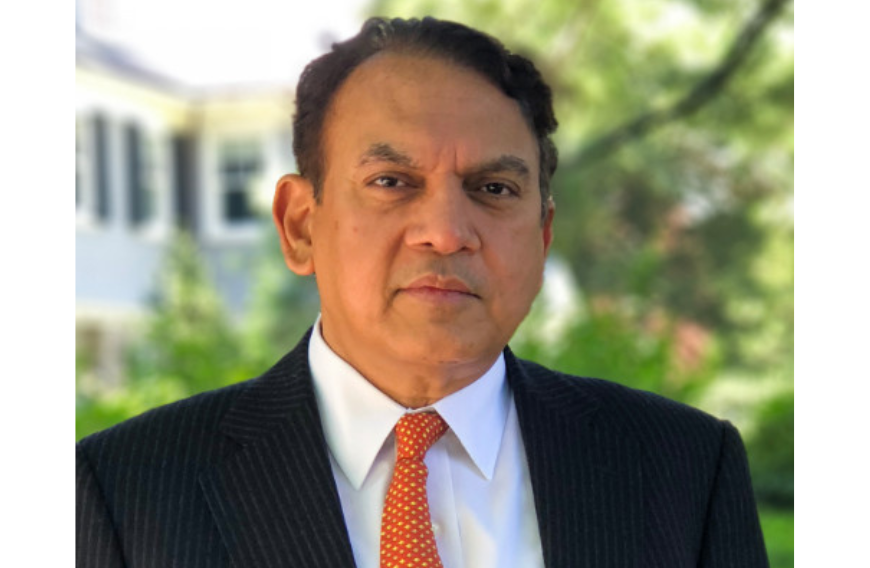
In the bustling world of Indian education reform, headlines often swing between two extremes: the soaring triumph of enrollment statistics and the sobering reports on learning poverty. Satish Jha stands at the center of this storm as a thoughtful bridge-builder. A former journalist, economist, and technologist, Jha has spent decades at the intersection of policy, innovation, and community-driven change.
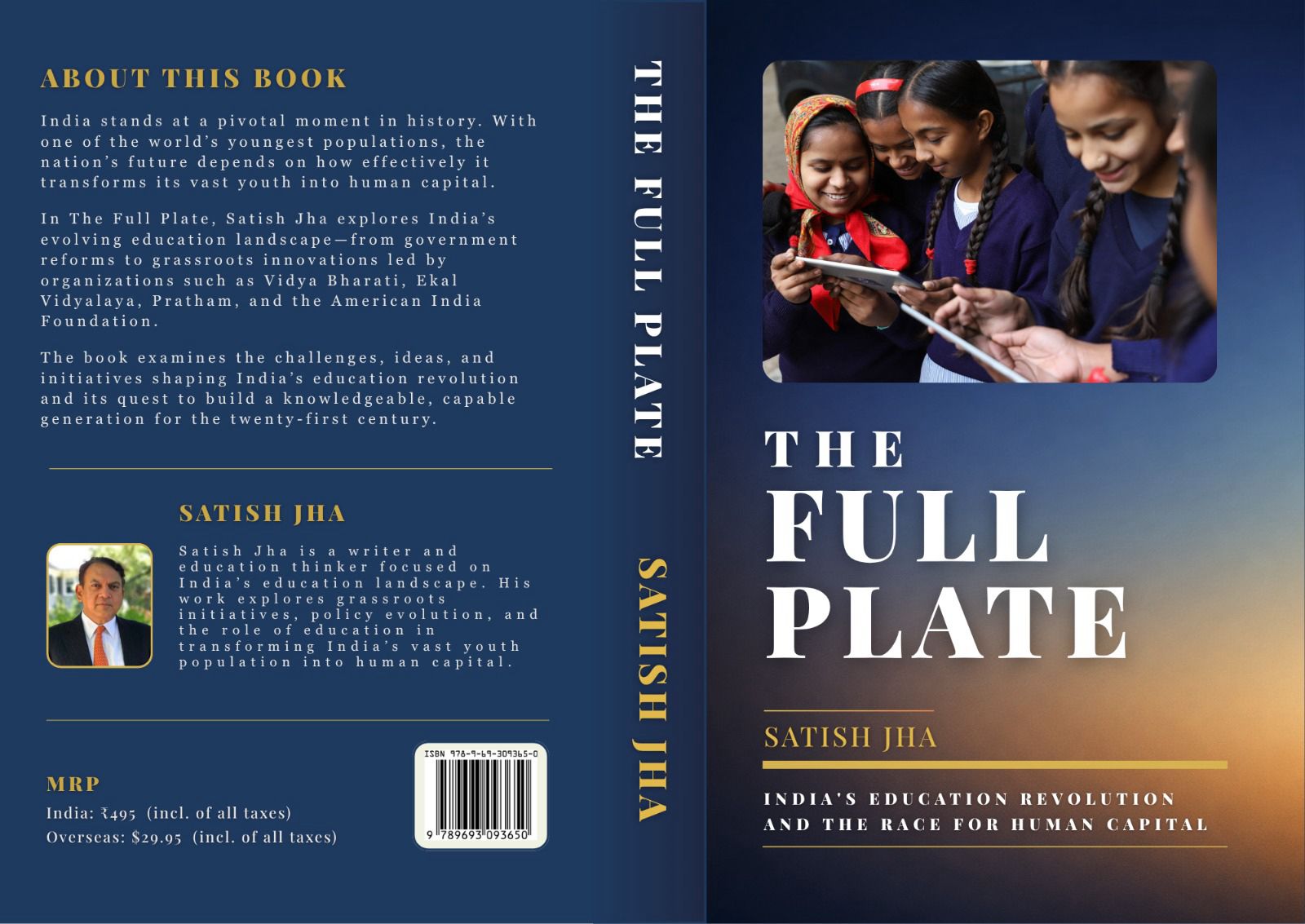
I recently sat down with Satish to discuss his latest work, The Full Plate: India’s Education Revolution and the Race for Human Capital. The book is more than a memoir of a career spent in reform; it is a clinical yet compassionate autopsy of why India’s educational systems often fail, and a pragmatic blueprint for how they can succeed.
Our conversation took place as he prepares for a milestone event: the Vidyabharati Foundation USA’s second annual gala on July 12, 2026, at the Burlington Marriott. The event promises to be a gathering of minds committed to one of India’s most successful, yet under-discussed, educational miracles.
The Scale of the Mission: The Vidyabharati Model
When we speak of “scale” in the non-profit world, we often talk in hundreds or perhaps thousands. But Vidyabharati operates on a level that challenges conventional organizational theory. What began in 1952 with a single school in Gorakhpur has blossomed into a network of approximately 14,000 schools serving nearly 3.5 million children annually.
As someone who led the Ekal Foundation USA for over a decade, I have seen firsthand how difficult it is to maintain quality while scaling across India’s diverse geography. Vidyabharati manages this by focusing on families with modest incomes—often below $5,000 annually—and providing them with full-fledged institutional support: classrooms, laboratories, and prayer halls.
“What sets Vidyabharati apart,” Jha explained to me, “is not just the bricks and mortar. It is the passion and the remarkably low teacher turnover. In these schools, teachers don’t view their work as a 9-to-5 job; they see it as a mission, a vrati. They engage deeply with parents and connect culturally with every child. They have won the most important currency in India: parental trust.”
This model proves a radical point: quality education does not have to be an elite luxury. When driven by commitment and community ownership, excellence can be democratized. The proof is in the results; Vidyabharati alumni have risen to high positions in the Prime Minister’s office, the Indian Police Service, and global technology firms.
The “Thali” Philosophy: Defining the Full Plate
The central thesis of Jha’s book—and our conversation—is a metaphor that is as intuitive as it is profound: the “Full Plate.” Jha’s journey into education reform gained momentum through his leadership of One Laptop per Child (OLPC) in India. In that role, he witnessed the limitations of technology-only interventions. He saw that dropping hardware into a vacuum does not create learning; it creates electronic waste. This realization crystallized into his “Full Plate” theory.
READ: ‘The Full Plate’ and the kindness of readers (March 26, 2026)
“Imagine a meal,” Jha said, leaning in. “If you have only chapati, you survive, but you aren’t healthy. A complete thali—rice, dal, vegetables, yogurt, and spices—nourishes the body and the soul. Education is identical. A full learning ecosystem requires several non-negotiable ingredients: engaged teachers who meet students at their level, appropriate materials, sufficient time on task, regular assessments, and family support. Technology is the salt—it enhances everything, but it cannot be the meal itself. Missing even one key element weakens the entire system.”
This concept emerged from Jha’s observation of “piecemeal fixes” across India. He contrasts India’s trajectory with South Korea and China. In 1947, all three nations had similar per-capita incomes of roughly $50. Today, South Korea stands near $40,000 and China’s around $15,000, while India’s hovers lower. The difference, Jha argues, lies in the sustained investment in a complete, “Full Plate” educational ecosystem.
Closing the Innovation Gap
Perhaps the most striking part of Jha’s narrative is his critique of India’s “Innovation Gap.” Despite the vibrant startup scene and the millions of engineers India produces, Jha points out that the nation has produced few globally transformative works in science, technology, or the arts that the world universally celebrates as pathbreaking.
“We have become excellent at passing exams,” Jha noted candidly. “But innovation happens at the apex of learning. We need systems that prepare students not just for known jobs, but for creativity and problem-solving at the frontiers of human knowledge.”
He argues that the current system is too often “self-referential,” relying on rote learning and internal grading. To move forward, Indian education must adopt external benchmarks and foster a culture that values originality over obedience. Grassroots organizations like Vidyabharati and Ekal demonstrate that even in resource-constrained settings, excellence is possible when the focus shifts from “covering the syllabus” to “uncovering the child’s potential.”
The Balanced Role of Technology
Jha remains a technologist at heart, but a tempered one. He shared an inspiring story of a Vidyabharati school in Jaipur (Adarsh Vidya Mandir, Ambabari) that went entirely bagless. By providing tablets for students and teachers and integrating STEM, robotics, and AI into the daily rhythm, the school saw a physical and psychological transformation.
“The children walked taller,” Jha recalled. “They weren’t weighed down by ten kilograms of books, and they weren’t bored by static lectures. They were engaged. But the technology only worked because the teachers were trained to use it as a tool for engagement, not as a replacement for teaching.”
He views the mobile phone revolution in India as a template. Connectivity moved from a luxury to a ubiquity in less than a decade. Education can follow that same path—but only if we build the institutional “Full Plate” around the digital tools.
An Urgent Call to the Diaspora
As we wrapped up our discussion, the conversation turned toward the role of the Indian-American community. The upcoming gala on July 12 is more than a social event; it is a strategic investment.
READ: The Full Plate: A powerful argument for grassroots change in India’s classrooms (March 25, 2026)
“Education is the only long-term strategy a nation has,” Jha reflected. “Everything else—tax policy, infrastructure, trade deals—is just tactics. If we don’t get the human capital right, the rest won’t matter.”
Jha’s narrative is ultimately one of “urgent optimism.” India’s demographic dividend—its massive youth population—offers a historic window of opportunity. If nourished correctly, this generation can propel India into the ranks of developed economies. If neglected, the “Full Plate” remains empty, and the window will close.
In Satish Jha, one finds a rare combination: the clarity of a journalist, the rigor of an economist, the pragmatism of a technologist, and the heart of an educator. His work reminds us that the true revolution in education is not a flashy disruption, but the patient, consistent nourishment of every child.
The thali is prepared; the ingredients for transformation exist in abundance across India’s landscape. What remains is the collective will of the global community to ensure every child receives their full plate.
Join the Revolution:
The Vidyabharati Foundation USA invites you to be a part of this transformative journey.
• What: 2nd Annual Gala for India’s Educational Future
• When: July 12, 2026
• Where: Burlington Marriott, 1 Mall Rd, Burlington, MA
• Keynote Speaker: Satish Jha, Author of “The Full Plate”
• Purpose: To support the education of 3.5 million children and the expansion of mission-driven schooling across India.
Reading “The Full Plate” is the first step in understanding the blueprint; attending the gala is the next step in building it. We hope to see you there.
(Ranjani Saigal is a veteran leader in the non-profit sector. Having headed the Ekal Vidyalaya Foundation of USA for over a decade, she was instrumental in building it into a premier global brand. Her work continues to focus on the intersection of community, education, and the empowerment of rural India.)