



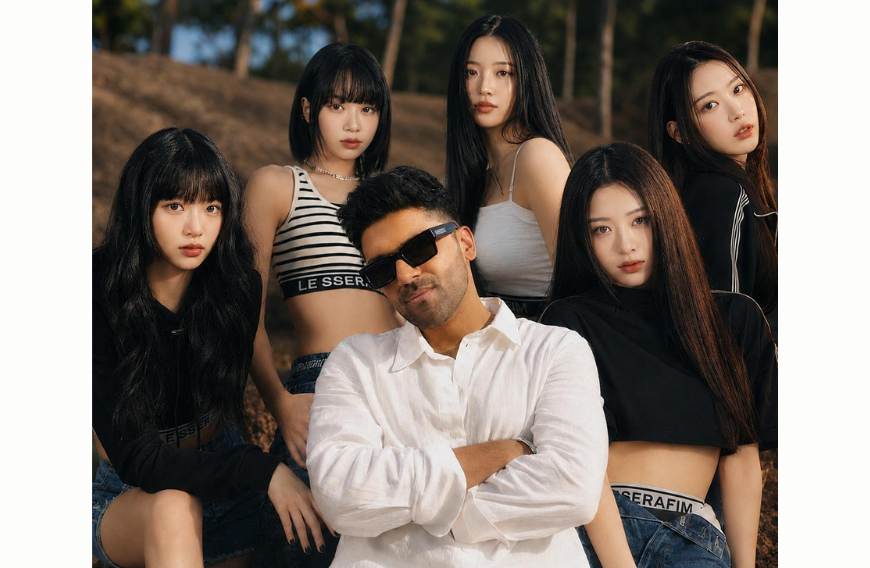
Guru Randhawa’s collaboration with K-pop group LE SSERAFIM blends Punjabi and Korean influences, reflecting a generation that embraces culture beyond borders and genres.
Music has long served as an invisible bridge between cultures and continents. For immigrant families navigating multiple identities while preserving traditions for future generations, it often plays a central role. For many second- and third-generation immigrants, Bollywood soundtracks competed with American hip-hop, while parents at home spoke Hindi, Urdu, Gujarati, or Tamil. Moving between cultures became second nature for countless children growing up in the United States.
Today, however, cultural convergence has become even more widespread. The lines separating traditions are increasingly blurred, giving rise to new hybrid identities. And this fluidity extends far beyond the familiar East-West binary.
It is no longer unusual for a teenager growing up not only in New York but even in Arkansas to listen to Diljit Dosanjh in the morning, switch to LE SSERAFIM at the gym, stream Drake with friends in the evening, and come home to watch a Korean drama before going to bed.
Against this backdrop of global cultural exchange, something notable—and in many ways unprecedented—has happened. Punjabi pop superstar Guru Randhawa has teamed up with K-pop sensation LE SSERAFIM for a global remix of “BOOMPALA.” LE SSERAFIM, a South Korean girl group formed by Source Music, consists of five members: Sakura, Kim Chaewon, Huh Yunjin, Kazuha, and Hong Eunchae.
READ: Indian American researcher making music from the cosmos (June 10, 2026)
What may appear at first glance to be just another international music collaboration is, for many Indian American Gen Z listeners, a reflection of the culturally connected lives they already lead.
Los Angeles-based multidisciplinary digital creator and singer Malvika Sheth, who recently released her EP “Online/IRL,” has experienced this cultural amalgamation firsthand.
She says, “As a third-generation Indian-origin immigrant, I grew up training in Bharatanatyam, and those raags and rhythms shaped me. At the same time, I was growing up in Los Angeles — immersed in global pop, R&B, hip-hop. Artists like Drake, Kendrick Lamar, Rihanna, and Lady Gaga shaped my sense of narrative and world-building.”
She adds, “I’ve never seen those influences as contradictory. They’re layered.”
For many young people who feel equally at home listening to Punjabi pop and K-pop, the Guru Randhawa–LE SSERAFIM remix reflects a broader shift in how youth culture is formed. Increasingly, cultural tastes are shaped not only by geography or family traditions but also by algorithms.
Streaming platforms have created new connections across languages and musical styles; even when listeners do not understand the lyrics, they often connect with the melody and emotion.
The internet has also played a major role in dismantling the barriers that once separated regional music markets. K-pop, once considered a niche import in the United States, has become a global phenomenon with devoted audiences even in India’s Tier 2 and Tier 3 cities. At the same time, Punjabi music has emerged as one of India’s most internationally recognizable cultural exports, attracting listeners far beyond South Asia.
READ: Grammy Winner Chandrika Tandon launches community Chant Club in New York City (May 26, 2026)
Reflecting on the collaboration and how he incorporated his own musical identity into the track, Guru Randhawa said, “I brought in a touch of my signature style to a Latin-house K-pop track sampling ‘Macarena’ and it felt like a beautiful masterpiece. I can’t wait for fans worldwide to dance to this.”
Cultural observers say that beyond an appreciation for melody and rhythm, something deeper may be taking place through these cross-cultural exchanges. K-pop narratives often explore themes such as ambition, perseverance, and belonging—ideas that resonate strongly with many immigrant and second-generation communities.
Asked about the vision behind the collaboration, LE SSERAFIM said in a statement: “When we created ‘BOOMPALA,’ our goal was to bring people together across different generations and cultures through a shared, festival-like energy. Guru’s incredible Indian artistry brought an entirely new, vibrant life to the track. It’s an honor to connect with our fans in India and around the world through this special cross-cultural celebration.”
The parallels between the two genres are difficult to ignore. K-pop itself is a product of cultural hybridity, drawing heavily from American hip-hop, R&B, electronic music, and global fashion trends while retaining a distinctly Korean identity. In many ways, it mirrors the experience of bicultural youth who blend influences from multiple worlds without feeling compelled to choose a single identity.
Read: Who Is Jasmine Sandlas? Indian American singer goes viral with ‘Jaiye Sajana’ from Dhurandhar (March 25, 2026)
That dynamic helps explain why K-pop fandoms across the United States increasingly include large numbers of South Asian fans. Social media platforms are filled with Indian American creators producing dance covers, reaction videos, and fan content. Likewise, K-pop concerts in major U.S. cities often attract audiences that are remarkably diverse.
Against that backdrop, the Guru Randhawa collaboration takes on added significance. The remix layers Punjabi lyrics onto a track that already incorporates Korean, English, and Spanish influences. The result is more than a fusion experiment; it reflects the way music consumption increasingly functions in the streaming era. For younger listeners, linguistic boundaries often matter far less than emotional connection and cultural relevance.
The collaboration also points to a broader trend in global entertainment. As digital platforms continue to connect audiences across borders, artists are finding new opportunities to create music that resonates across cultures rather than within a single market.
Collaborations such as the one between Guru Randhawa and LE SSERAFIM suggest that the future of popular music may belong to artists—and audiences—who are equally comfortable navigating multiple cultural worlds. As musician Malvika Sheth puts it, “I think of myself as a bridge. I bridge worlds — East and West, traditional and modern, fashion and music.”