



In June 2026, the Dussehra Maidan in Kota, Rajasthan, ceased to be a ground and became a stage for generational despair. Under harsh lights, thousands of teenagers gathered not to celebrate achievement but to mourn a broken promise.
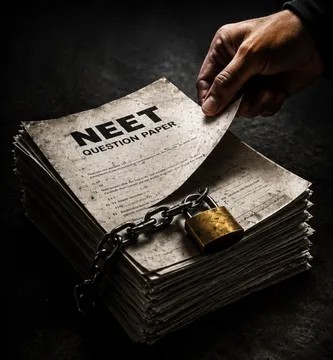
The cancellation of NEET amid a cascading paper-leak scandal had snapped the final thread of credibility in India’s assessment system. Speaking at the Chhatron Ki Goonj rally, Leader of the Opposition Rahul Gandhi articulated what millions of families already understood: India’s centralized examination architecture no longer functions as a meritocratic filter. It has mutated into a rigged gamble in which the questions themselves are commodities.
To treat the epidemic of leaks, Telegram-circulated answer keys, and entrenched corruption as isolated criminal events is to misread a terminal condition. The leaks are merely the visible lesions of a deeper malignancy: the republic’s near-total surrender of education to the Coaching Leviathan.

India suffers from a socio-economic pathology disguised as aspiration. The entire machinery of adolescent life has been funnelled into hyper-competitive entrance examinations for a vanishingly small number of seats in higher education and public employment. This parallel industry does not supplement the formal schooling system; it thrives on its ruins.
Each year, millions of students enter a brutal contest for a fraction as many opportunities. NEET alone attracts more than two million aspirants for roughly one hundred thousand medical seats. The major recruitment examinations of government and public institutions add millions more.
Read: Satish Jha | The myth of the statistical exception: Dismantling India’s factory of unrealized potential (June 1, 2026)
The mathematical absurdity of these odds has spawned a shadow economy that extracts vast sums from households while promising access to an ever-narrowing gateway.
In return, it produces a generation of cognitively narrowed citizens: masters of elimination techniques on optical-mark recognition sheets, yet increasingly deprived of independent thought, intellectual risk-taking, creativity, and exploration.
To understand how India arrived at this precipice, one must examine what might be called the Full Plate phenomenon.
In a healthy educational ecosystem, the curriculum balances foundational literacy, analytical depth, ethical grounding, aesthetic development, and creative inquiry. In India, that plate has been progressively colonized by the demands of high-stakes testing. When a single examination comes to determine life trajectories, education ceases to be education and becomes preparation.
The curriculum remains on paper. The examination becomes the curriculum in practice.
Coaching factories in Kota, Janakpuri, Hyderabad, Delhi, Patna, and countless smaller cities operate as industrial processors, compressing the rich and untidy landscape of human knowledge into algorithmic shortcuts, elimination tricks, pattern-recognition drills, and memorization protocols. Concepts are valued not for their explanatory power but for their probability of appearing on an exam.
The formal schooling apparatus, intended to nurture literacy, curiosity, creativity, citizenship, and intellectual confidence, is increasingly displaced by this machinery. Dummy schools proliferate. Students enroll formally to satisfy regulatory requirements while spending their actual lives in coaching centres. The official system remains standing; its purpose has migrated elsewhere.
The consequence is severe cognitive narrowing.
Genuine learning requires intellectual romance. It requires the freedom to ask questions whose answers may never appear on a test. It requires wandering into apparently unproductive territory, reading beyond the syllabus, making mistakes, discovering interests, changing one’s mind, and cultivating wonder. The coaching model treats such wandering as inefficiency. If an idea cannot be reduced to a question that can be answered in seconds, it is discarded.
By filling students’ plates exclusively with the dense fuel of competitive preparation, India has extinguished the spark of curiosity that sustains lifelong learning. We are not educating our youth. We are optimizing them for examinations.
This domestic failure is compounded by a profound misunderstanding of twenty-first-century competitiveness.
Read: Satish Jha | The widening gap: Legitimacy, epistemic chaos, and the next civilization (June 4, 2026)
A Learning State organizes its institutions, industries, and public systems around continuous adaptation, innovation, and knowledge creation. It understands that in an age defined by artificial intelligence, automation, biotechnology, climate disruption, and geopolitical volatility, national strength derives not from the ability to sort talent but from the ability to continuously develop it.
A Learning State teaches citizens how to learn, unlearn, and relearn. India, by contrast, risks becoming a Testing State.
A Testing State prioritizes filtration over formation. It values ranking more than understanding. It becomes obsessed with identifying the winners of a competition rather than expanding the capabilities of the population itself. Such a state does not ask whether students understand the physics of semiconductors, the biology of disease, or the ethics of technological change. It asks whether they can outperform millions of others under artificial conditions for a few hours on a single day.
The coaching industry functions as the enforcement arm of this Testing State.
Its objective is not to cultivate thought but to anticipate the examiner. Students are trained not to think independently but to think as the examination system expects them to think. The result is a tragic cognitive ceiling.
They become disciplined, resilient, and hardworking, yet often constrained within intellectual frameworks designed by others. They learn to reproduce equations but struggle to design experiments. They memorize legal provisions but hesitate before original critique. They become successful test-takers in a world increasingly rewarding creators, innovators, collaborators, and problem-solvers.
The crisis is illuminated not only by its psychology but by its economics.
Parents understand that conventional schooling alone rarely provides a competitive advantage within this structure. The result is a vast financial hemorrhage. Families liquidate savings, postpone retirement, mortgage assets, incur debt, and redirect household resources toward coaching fees. What appears as private educational spending is, in reality, a national transfer of capital into an arms race whose aggregate returns remain deeply questionable.
Resources that might have expanded universities, strengthened public schools, improved teacher quality, financed research, modernized laboratories, or created vocational alternatives are consumed by a perpetual contest for fixed opportunities.
The system manufactures inequality with the same precision that it manufactures conformity.
The wealthy purchase superior preparation. The connected purchase access. The poor purchase hope.
When examination papers leak, when answer keys circulate in advance, when admissions become suspect, merit itself becomes a tradable commodity. The message delivered to millions of young people is devastating: success may depend less on effort than on proximity to advantage.
The deepest cost, however, cannot be measured in rupees. It is measured in childhood.
By ceding the formative years of adolescence to coaching centres, India is steadily eroding the psychological foundations of an entire generation. Students live under relentless pressure to convert every waking hour into measurable performance. Art becomes a distraction. Sport becomes a luxury. Friendship becomes negotiable. Curiosity becomes inefficient.
When a teenager’s worth is reduced to a rank, failure ceases to be an academic outcome and becomes an existential verdict.
In 2023 alone, Kota’s coaching hub recorded thirty-two such verdicts. In Sikar this May, one more: a twenty-three-year-old aspirant, his family already deep in debt from selling land to fund years of coaching, took his own life days after the examination he had built his future around was cancelled over a leak he had no part in.
The tragedy is amplified by the fragility of the system itself. Even perfect preparation offers no guarantee. A leaked paper, a cancelled examination, a clerical error, an arbitrary normalization formula, or an administrative failure can nullify years of sacrifice overnight.
Read: Satish Jha | The wrong question about Rahul Gandhi (June 7, 2026)
Real life offers no four-option multiple-choice questions.
It demands moral judgment, emotional intelligence, collaboration, adaptability, creativity, and resilience in the face of ambiguity. It rewards those capable of navigating unstructured problems rather than selecting among predetermined answers. Yet these are precisely the capacities that the Testing State neglects.
The warning emerging from Kota should therefore be heard not as a partisan argument but as a national alarm.
India stands at a historic crossroads.
One path leads deeper into the Testing State: a society that mistakes ranking for learning, scarcity for excellence, and competition for education. The other path requires a deliberate reconstruction of the Learning State. It demands expanded educational capacity, diversified pathways to achievement, multidimensional assessment systems, stronger schools, better teachers, richer curricula, and institutions that reward curiosity rather than conformity.
But policy reforms alone will not resolve the deeper challenge.
The republic must decide what kind of minds it wishes to cultivate.
Every civilization inherits a reservoir of curiosity larger than itself. That inheritance arrives in the form of children: restless, questioning, imaginative, impatient with boundaries they did not create. Their curiosity is not merely a private asset. It is a national resource.
India is spending that resource with alarming recklessness.
It is exchanging wonder for rank lists, imagination for elimination techniques, discovery for coaching modules, and learning for filtration. The Coaching Leviathan is not merely consuming household income, student time, or public trust. It is consuming futures.
Nations survive many policy mistakes. They survive corruption, inflation, administrative incompetence, and political cycles. What they do not survive indefinitely is the systematic shrinking of their children’s imagination.
A republic that teaches its young to fear mistakes more than they love learning may eventually discover that the greatest examination it failed was its own.