



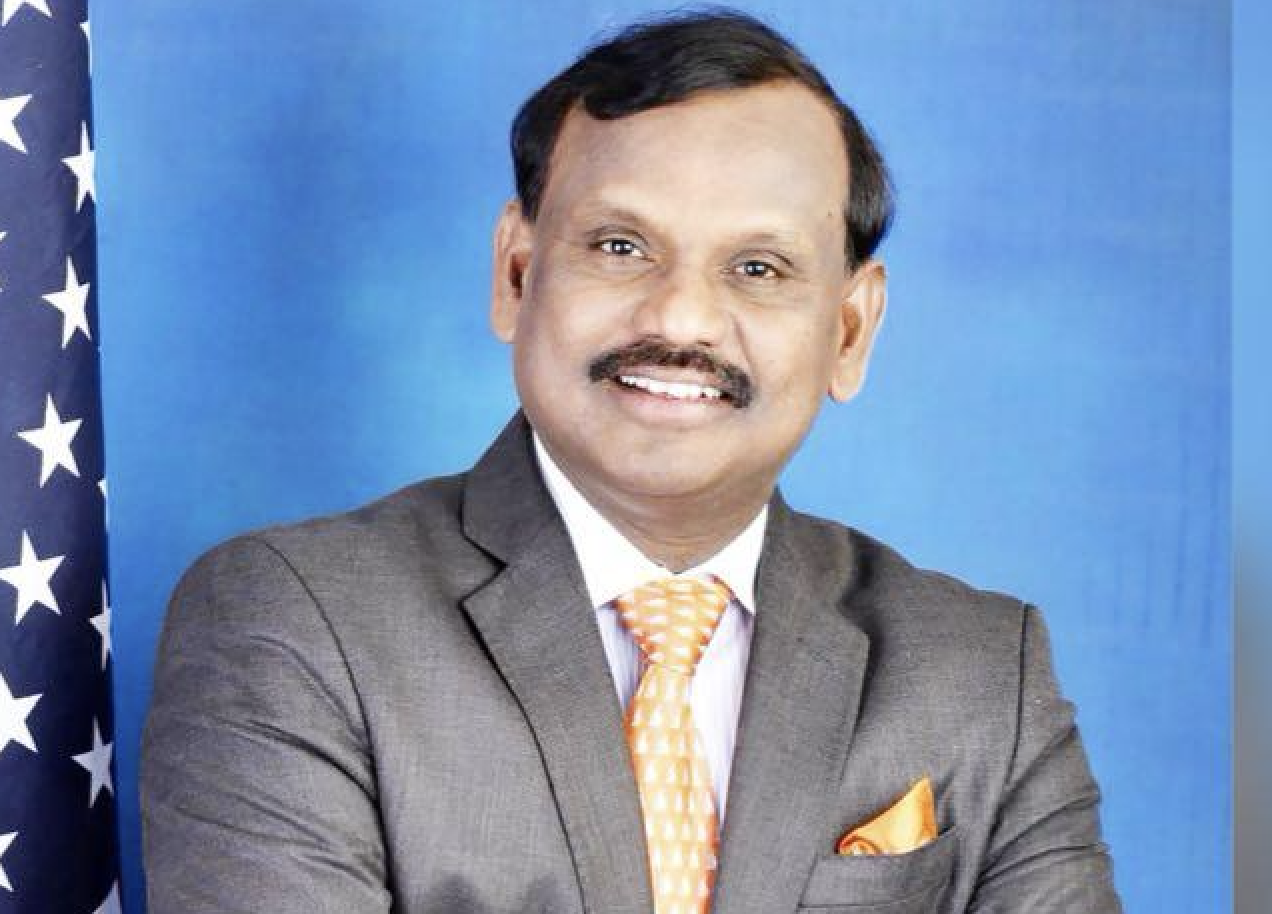
When Dr. Rajan Natarajan arrived in the United States more than four decades ago from a small village in India’s Tamil Nadu state, he carried with him little more than ambition, education, and a belief in the power of opportunity.
Today, he is a successful technology entrepreneur, business executive, public servant, investor, and community leader whose career spans biotechnology, diplomacy, government, and technology.
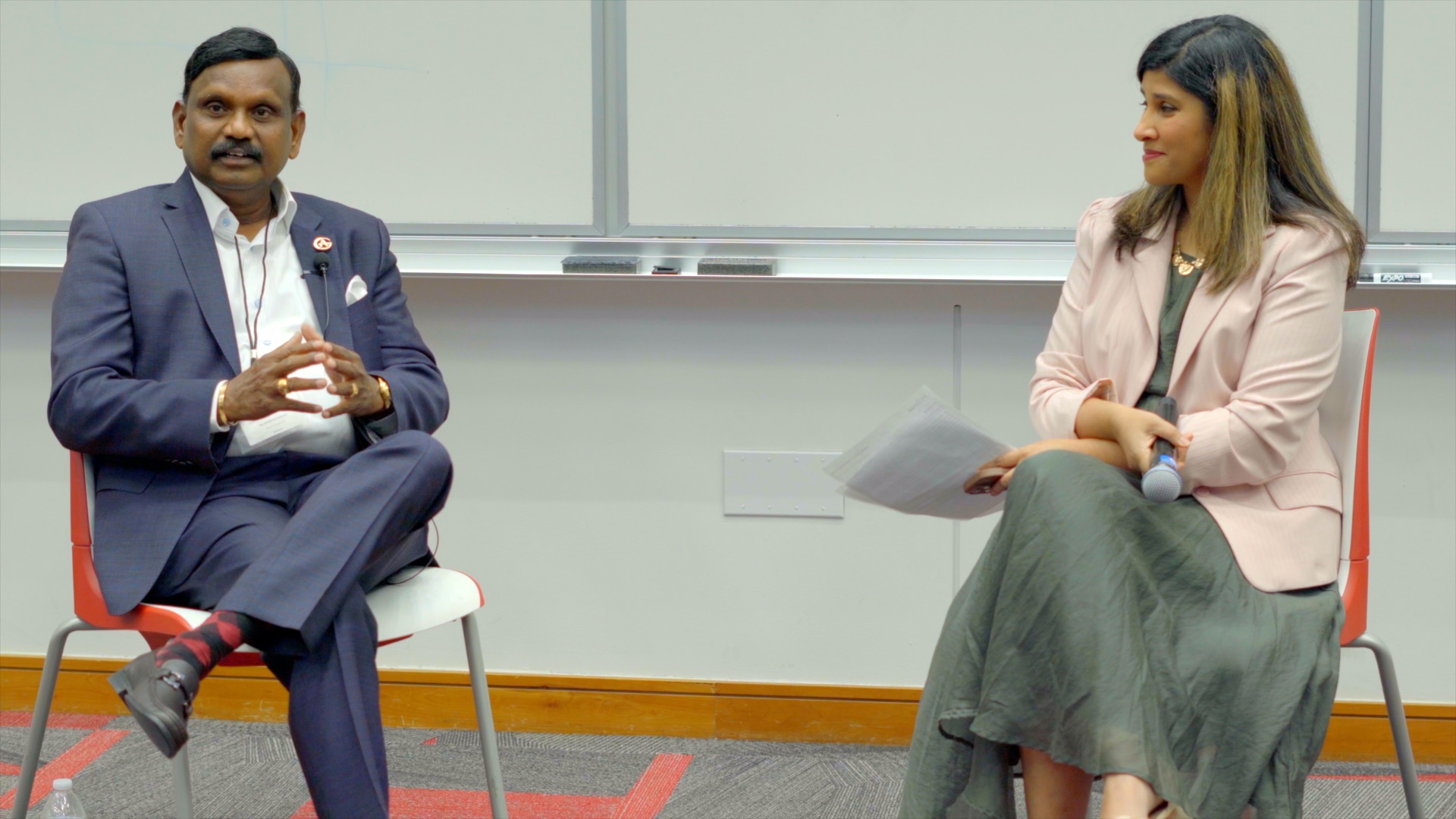
Speaking at Startup Bazaar: GovCon at the University of Maryland on June 13, Dr. Natarajan reflected on that remarkable journey during a fireside chat moderated by Soumya Padmanabhan, Vice President of Technical Delivery at MERP Systems. The conversation offered attendees a blend of practical business advice, leadership lessons, and personal reflections on entrepreneurship in America.
For many in the audience, Rajan embodied a uniquely American success story.
Born in a small village in the Pudukkottai district of Tamil Nadu, he went on to earn three master’s degrees and a Ph.D., build a thriving technology company, serve in a senior position in Maryland State government, and become the first Indian American appointed as the Deputy Secretary of State in Maryland’s history.
Yet throughout the conversation, Dr. Natarajan returned repeatedly to a simple idea: success is ultimately about people.
Building a tech company
As founder and CEO of Global Alliant, Dr. Natarajan has built a fast- and smart-growing software technology and IT consulting firm serving government clients. But unlike many technology companies, he said, Global Alliant’s identity extends far beyond software, data, and digital transformation.
The company employs not only technologists, but also scientists, researchers, and subject matter experts from a broad range of disciplines.”We have agriculture scientists, policy experts, anthropologists—you can imagine my company,” Dr. Natarajan said. “Global Alliant is a corporation of opportunities for individuals from diverse backgrounds.
Roughly half of the company’s workforce comes from non-IT education, reflecting Dr. Natarajan’s belief that innovation often emerges at the intersection of disciplines.
The company’s mission, he explained, is built on a balance between customer success, employee well-being, and flawless execution. While many businesses focus heavily on customer satisfaction, Rajan prefers a different metric.
READ: ‘A way to build bridges between the US and India’: Dr. Rajan Natarajan on the 12th World Tamils Economic Conference (October 31, 2025)
“Customer satisfaction is momentary,” he said. “But Customer success and system success are very important and permanent. That’s why we focus more on them.”
That philosophy influences every aspect of the company, from client relationships to employee incentives and talent development.
“If we take care of our employees, they are going to take care of the customers well,” he said.
Winning contracts and delivering
For an audience gathered to learn about government contracting, one of Natarajan’s most memorable observations concerned execution.
Many entrepreneurs obsess over winning contracts, securing funding, or landing customers. Dr. Natarajan argued that the real challenge begins after the contract is signed.
“Winning contracts, I can tell you, is important and hard,” he said. “But delivering the projects successfully is harder and not easy.
Execution, he explained, is particularly critical in an era dominated by emerging technologies such as artificial intelligence, quantum computing, and digital transformation.
No matter how exciting a technology may be, customers ultimately judge companies by results. As CEO, Dr. Natarajan said his role often involves balancing two equally important constituencies: customers and employees.
That balancing act, he noted, is one of the most difficult leadership challenges in any growing company.
The power of collaboration
If there was a central theme running through the discussion, it was collaboration.
Dr. Natarajan described himself as a strong believer in partnerships, mentorship, and networks as engines of entrepreneurial success. “When I came to this country, you didn’t need capital to become an innovator or entrepreneur,” he said. “Right Network, mentorship, collaboration, partnership—this brings prospects, opportunities, and confidence.
READ: From startup to exit: Deepak Hathiramani’s playbook for GovCon entrepreneurs (June 15, 2026)
Those principles have become embedded within Global Alliant’s corporate culture and organizational structure. Beyond its consulting and technology services, the company operates several initiatives designed to foster collaboration, innovation, and entrepreneurship.
One is GAIN, a think tank focused on education, innovation, and community impact. The main mission of this initiative is to transform interns into innovators. Another is GAinnoLab, an internal innovation accelerator that helps employees and entrepreneurs transform ideas into products and intellectual property. The main goal of this R&D hub is to ignite ideas and innovate the future.
Together, these initiatives reflect Dr. Natarajan’s conviction that companies should contribute to broader economic and social development, not merely generate profits.
“Collaboration is very key,” he said. Among the programs Dr. Natarajan discussed most passionately was GAINship, a paid internship initiative designed to cultivate the next generation of entrepreneurs.
Unlike traditional internships, participants are expected to leave the program having accomplished two specific goals. The first is registering a company in their own name.
The second is filing a provisional patent application. “I tell all the interns, when you leave, I want to work with you,” Dr. Natarajan said. “Register a company in your name and have one patent.” This year alone, more than 800 students applied for just 12 positions.
The objective, Dr. Natarajan explained, is not merely to provide workplace experience but to create measurable outcomes that strengthen students’ entrepreneurial capabilities and confidence.
The program reflects his broader belief that innovation must be practical and actionable.
Entrepreneurship, he suggested, is not a theoretical exercise—it is something that should produce tangible results. He also emphasized the true meaning of public servant means not only serving people and helping them, but also creating a meaningful impact around them. In short, make others look good.
Start with the problem
During the discussion, Dr. Natarajan offered advice to aspiring entrepreneurs in the audience, many of whom were building technology companies or exploring new ventures.
His guidance began with a common mistake he sees repeatedly.
Too many innovators, he said, become obsessed with solutions before understanding the problem.
READ: Rajan Natarajan sworn in as Maryland Transportation Commissioner (December 31, 2014)
“I tell you one thing:if you want to become an innovator, first identify the problem,” he said. “First, the problem should begin with the business, then the solution. “He recalled meeting entrepreneurs who proudly described sophisticated AI solutions without being able to explain the problem they were solving.
He encouraged founders to remain open-minded, think beyond traditional boundaries, and avoid allowing negativity or fear to limit their ambitions.
At the same time, he emphasized the importance of continuous learning.
“What you learned last month, next year may not be relevant,” he said.
In a world shaped by rapidly evolving technologies, adaptability has become a competitive advantage.
Never stop learning
One of the more unconventional pieces of advice Dr. Natarajan offered concerned career development.If you want to become an employer ie. entrepreneur, “never work more than five years as an employee,” he told the audience. The comment generated laughter, but his underlying point was serious. People should continually seek growth opportunities, challenge themselves, and avoid complacency.
Whether through entrepreneurship, new roles, further education, or international experiences, individuals should actively manage their own development rather than waiting for circumstances to force change.
He paired that advice with another recommendation: find mentors.
Mentorship, he argued, is one of the most valuable assets any entrepreneur can possess.
Mentors need not be celebrities or famous executives. They can be family members, colleagues, professors, or community leaders. “Mentor means motivator,” Dr. Natarajan said. “Mentor really understands your passion and understands your vision.”
Throughout his career, he said, various mentors have guided him through different phases of life and business.
Investing in passion
Audience members also asked Dr. Natarajan about his investment philosophy.
As an investor who has backed multiple startups, he said financial returns are not always his primary motivation. Instead, he looks for founders with passion, energy, and commitment.
“When some people have that energy, that fire in their belly, I want to help them,” he said.
To evaluate opportunities, Dr. Natarajan uses a framework he calls “MET.”
The first component is Technology. Is the innovation truly differentiated?
The second is Economics. Is the idea or product commercially viable?
The third is Marketability. Is there a real market need and customer demand?
“Don’t invent something without purpose,” he cautioned. “Don’t invent something without knowing the problem.” The framework reflects the same principles that guided much of the discussion: practical innovation, clear purpose, and measurable value.
A message of possibility
As the conversation drew to a close, Dr. Natarajan returned to the theme that has defined much of his professional life: possibility.
From a rural village in southern India to leadership roles in business, government, science, and public service, his journey stands as evidence of what can happen when ambition is matched by persistence.
For entrepreneurs navigating uncertainty, competitive markets, and technological disruption, his message was straightforward.
“When you have hard work and commitment with a clear purpose and vision, everything is possible,” he said.
It was a fitting conclusion from a leader whose own career has demonstrated precisely that.