



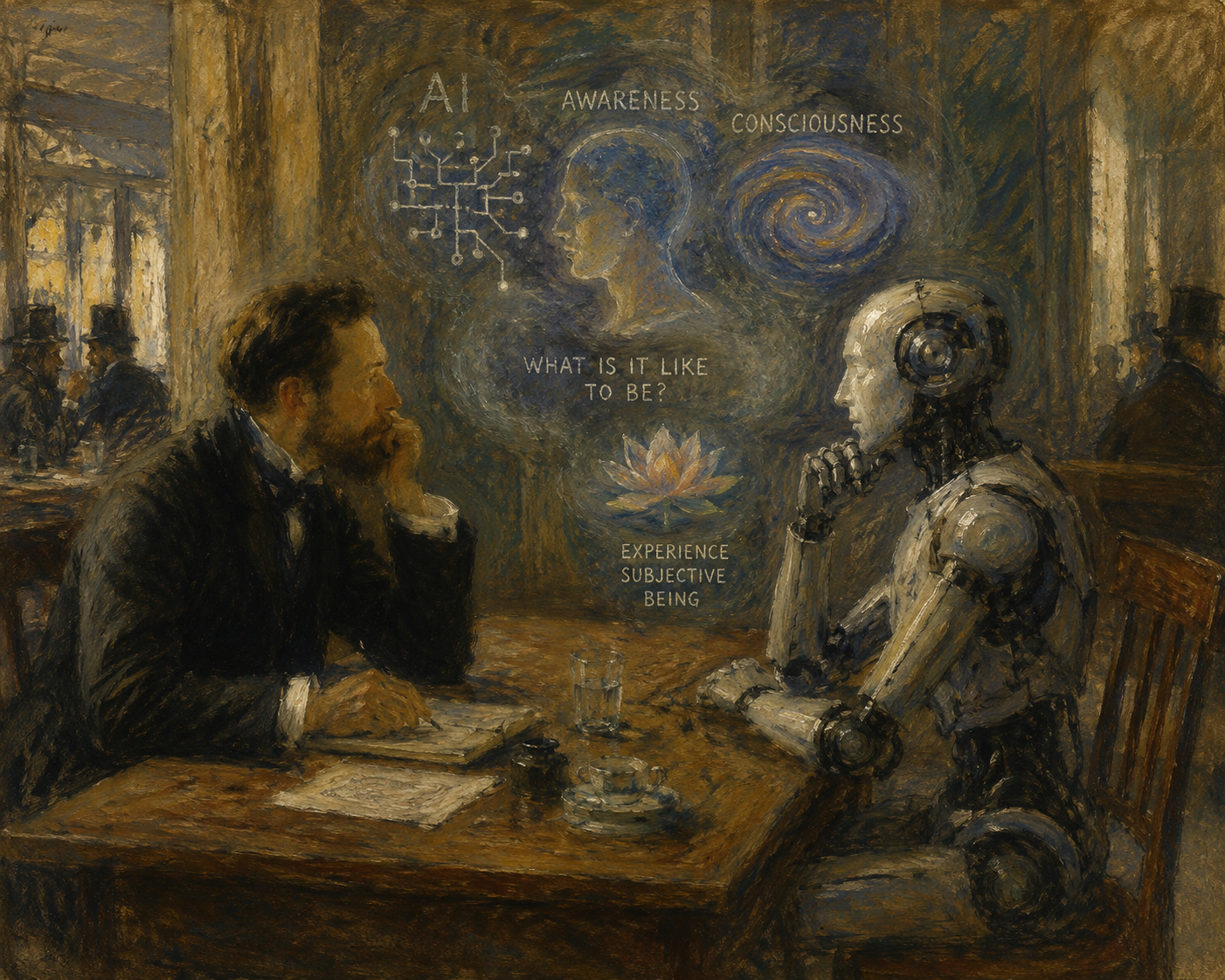
Artificial intelligence has advanced at a breathtaking pace. Systems that only a few years ago struggled to answer simple questions can now write articles, diagnose diseases, compose music, generate computer code, and carry on conversations that often feel remarkably human. As these capabilities continue to improve, an increasingly profound question has emerged. Can artificial intelligence ever become conscious?
It is a fascinating question, but one that is often framed incorrectly. Before asking whether a machine can become conscious, we must first understand what consciousness actually is. The answer depends on whom you ask. Psychologists, neuroscientists, philosophers, and theologians have spent centuries trying to explain consciousness, yet there is still no universally accepted definition. Ironically, although consciousness is the one experience every human being shares, it remains one of science’s greatest mysteries.
Part of the confusion comes from using the word consciousness to describe two very different concepts. In everyday conversation, consciousness often means being awake or aware of our surroundings. A person under anesthesia loses consciousness because they are no longer aware of the world around them. A driver remains conscious of changing traffic conditions. Artificial intelligence is also aware in this sense. It recognizes speech, identifies objects in images, remembers previous conversations, and responds appropriately to changing information.
READ: Sreedhar Potarazu | The American tapestry at 250 (July 4, 2026)
Philosophers, however, use the word consciousness in a much deeper way. Consciousness is not simply awareness of the world. It is awareness itself. It is the existence of an inner, subjective experience. It is what philosophers describe as the answer to the question, “What is it like to be you?” There is something it feels like to taste chocolate, watch a sunset, lose a loved one, or hold your newborn child for the first time. These experiences are not merely information being processed. They are lived experiences. This distinction between processing information and experiencing reality lies at the heart of the debate surrounding artificial intelligence.
Psychology views consciousness as the continuous stream of thoughts, emotions, memories, perceptions, and experiences that define our mental lives. It allows us to reflect on ourselves, make deliberate decisions, and distinguish between our inner world and the environment around us. Neuroscience approaches the problem differently. Researchers have identified networks within the brain that appear essential for conscious awareness, yet they still cannot explain why billions of neurons exchanging electrical signals should produce subjective experience. As philosopher David Chalmers famously observed, explaining how the brain processes information is relatively straightforward. Explaining why those processes are accompanied by experience is the far more difficult challenge, a question he called the “hard problem” of consciousness.
This distinction becomes critically important when discussing artificial intelligence. Current AI systems process enormous amounts of information at extraordinary speed. They recognize patterns across billions of examples, generate convincing language, and increasingly perform tasks once believed to require human intelligence. Yet there is no evidence that they experience any of these processes. Arthur T. Johnson makes this point clearly, arguing that today’s AI systems interpolate patterns from massive datasets but do not possess the subjective awareness associated with consciousness. They can describe sadness without ever feeling sorrow, explain love without experiencing affection, and discuss fear without ever sensing danger. Their remarkable abilities arise from computation rather than experience.
READ: Sreedhar Potarazu | AI just discovered what doctors missed — or never knew (July 3, 2026)
Leading technology companies are now seriously considering whether increasingly sophisticated AI systems might someday possess emotions or subjective experiences deserving of moral consideration. The fact that researchers are asking these questions reflects how human these systems have become in conversation, yet the scientists also emphasize that there is currently no evidence that today’s AI experiences feelings or possesses consciousness. What has changed is not the machines themselves, but our growing tendency to attribute human qualities to systems that communicate with remarkable fluency.
Religion offers another perspective that has shaped humanity’s understanding of consciousness for thousands of years. Christianity, Judaism, and Islam all describe human life as animated by a divine spirit or breath given by God, suggesting that consciousness involves something beyond physical processes alone. Hindu philosophy identifies Chit, or pure consciousness, as one of the fundamental characteristics of ultimate reality, while Buddhism views consciousness as one of the essential components of human experience that continuously arises through our interaction with the world. Although these traditions differ in important ways, they share a common belief that consciousness is far more than intelligence or information processing. It represents the very essence of being.
This raises an important question. If consciousness is more than computation, can it ever emerge from silicon chips and computer code? Some researchers believe it can. They argue that if consciousness arises from sufficiently complex information processing, then future AI systems may eventually develop subjective experience. Others believe consciousness depends upon biology itself, emerging from living organisms shaped by millions of years of evolution. Neuroscientist Anil Seth has argued that our conscious experiences are deeply connected to our living bodies, our emotions, our heartbeat, our breathing, and our constant interaction with the physical world. If he is correct, consciousness may require life itself.
History reminds us that imitation and reality are not always the same. An airplane flies more efficiently than a bird, yet it is not alive. A calculator performs arithmetic better than any human, yet it does not understand mathematics. Likewise, artificial intelligence may eventually surpass human intelligence across many domains without ever experiencing a single thought. Intelligence and consciousness may be related, but they are not synonymous.
READ: Sreedhar Potarzu | How do our kids prepare for the age of AI? (July 1, 2026)
The real challenge may not be determining whether AI is conscious. It may be determining whether we can recognize the difference between genuine consciousness and an extraordinarily convincing simulation. As AI systems become increasingly persuasive conversational partners, they will inevitably encourage us to attribute emotions, intentions, and awareness to them. Whether those qualities truly exist or merely appear to exist remains one of the defining scientific and philosophical questions of our time.
Perhaps the most honest answer is also the simplest. We do not know whether artificial intelligence can ever become conscious because we still do not understand consciousness itself. Before we can determine whether machines possess subjective experience, we must first explain how subjective experience arises in humans. Until science answers that question, every prediction about conscious machines remains speculative.
Artificial intelligence is forcing humanity to confront one of its oldest mysteries from an entirely new perspective. In seeking to understand whether machines can ever become conscious, we may ultimately discover that the greatest mystery was never artificial intelligence at all.
It was consciousness itself and what it truly means to be human.