



Editor’s note: This article is based on insights from a podcast series. The views expressed in the podcast reflect the speakers’ perspectives and do not necessarily represent those of this publication. Readers are encouraged to explore the full podcast for additional context.
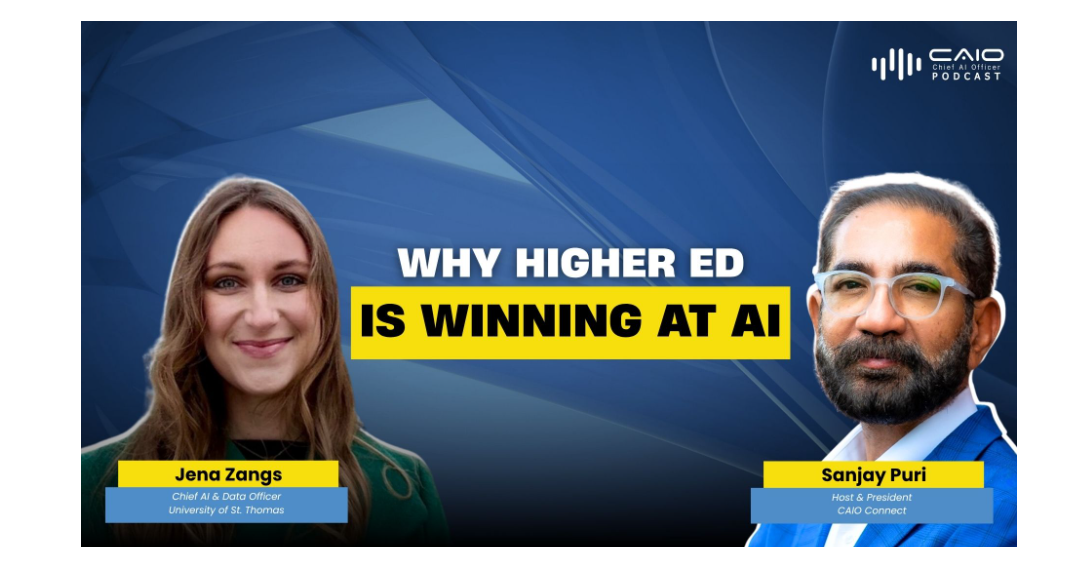
On a special Women’s Day edition of the “CAIO Connect” podcast, host Sanjay Puri welcomed Jena Zangs, Chief Data and AI Officer at the University of St. Thomas, for a thoughtful conversation about leadership, innovation, and the future of artificial intelligence in higher education. With more than 15 years of experience in data science and AI, Zangs also serves as the Minnesota Ambassador for Women in AI, advocating for ethical, human-centered technology.
During the episode, Zangs shared insights into her unconventional career journey, the challenges of implementing AI responsibly in universities, and why the future of AI depends as much on trust and governance as it does on technology.
One of the most compelling moments came when Zangs described her unconventional path into AI leadership. Early in her career at the University of St. Thomas, she was working in alumni relations, organizing homecoming events and reunions far from the world of artificial intelligence. However, everything changed when she discovered coding after completing her undergraduate degree.
Driven by curiosity, Zangs returned to the same institution to pursue a master’s degree in data science. Teaching herself programming and experimenting with coding projects opened a new professional pathway. Soon, she transitioned into the university’s advancement systems team, where she began integrating data analytics, machine learning, and eventually AI into institutional operations.
READ: ‘Evaluation is one of the most important tools’: Microsoft’s Sarah Bird on responsible AI (June 29, 2026)
Zangs emphasized a powerful lesson for aspiring leaders: take risks, embrace uncertainty, “Don’t fear failure. Go for it… don’t tell yourself no, continue forward and don’t fear that failure because that’s what’s going to open the door bigger than what your mind is even thinking about.”
Throughout the conversation, Zangs stressed that successful AI adoption must always align with an organization’s mission. In higher education, that mission begins with students.
According to Zangs, students are the university’s most important stakeholders, and every AI investment must ultimately support their learning journey and career readiness. This includes preparing them for an AI-driven workforce through internships, AI-enabled coursework, and innovative academic programs. At the University of St. Thomas initiatives such as “re-imagining the major where we are focusing on evaluating every major” to ensure graduates develop the competencies needed in an evolving technological landscape.
Zangs also explained that AI strategy must balance speed with responsibility. Rather than rushing to deploy every new technology, institutions should define clear ROI metrics such as student outcomes, workforce readiness, and institutional efficiency before implementing AI solutions.
Another key theme highlighted was the importance of leadership collaboration. At the University of St. Thomas, the partnership between the CIO and the chief data and AI officer ensures that innovation and infrastructure evolve together.
While the CIO focuses on system scalability, operational stability, and change management, Zangs concentrates on building the university’s AI capabilities and data strategy. This collaboration enables the institution to innovate without disrupting its complex operational environment.
Zangs also described how the university has built a centralized data lakehouse architecture, placing data at the center of its AI ecosystem. This structure allows the university to remain tool-agnostic, experimenting with multiple AI models and platforms without becoming dependent on any single vendor.
During the discussion, Zangs also highlighted several innovative initiatives underway at the University of St. Thomas. One notable example is TommyBot, an internally developed chatbot built using retrieval-augmented generation (RAG). Because the university already had extensive data infrastructure in place, building the chatbot internally proved more cost-effective than purchasing a commercial solution.
Zangs also discussed early experiments with agentic AI, particularly within the university’s Salesforce environment. These AI agents help connect students with internships, support alumni engagement, and streamline administrative tasks.
READ: AI governance, copyright, global collaboration: Key insights from Regulating AI by Sanjay Puri (June 22, 2026)
Another emerging trend she finds exciting is vibe coding the ability for individuals to build applications quickly using AI-assisted development tools. While this democratizes innovation, Zangs noted on this podcast that organizations must remain vigilant about governance, security, and data privacy.
As the conversation turned to the broader societal impact of AI, Zangs offered an optimistic perspective. She compared today’s AI revolution to the introduction of scientific calculators in classrooms decades ago. While the tools changed how people worked, they also created opportunities for deeper learning and new forms of innovation.
Similarly, Zangs believes AI will transform not eliminate jobs. She explained, “Education is about building curiosity, opening your eyes to other opportunities around the world that you didn’t even think of… AI is just a new layer that we have to shift how we’re thinking about critical thinking and what the new critical thinking becomes.” Universities play a crucial role in preparing students to collaborate with AI technologies while maintaining the human creativity that drives innovation.
Ultimately, Zangs concluded on the podcast episode that the most successful AI strategies are not the fastest but the most trusted. By investing in strong data foundations, governance frameworks, and collaborative leadership, organizations can ensure that AI delivers meaningful, long-term impact.