



Editor’s note: This article is based on insights from a podcast series. The views expressed in the podcast reflect the speakers’ perspectives and do not necessarily represent those of this publication. Readers are encouraged to explore the full podcast for additional context.
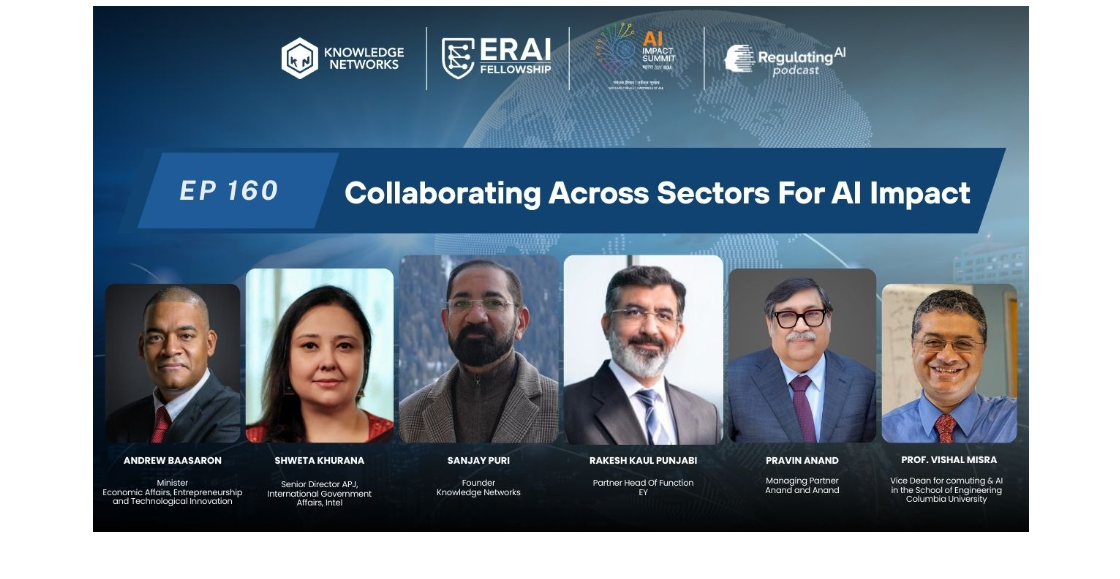
Artificial intelligence is no longer a distant concept, it is actively reshaping industries, governments, and legal systems across the world. On the “Regulating AI” podcast, host Sanjay Puri brought together experts including intellectual property lawyer Pravin Anand, Suriname’s government leader Andrew Baasaron; Rakesh Kaul Punjabi, Partner Head of Function, EY; Professor Vishal Misra, Vice Dean, School of Engineering, Columbia University; and Shweta Khurana, Sr. Director APJ – Government Partnerships & Initiatives, Global Government Affairs Group, Intel to discuss the evolving challenges around AI governance, intellectual property, leadership, and global collaboration.
One of the key insights highlighted on “Regulating AI” was that AI should not be viewed simply as another technology tool. The panel explained that AI represents a fundamental organizational transformation.
Unlike earlier technologies managed by CIOs or CTOs, AI impacts nearly every function in a company from operations and compliance to human resources and strategy. Because of this, many organizations are introducing the role of a Chief AI Officer, responsible for technology, governance, policy, and change management across departments. Panelists predicted that this role will soon become standard in major global corporations.
READ: Mehdi Jomaa on AI governance, global south voices, and the future of leadership (June 22, 2026)
Another critical topic explored was the evolving landscape of intellectual property in an AI-driven world. “The best thing about copyright is that it does not require a registration system for its protection. So the moment I draw something in a notebook sitting in this hall, immediately it receives copyright protection. Unlike patents which have to be registered, unlike trademarks which have to either be registered or used in order to receive protection, copyright gives you instant protection upon creation,” Anand explained.
This automatic protection extends to over 150 countries through international agreements like the Berne Convention. In the context of AI where creative outputs, datasets, and digital content are constantly generated, copyright plays a vital role in protecting innovation and creativity.
Data governance was another major theme discussed on the podcast. The panel emphasized the difference between raw data and structured databases.
While raw data may not always be copyrightable, databases and structured collections of information can qualify as intellectual property. Additionally, personal data is protected under privacy regulations and modern data protection laws, which are becoming increasingly important as AI systems rely heavily on large training datasets.
The discussion also highlighted the role of governments and global partnerships in shaping responsible AI adoption. Baasaron emphasized that collaboration between governments, businesses, and educational institutions is essential for long-term technological progress.
He explained, “What I’m looking at is really making sure that our people benefit in the long term… It’s not a popularity game, but with the private sector, really, that word already fell, making sure that we have a change of mind, attitude in how we go about a sustainable implementation of artificial intelligence, digital technology, and making people part of the process. It’s not an Andrew thing. It’s not a political thing, but it’s making sure that all of society, the whole nation gets on board with one vision.”
READ: ‘One must build for the differentiation’: Abhinav Johri on AI transformation beyond the hype (June 11, 2026)
Rather than focusing on short-term initiatives, policymakers should prioritize sustainable AI strategies that create lasting value for citizens and businesses.
Khurana raised concerns about what she called the “AI divide.” She explained, “I think what is more important is what really concerns us at this point in time. I’m assuming everybody here has… kind of figured out how to manage a digital divide. Today, what concerns us is the AI divide, which is something which we need to be very careful on. We don’t want AI to be in a situation where access to the right technologies (is) available only in the hands of few, that’s for sure.”
According to her, the solution lies in investing in AI education, skill development, and international cooperation to ensure broader and more equitable access to AI tools.
Ultimately, the conversation on “Regulating AI” underscored that the future of AI will not be shaped by technology alone. It will depend on governance frameworks, legal systems, global cooperation, and strong leadership.