



Editor’s note: This article is based on insights from a podcast series. The views expressed in the podcast reflect the speakers’ perspectives and do not necessarily represent those of this publication. Readers are encouraged to explore the full podcast for additional context.
Artificial intelligence is rapidly transforming the way governments, businesses, and societies operate. But as innovation accelerates, an equally important question emerges: how should the world govern AI responsibly?
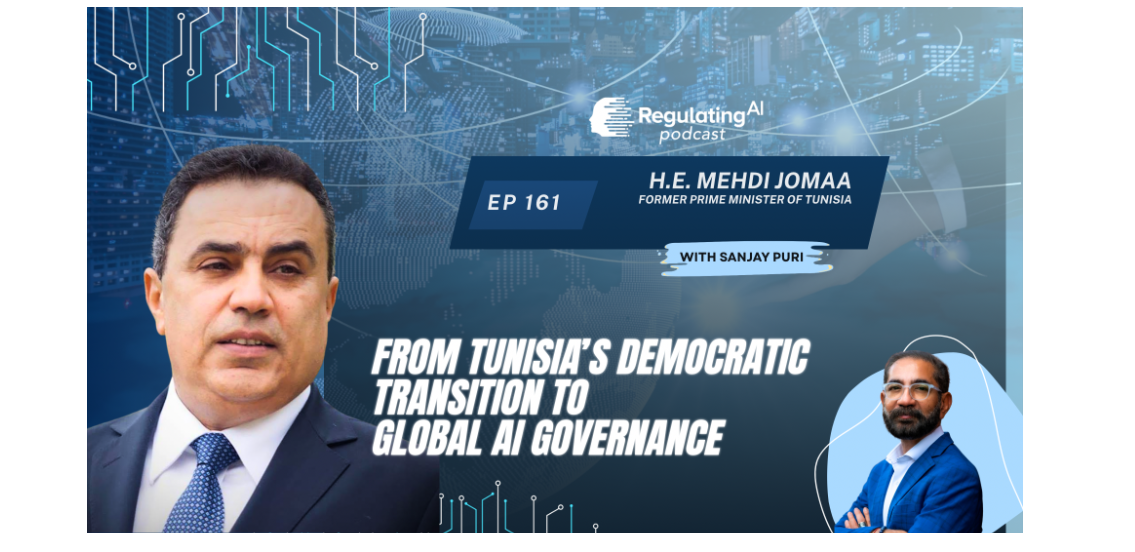
In this episode of “Regulating AI Podcast,” host Sanjay Puri is joined by Mehdi Jomaa, former Prime Minister of Tunisia, engineer, and global policy leader. Their conversation explores how governments can approach AI governance, why leadership must adapt to technological change, and why voices from the global south are essential in shaping the future of artificial intelligence.
A key theme discussed by Jomaa is that leaders do not need to be AI engineers to govern AI effectively. However, they must develop a basic understanding of how the technology works and how it impacts society.
He explains, “We don’t need them to be experts in artificial intelligence. But… you are expected to have a vision of the future, artificial intelligence is a part of the future, is a part of the policies, is the part of your decision, is the part of what you will manage socially, economically, financially, security, all of that you will have this. And is to be sure that we are doing the right job to make this leader aware and with a minimum knowledge and culture of that.”
Artificial intelligence now influences everything from financial systems and national security to healthcare, education, and public services. According to Jomaa, political and policy leaders must build technological awareness to make informed decisions about regulation, investment, and long-term national strategy.
READ: ‘One must build for the differentiation’: Abhinav Johri on AI transformation beyond the hype (June 11, 2026)
Without this understanding, governments risk falling behind the pace of innovation.
Drawing from his background in engineering and the aerospace industry, Jomaa shared an interesting comparison. Aerospace has always balanced rapid technological advancement with strict safety oversight.
This model offers an important lesson for AI governance, “in the meantime, if you take the example of aerospace, it was mandatory to have a regulation frame. So you have to push, you have to progress through innovation, but don’t forget that you have a frame because there are many issues that we have to take into account, security, the safety.”
Risk detection, auditing systems, and continuous testing can ensure that AI technologies develop responsibly while still encouraging experimentation and growth.
For policymakers, the goal should not be to restrict innovation but to guide it.
Another major question raised by Puri is whether the world needs international cooperation on AI regulation.
Unlike many traditional technologies, AI is inherently global. Systems developed in one country are quickly deployed across multiple markets and cultures.
Jomaa emphasized that this reality makes international collaboration essential. Global governance principles could help address issues such as data security, algorithmic transparency, and ethical AI deployment.
Without shared frameworks, fragmented regulations could slow innovation and create regulatory confusion.
One of the most important aspects of the conversation between Puri and Jomaa was the need to ensure that the Global South participates in shaping AI governance.
Today, most AI systems are trained primarily on Western datasets and languages. Yet regions such as Africa represent a significant portion of the global population.
Jomaa pointed out that Africa accounts for roughly 18 percent of the world’s population but only a small fraction of global data infrastructure. This imbalance risks creating AI systems that overlook local languages, cultural contexts, and regional needs.
READ: ‘AI is not a monolith’: Teradata’s Joshua Fecteau on the future of enterprise AI (June 8, 2026)
Jomaa further explains, “when you compare the population that we have in Africa, the potential we have and the reality today, I think it’s global and you cannot impose or be a contributor or take your large place or a suitable place if you don’t have the other powers. And the challenge today in Africa is that we know that the future, in the future, Africa will be a part of the future. And that’s why I’m really active to advocate the position of Africa in the global South, but globally in the global space. I think it’s possible. I think it’s possible.”
Including emerging economies in AI policy discussions is therefore not just fair, it is necessary for building inclusive and globally relevant technology.
Despite the challenges, Jomaa believes the AI revolution also presents major opportunities for developing economies.
Countries across Africa are investing in digital infrastructure, education, and technology ecosystems. By collaborating regionally and aligning policies, African nations could strengthen their role in the global AI economy.
Tunisia itself, Jomaa noted, has strong academic institutions and a growing technology sector that could position it as a regional innovation hub.
The conversation ultimately highlights a powerful message: the future of AI will depend as much on governance as it does on technology.
As AI continues to evolve, leaders must work together across countries, industries, and cultures to build systems that are innovative, responsible, and inclusive.