



Editor’s note: This article is based on insights from a podcast series. The views expressed in the podcast reflect the speakers’ perspectives and do not necessarily represent those of this publication. Readers are encouraged to explore the full podcast for additional context.
“Using AI” is not a strategy. It’s not a victory. And it’s certainly not a differentiator.
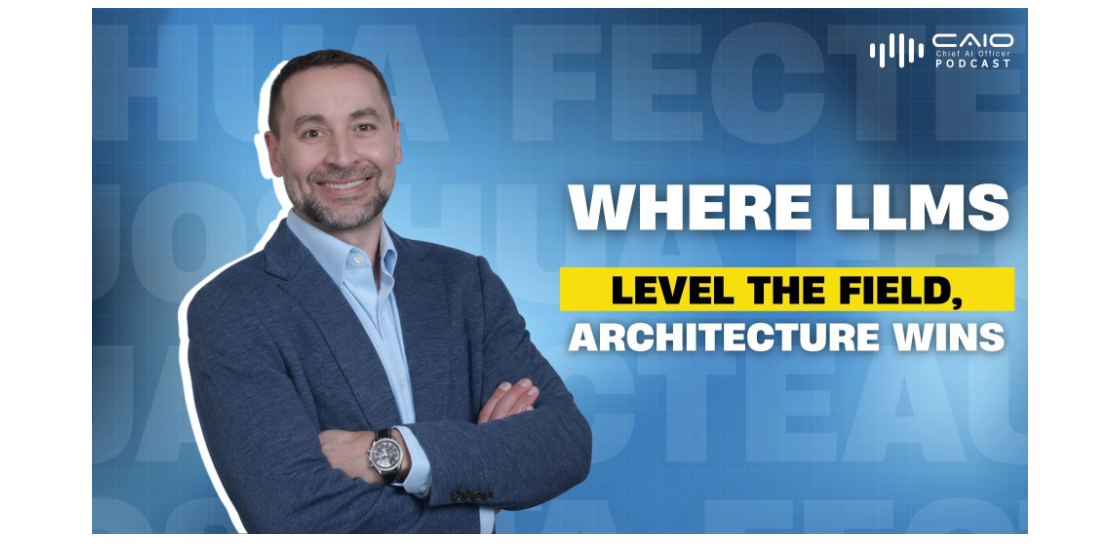
On the “CAIO Connect” podcast, host Sanjay Puri sits down with Joshua Fecteau, Chief Data & AI Officer at Teradata, to confront one of the most dangerous myths in business today: that AI is a monolithic solution you can simply switch on and win with.
It isn’t. Fecteau clarifies, “AI is certainly not a monolithic thing. It has so many different dimensions, so many different applications of utilization, and just claiming the fact that you’re using AI is not a victory. There are a million different ways to utilize AI, many of which are not actually impactful to moving the company forward.”
As Fecteau explains, AI spans everything from individual productivity tools to fully autonomous enterprise agents. It touches marketing, finance, product development, and customer engagement. But claiming “we use AI” is meaningless unless it moves the business forward.
There are a million ways to deploy AI. Many of them don’t matter.
The real danger? Chasing shiny use cases in isolation. Spinning up pilots without architectural discipline. Creating shadow AI systems that drift away from enterprise truth.
Without a foundation, AI doesn’t scale. It fractures.
Teradata’s journey reflects this evolution. What began as a pioneer in data warehousing and massive parallel processing has transformed into an autonomous AI and knowledge platform.
But the real shift isn’t technological, it’s strategic.
READ: Reframing India’s AI future: Insights from Ambica Rajagopal (June 4, 2026)
Fecteau’s background in enterprise architecture and business transformation shapes his philosophy:
AI success is about the how, not just the what. Boards don’t care about model parameters. They care about ARR, operating margin, and competitive advantage.
Which brings us to ROI.
Last year may have been the AI honeymoon period. This year? The leash is tightening.
According to Fecteau, AI ROI falls into two buckets:
- Person + AI — “in order for us to get ahead, we have to treat that as a non-discretionary thing. So while it may be difficult to measure, we’ll find ways, but you have to start with the fact that everybody needs it. You have to make it available to everybody. Otherwise you’re doing your employees a disservice.” If your employees aren’t AI-enabled, you’re not competitive.
- Enterprise AI — Deploying agentic systems tied directly to strategic objectives. “The second component is the business aspect” Fecteau explained “it’s very important to anchor your AI initiatives back to the company’s strategic objectives, imperatives, business objectives, and the strategic things you’re measuring…”
The challenge? ROI is a lagging indicator. You must show early proof points before full-scale transformation. If you can’t connect an AI initiative back to top-line growth or cost optimization, abandon it.
Bold? Yes. Necessary? Absolutely.
Models are commoditizing. Capabilities are accelerating. What separates winners from laggards is architecture.
Fecteau stresses the need to anchor AI to enterprise truth master data, semantic layers, financial definitions. Without that anchor, hallucinations multiply and decision-making erodes.
Truth isn’t optional. It’s structural.
High-risk agents require human oversight. Accountability cannot be outsourced to a model. Governance must scale with autonomy.
READ: ‘I tend to use AI openness’: Amanda Brock on why open source AI is about transparency (June 1, 2026)
And strategy? It must be refreshed every six months. If you’re not recalibrating, you’re obsolete. Fecteau said, “you won’t be able to apply the fast-moving technologies in a way that actually moves the needle for your company. So refresh your strategy… you have to be realistic, even if that means having tough conversations with the board…”
One standout example shared on the podcast was Teradata’s internal deployment of AI-powered account planning. By vectorizing contracts and unstructured documents, the team built an agentic workflow that cut sales prep time dramatically.
This “customer zero” approach forces honesty. Nothing goes to market unless it works internally. No hype. Just validation.
That’s how credibility is built.
AI is redefining enterprise architecture. It’s creating knowledge at a pace humans cannot consume. It’s changing product development cycles beyond recognition.
And the Chief Data & AI Officer role? It’s not fading.
It’s becoming essential.
The leaders who thrive will understand the nexus between business and technology. They’ll be comfortable with constant recalibration. They’ll resist sprawl while enabling innovation.
Because in two years, the companies that survive won’t be the ones that “used AI.” They’ll be the ones that wielded it intentionally, architecturally, and relentlessly aligned to truth.