



Editor’s note: This article is based on insights from a podcast series. The views expressed in the podcast reflect the speakers’ perspectives and do not necessarily represent those of this publication. Readers are encouraged to explore the full podcast for additional context.
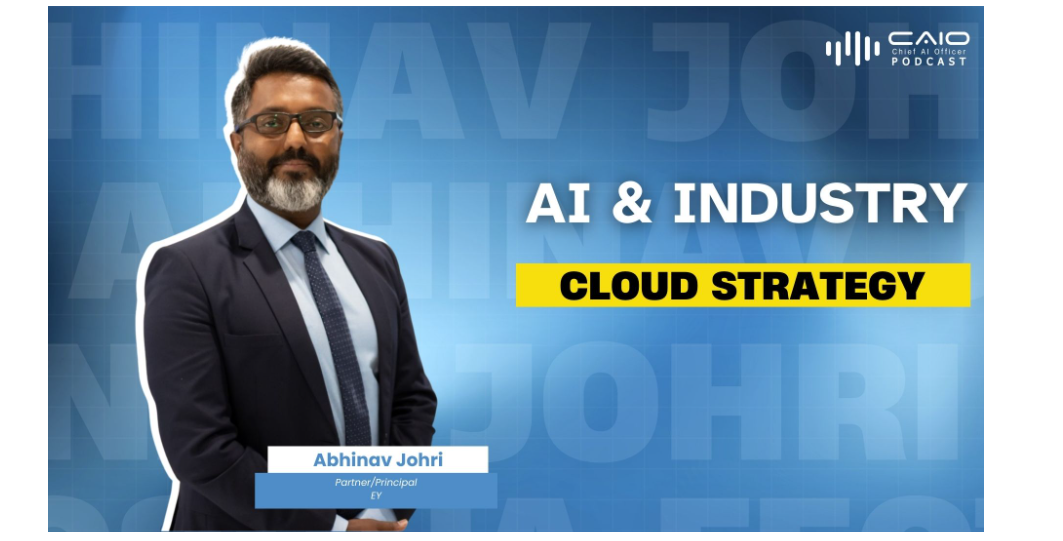
On the “CAIO Connect” podcast, host Sanjay Puri sat down with Abhinav Johri of EY at the India AI Impact Summit to discuss a pressing enterprise question: how can organizations pursue AI transformation while managing cost pressure and uncertain returns?
The conversation was less about hype and more about execution. It explored what’s changing for CIOs, why many AI initiatives stall, and how cloud, SaaS, and AI agents are reshaping enterprise strategy.
As Johri explained, today’s CIOs face a unique paradox. They are expected to keep run costs low while simultaneously investing heavily in AI, a technology whose returns are still evolving.
Boards want clarity: How much are we investing? What is the ROI? When will it materialize?
Johri said, “In today’s time… CIOs have been asked the question constantly, keep my run cost minimum. So in a role where you are constantly being scrutinized that how much you’re really investing on technology and what’s the return on the business, dealing with a topic like AI is that difficult.”
Unlike previous waves of digital transformation, AI introduces uncertainty at scale. It’s not just an infrastructure upgrade or application rollout. It challenges business models, workflows, and governance structures. For CIOs, this is both an opportunity and a career-defining test.
READ: ‘AI is not a monolith’: Teradata’s Joshua Fecteau on the future of enterprise AI (June 8, 2026)
Not all companies approach AI in the same way. Large enterprises, often backed by capital strength, can afford wide experimentation, multiple proofs of concept and aggressive deployment strategies.
Mid-cap and smaller firms, however, take a more calibrated approach. They focus on specific use cases, clearer ROI pathways, and tighter cost control. While AI may be technologically democratizing, capital still influences speed and scale.
A recurring theme in the conversation was this: most AI failures aren’t technical, they’re structural.
Many organizations deploy AI as a top layer on legacy systems. The tool looks modern, but the workflows remain unchanged. Data is siloed. Ownership sits with IT instead of the business.
Johri drew parallels to the ERP era, when companies had to rethink processes through Business Process Reengineering. AI requires a similar rethink. It’s not about installing a chatbot; it’s about redesigning how work gets done.
One of the sharper insights from the CAIO Connect Podcast discussion was that cloud must be treated as an operational enabler, not just infrastructure.
AI economics are driven by infrastructure costs, model usage, and GPU demands. Organizations must decide where to modernize foundational capabilities and where to reimagine workflows.
Hybrid models, sovereign clouds, and alternative providers are increasingly part of the cost conversation. But the larger shift is conceptual: cloud should help operationalize AI across workflows, not merely host it.
When it comes to SaaS and AI platforms, he offered a practical lens: build what differentiates you; buy what accelerates you, “we always say, one must build for the differentiation and you must buy for the speed.”
READ: Reframing India’s AI future: Insights from Ambica Rajagopal (June 4, 2026)
SaaS isn’t disappearing, but it may evolve. Traditional per-user licensing models could shift toward transaction-based or API-based pricing. As AI simplifies product engineering, the structure of enterprise software economics may change.
Johri was optimistic about AI agents, describing them as one of the most accessible ways to deploy AI. Yet she also cautioned against “agent sprawl.” Just as enterprises once struggled with application portfolio bloat, they may soon face thousands of unmanaged agents.
Governance, orchestration, and clear ownership will become essential. Without discipline, today’s agility could become tomorrow’s technical debt.
The conversation makes one thing clear: AI transformation is not about adding smarter interfaces. It is about redesigning workflows, rethinking data architecture, clarifying ownership, and managing cost intelligently.
The enterprises that treat AI as structural change rather than incremental enhancement are more likely to realize lasting value.