



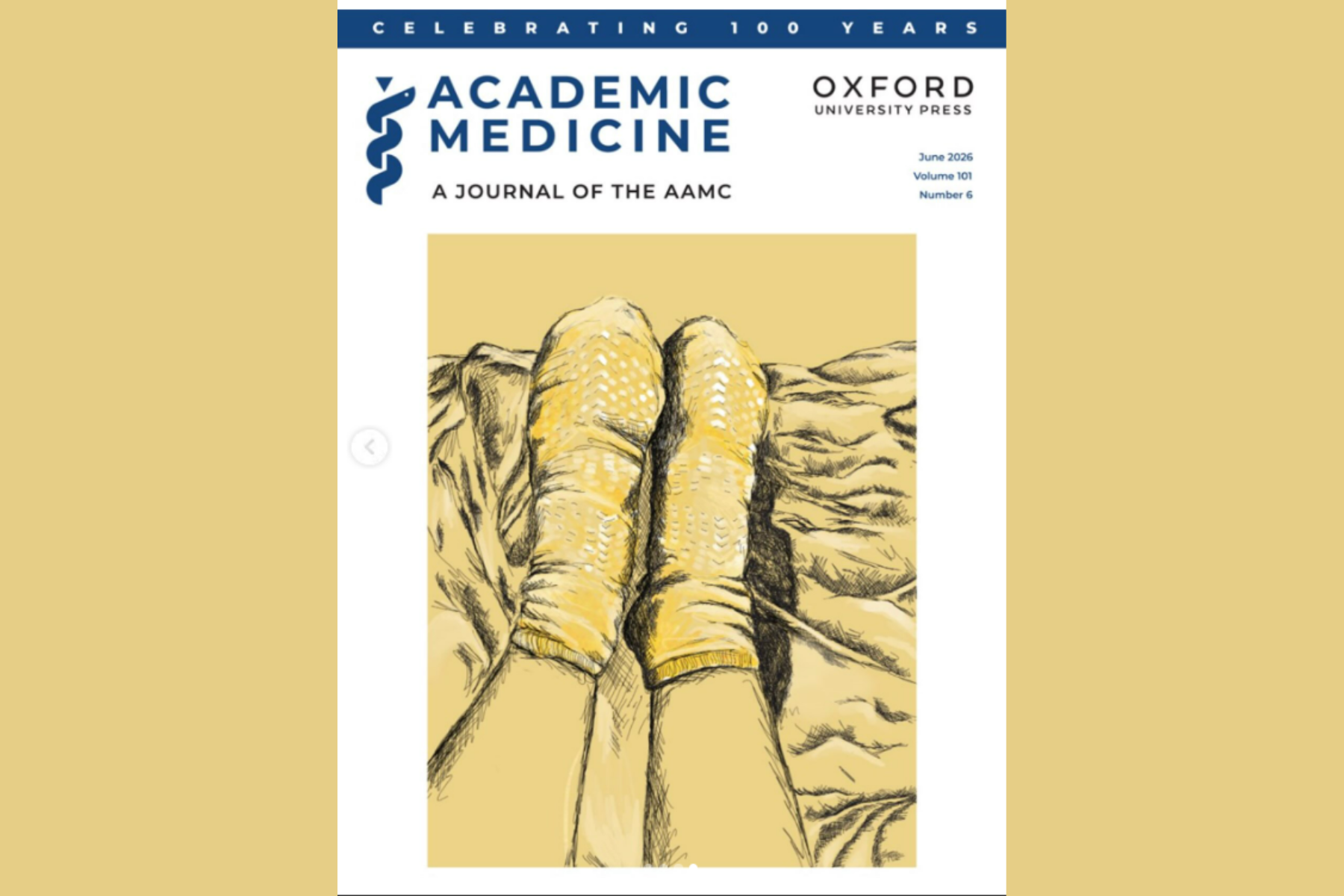
An observation during her first year of medical school left an indelible mark on Sneha Akurati which inspired her to create an artwork to convey empathy and deeper human connection.
Guided by her faculty mentor on how to navigate patient conversations with respect and curiosity, Akurati sat down with a patient to discuss her kidney transplant and noticed her bright yellow socks.
It reminded her of the warmth and kindness of the conversation she had with the patient. She reflected on the moment in her journal and later translated it into a drawing titled “Bedside.”
That initial creation reached a national stage when it was chosen as the cover art for the June 2026 issue of Academic Medicine, a publication in medical education.
Read: Three Indian Americans join Northern Virginia tech council board
By (July 13, 2026)
Raised in Chicago, Akurati is the youngest child of Indian immigrants who worked in technology. Growing up with deep roots in her family’s cultural heritage, she balanced an early interest in science with a passion for creative expression as an outlet.
Akurati pursued her undergraduate education at the University of Miami, earning a dual degree in global health studies and studio art. During her time on campus, she noted how both fields informed each other: studio art nurtured the intuitive observation needed at a patient’s bedside, while scientific rigor provided the focus and structure necessary for detailed artistic work.
Now a fourth-year medical student at the University of Miami Miller School of Medicine, Akurati continues to merge her artistic skills with her medical training.
Read: Indian American high school graduate from Florida sets historic grade point average record (July 16, 2026)
During her second year, she was elected president of Medical Humanities and served as editor-in-chief of Obliterants, leading an initiative to revive the student-and-faculty journal after a four-year hiatus.
Daily journaling and visual art remain central to how she processes the emotional realities of clinical rotations, particularly when engaging with patients through moments of vulnerability.
Alongside her medical studies and art, teaching has been a consistent thread in Akurati’s background. She previously taught neighborhood art classes in high school, tutored undergraduate biology and chemistry, and worked as an MCAT instructor.
Currently enrolled in a medical education elective, Akurati is applying to internal medicine residency programs with plans to incorporate academic teaching into her future career as a physician.