



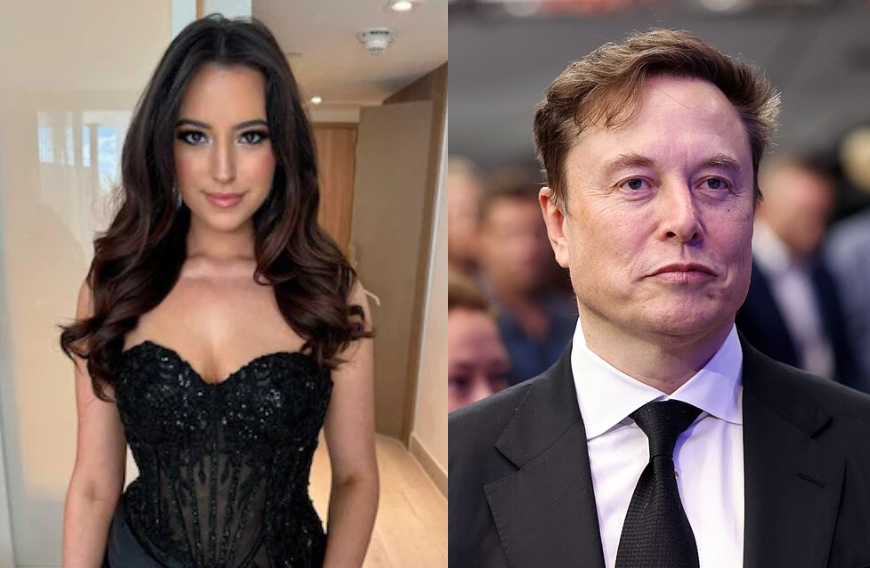
Ashley St. Clair says she walked away from a reported $40 million payout because she did not want money to silence her.
The 28-year-old mother of one of Elon Musk’s children said she rejected an alleged $40 million non-disclosure agreement offered after the birth of their son last year. Instead, she agreed to speak on camera for Oscar-winning filmmaker Alex Gibney’s new documentary “Musk,” giving the film a firsthand account of her relationship with the billionaire.
St. Clair discussed the decision Tuesday at the Venice Film Festival, where “Musk” premiered. She said the offer came through Musk’s wealth manager and forced her to confront a difficult question: What is the value of staying silent?
“When you are offered something like that, it creates a debate about what your speech means and how valuable that is,” St. Clair said. “Why do they want to offer me this amount of money to not speak?”
For St. Clair, the answer was bigger than the money. She said she wanted her children to see that financial comfort should never come at the expense of telling the truth.
READ: Elon Musk says Grok can earn users money (August 20, 2026)
“I wanted to set the example for my kids that we should never take being materially comfortable over speaking the truth,” she said.
St. Clair has previously said Musk provided about $2.5 million in financial support. Her relationship with Musk and the birth of their child have drawn widespread attention, making her one of the more closely watched voices featured in Gibney’s documentary.
But St. Clair’s appearance in “Musk” is not only about her relationship with the billionaire. She also used the Venice press conference to reflect on her own political past.
St. Clair previously built a following as a right-wing political commentator and promoted conservative and anti-trans views. She now says she regrets some of those positions and attributes them partly to her age and the people who influenced her at the time.
“I got involved with Republican politics when I was 18 after I met Charlie Kirk, and there was an air of ignorance,” she said. “But that ignorance does not excuse any role in that.”
St. Clair said she hopes speaking publicly now can help counter some of the views she once promoted.
“I hope the risk that I’m taking now in speaking out and trying to fight back at least helps a little bit,” she said.
Gibney’s film takes a much wider look at Musk, examining the billionaire’s enormous influence across technology, business and politics. The filmmaker, whose previous work includes “Enron: The Smartest Guys in the Room,” “Going Clear and Agents of Chaos,” began developing the documentary in 2023.
What started as a film about Musk’s business empire eventually became something much bigger as his role in American politics expanded, particularly through his relationship with Donald Trump.
Gibney said he initially expected to make a shorter documentary, but Musk’s growing influence kept expanding the scope of the project. The final film runs for nearly four hours.
One of the biggest hurdles, Gibney said, was getting people to talk.
“There was a tremendous sense of fear of talking,” he said, referring to conversations with Musk’s critics, colleagues and friends. “Many declined to speak.”
READ: Elon Musk says curing diseases is now a software problem (August 20, 2026)
Musk himself was approached for an interview but declined to participate. He has previously dismissed the documentary as a “hit piece.”
The film examines Musk’s rise through companies such as Tesla and SpaceX, his acquisition and rebranding of Twitter as X, and his newer ventures including xAI and its chatbot Grok.
Gibney does not present Musk simply as a technology visionary. The documentary takes a critical look at the billionaire’s public image and the gap between his reputation as an innovator and the influence he now wields over politics, technology and public discourse.
At the Venice press conference, Gibney went even further, calling Musk a “very dangerous” man and questioning his ability to empathize with others.
“I would say he has a very difficult time with empathy, especially cognitive empathy, which is putting himself in the shoes of others,” Gibney said. “He seems incapable of doing that.”
St. Clair agreed, arguing that Musk’s lack of empathy is not simply an inability to understand others.
“He makes a conscious choice to not put himself in other people’s shoes,” she said. “It is a deliberate rejection of empathy.”
“Musk” premiered at the Venice Film Festival Tuesday and is expected to hit U.S. theaters in October.