



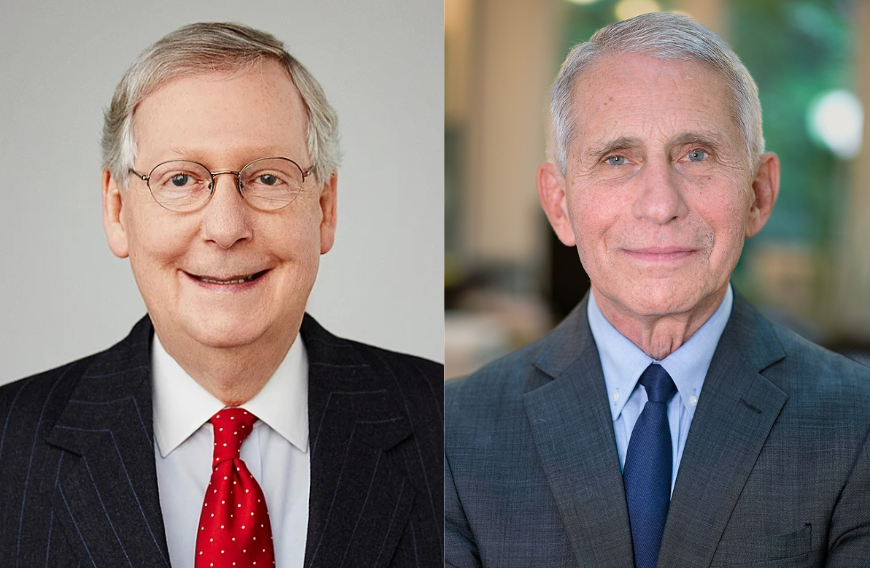
The recent silence by people like Dr. Anthony Fauci and Mitch McConnell is cause for alarm. In both cases we have people in positions of leadership who have been entrusted with responsibility to the public. And when asked about questions related to health — whether it’s their own or public — their refusal to respond is an issue we should be concerned about. When individuals accept positions of enormous public responsibility, does their obligation to transparency outweigh their desire for privacy?
Dr. Fauci became one of the most visible figures in America during the COVID-19 pandemic, advising the public during one of the most consequential health crises in modern history. Fauci’s decision today to invoke the Fifth Amendment during congressional questioning illustrates the growing crisis of public trust facing American institutions. The constitutional right to avoid self-incrimination is fundamental, but when individuals have occupied positions of extraordinary public responsibility, the public is left asking whether legal protections have become a substitute for the transparency necessary to maintain confidence in leadership. The public deserves to know what really happened with the COVID-19 crisis.
Regardless of one’s views on pandemic policies, many Americans continue to believe that unanswered questions surrounding decision-making, scientific communication, and government oversight deserve a complete and transparent accounting. Public confidence in science and public health depends not only on expertise but also on the willingness of leaders to openly address difficult questions.
READ: Sreedhar Potarazu | Indians may be more connected. But are we connecting ? (August 2, 2026)
Similarly, Sen. McConnell’s extended absence has raised legitimate questions about the health and capacity of one of the most powerful figures in the United States Senate. The issue was not whether Sen. McConnell has a right to medical privacy. Every individual deserves compassion and dignity when facing health challenges. The issue is whether the public has sufficient information to understand whether a person entrusted with significant national responsibilities remains capable of carrying out those duties.
The debate surrounding President Joe Biden’s health and cognitive abilities raised perhaps the most significant recent question about transparency in American leadership. For months, concerns expressed by voters, journalists, and political observers about his age and ability to perform the demanding responsibilities of the presidency were often dismissed or minimized by members of his inner circle. After his widely scrutinized debate performance in 2024, many Americans questioned whether they had been provided a complete and accurate picture of the president’s condition before that moment. The issue was not whether President Biden was entitled to dignity, compassion, or personal privacy regarding the natural process of aging. The issue was whether those closest to him had an obligation to provide a more transparent assessment of his ability to carry out the most consequential leadership role in the world. When a small group of advisers becomes the gatekeeper of information about a leader’s capacity, it creates a dangerous separation between the person exercising power and the public that entrusted them with that power.
The same principle applies across all sectors of society. Leadership creates obligations that are different from ordinary citizenship. Kentucky Governor Andy Beshear’s call for greater transparency reflects a growing recognition that public trust cannot be rebuilt through carefully managed messages and limited disclosures; it requires leaders to provide the public with the information necessary to understand the decisions being made in their name.
No passenger boarding a commercial aircraft would accept being told that a pilot who had experienced repeated medical events was entitled to complete privacy and that the airline had no obligation to disclose whether the pilot could safely operate the aircraft. We recognize that certain responsibilities require transparency because other people’s lives depend on the decisions being made. The same principle applies to physicians, military commanders, corporate executives, and elected officials.
READ: Sreedhar Potarazu | AI is burning through free cash flow (July 25, 2026)
Physicians understand this responsibility well. Doctors are expected to disclose conditions that may impair their ability to safely care for patients. Hospitals have credentialing processes designed to ensure that those entrusted with patient lives remain capable of performing their duties.
Transparency in these situations is not viewed as punishment. It is viewed as an ethical obligation.
Yet, in many areas of public life, transparency has increasingly become viewed as a burden rather than a responsibility. Leaders often invoke privacy, legal protections, or institutional processes as reasons why the public cannot receive straightforward answers. While legitimate privacy rights must always be respected, privacy cannot become a shield that prevents accountability when public responsibilities are affected.
America’s leadership crisis is not simply about any one individual or political party. It is about a culture in which silence has too often been mistaken for discretion and secrecy has been confused with leadership. The people who hold positions of power do not surrender their humanity when they accept responsibility, but they do accept a higher obligation to explain, disclose, and be accountable.
Transparency is not a weapon used against leaders. It is the foundation upon which legitimate leadership is built. When millions of people place their trust in an individual, that trust requires more than authority. It requires honesty.