



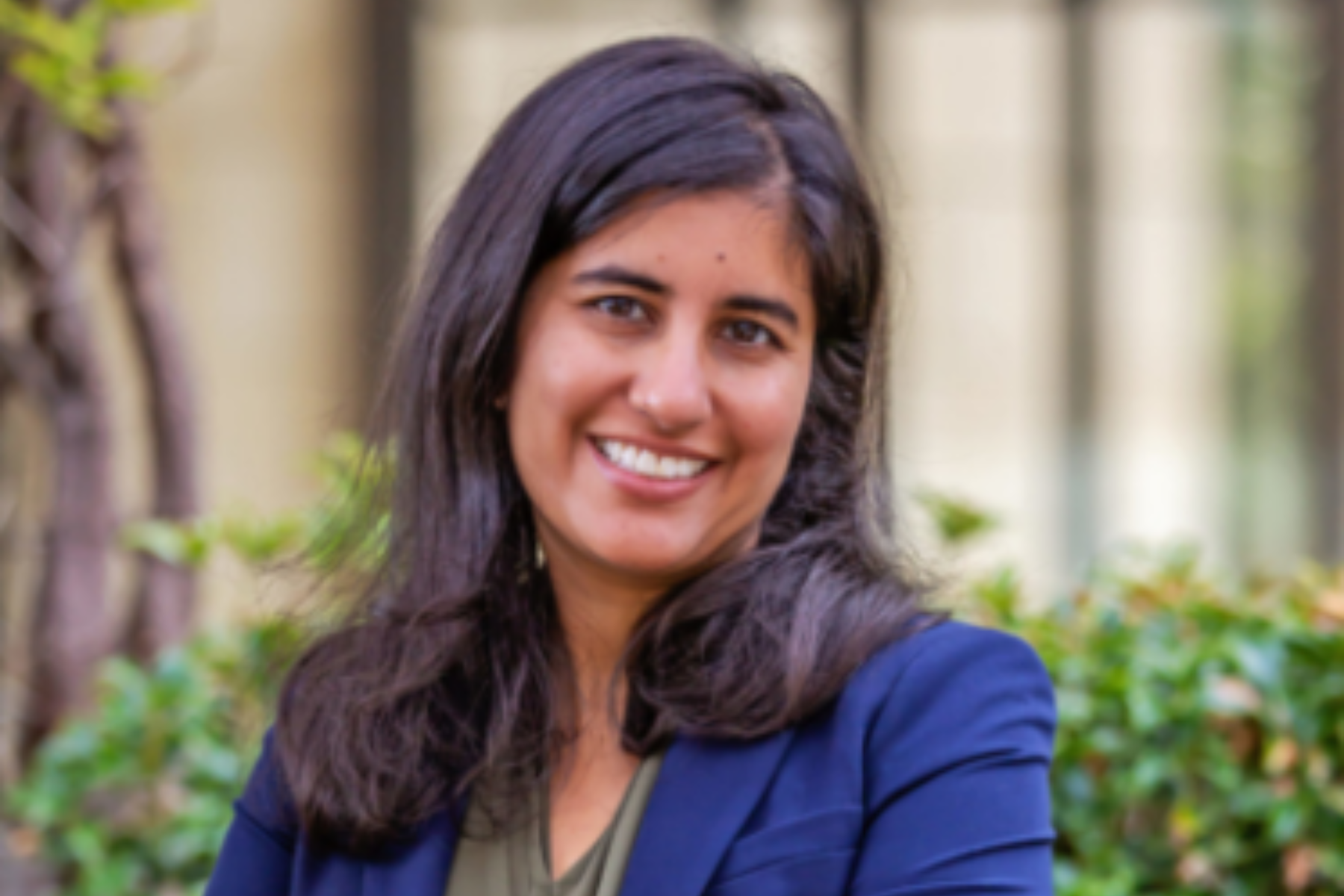
Stanford Law School Assistant Professor Easha Anand has been elected to the American Law Institute, joining a select group of legal scholars, judges, and practitioners dedicated to clarifying and modernizing U.S. law.
Anand, who serves as co-director of Stanford’s Supreme Court Litigation Clinic, now joins 27 current and emeritus Stanford Law faculty members in contributing to the century-old institution. The American Law Institute produces Restatements of the Law, Model Codes, and legal principles that are widely cited across federal and state court systems.
In her work at Stanford, Anand focuses on civil rights, appellate practice, and prisoners’ rights. She represents workers, noncitizens, consumers, and criminal defendants before the U.S. Supreme Court. Her recent clinic advocacy includes securing victories for a truck driver deceived into buying a federally controlled substance, a jeweler falsely jailed due to fabricated evidence, and a whistleblower fired after reporting corporate securities law violations.
Read: Stanford’s Saumitra Jha among Falling Walls 2026 finalists (August 7, 2026)
“ALI has played an extraordinary role in shaping American law by bringing together judges, practitioners, and scholars to work through difficult legal questions with rigor and care,” Anand said, reflecting on her election to the organization.
Anand’s legal path is grounded in a strong academic foundation and a deep connection to her Indian heritage. She grew up partly in India and partly in suburban Washington.
Anand earned a Bachelor of Arts in Mathematics and Philosophy from Yale University and went on to receive her Juris Doctor from the University of California, Berkeley, School of Law in 2014. She worked as a journalist, including a reporting stint at The Wall Street Journal before embarking on her legal career.
Read: Indian American high school graduate from Florida sets historic grade point average record
(July 16, 2026)
Following law school, Anand clerked for Judge Paul J. Watford of the U.S. Court of Appeals for the Ninth Circuit and Associate Justice Sonia Sotomayor on the U.S. Supreme Court.
Prior to joining the Stanford faculty in 2023, she served as Supreme Court and appellate counsel at the MacArthur Justice Center, handling cases involving police excessive force, prison conditions, and habeas corpus defense.
ALI President Wallace B. Jefferson welcomed the incoming class of members, emphasizing that the institute’s work relies on bringing fresh perspectives to ongoing legal reform efforts.
Anand’s election reflects both her contributions to Supreme Court advocacy and the growing presence of Indian American legal scholars shaping American jurisprudence.