



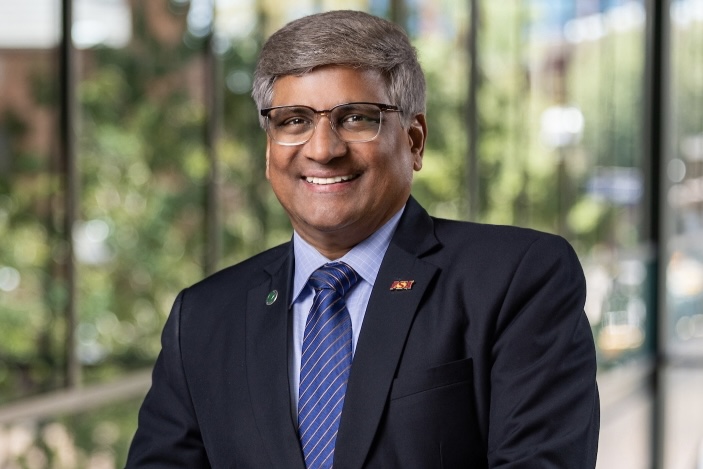
National Academy of Engineering has honored Sethuraman Panchanathan, University Professor of Technology and Innovation at Arizona State University and former director of the National Science Foundation (NSF), with the 2026 Arthur M. Bueche Award.
Panchanathan is the first Indian American to receive the prestigious award in its more than 40-year history. It honors an engineer who has had “active involvement in determining U.S. science and technology policy, promoting technological development, and contributing to the enhancement of the relationship between industries, government and universities.”
The award cites Panchanathan “for leadership in promoting fundamental science, technology and policy that advances translational research and expands opportunities nationwide.”
“Panch is one of the most remarkable systems thinkers we have in this country,” ASU President Michael M. Crow said. “This award is a national recognition of what we have known here at ASU for some time, which is that when big problems need to be solved, Panch needs to be in the room.”
Read: RFU names Narayanan Parameswaran executive VP for research (September 1, 2026)
“Awards like this are never only about the individual. They are about the scores of people that have contributed to the outcomes recognized,” said Panchanathan thanking “my family, teachers and mentors” for his inspiration.
The Bueche Award will be presented in October at the National Academy of Engineering’s annual meeting in Washington, D.C., according to ASU News.
As the 15th director of the National Science Foundation, Panchanathan’s term spanned COVID-19 and the race for a vaccine, and included the creation of the first new directorate in more than 30 years. That directorate works to accelerate the translation of science and technology for economic progress, national security and societal impact in local and regional hubs throughout the country.
Before his appointment to the NSF, Panchanathan led ASU’s research portfolio as the head of Knowledge Enterprise and served as the university’s chief research and innovation officer.
Now back at ASU, Panchanathan focuses his work on artificial intelligence, quantum computing and the future of higher education. In April, he was appointed by Phoenix Mayor Kate Gallego to lead the city’s quantum strategy.
He is also developing a vision for higher education in an age of artificial intelligence that will stress cultivating students’ mindsets and forging closer partnerships between universities and industries in high-tech fields, according to ASU News.
Read: Suresh Naidu wins IGP grant for research on global challenges (September 1, 2026)
Panchanathan was elected to the National Academy of Engineering, one of the highest honors for an American engineer, in 2024.
Recalling a key moment that would shape Panchanathan’s life, ASU News related the inspiring story of an 8-year-old boy standing in line outside the American Center in Chennai, India, back in 1969.
Panchanathan was with his father and hundreds of others who had come to see something truly remarkable in the history of human achievement: moon rocks from the Apollo 11 mission.
As he approached the gray pebbles shielded under glass, he was struck, even at a young age, not by what he saw directly in front of him, but by what the rocks represented.
“The rocks were just rocks,” Panchanathan recalled. “But what fascinated me was all the human ingenuity and scientific prowess that went into bringing them here.”
He has since spent his career studying and building the modern structures of engineering and science that have advanced knowledge and benefited humanity — just like the ones that allowed for the success of the moon missions.