



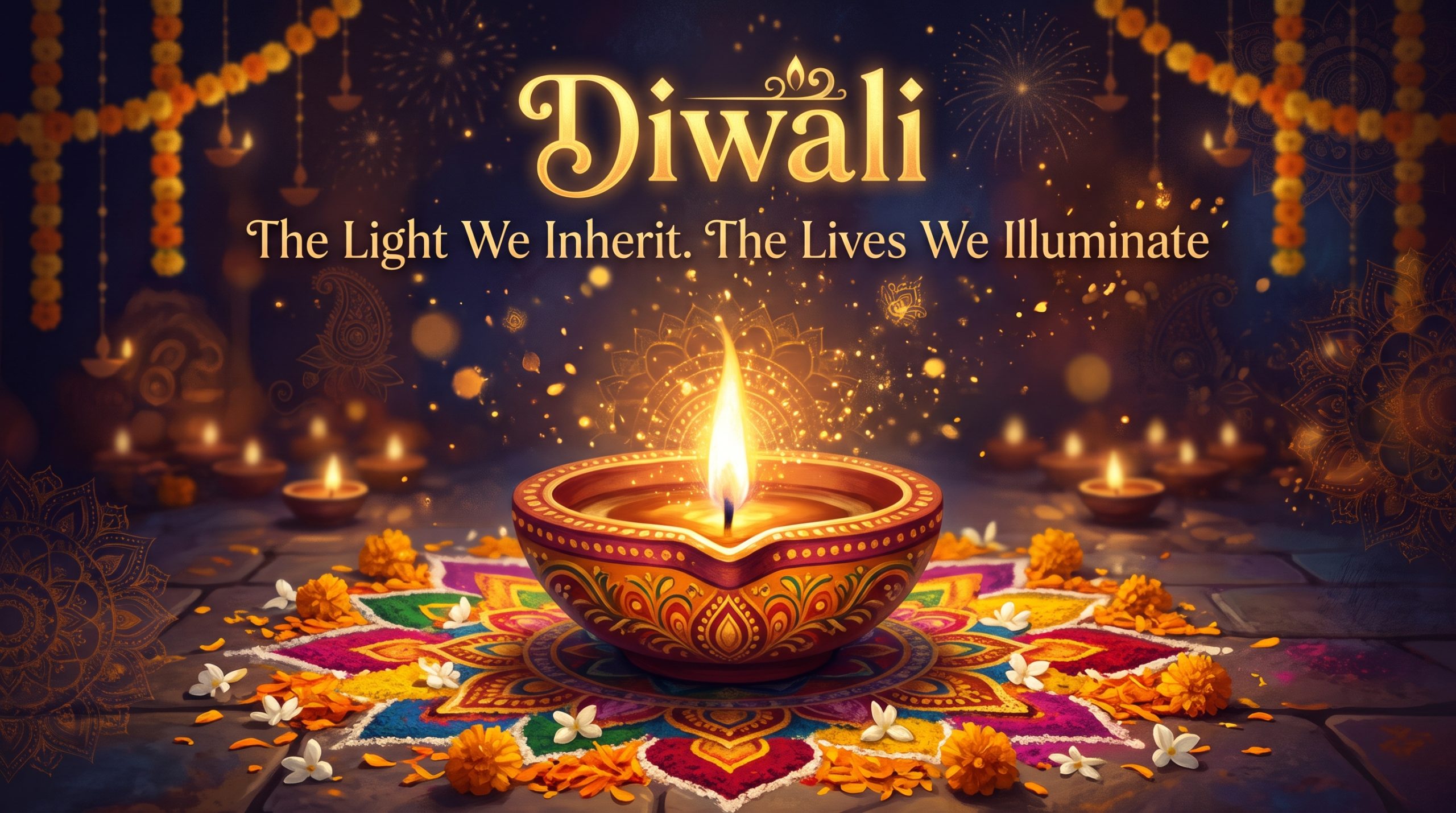
Diwali ,the festival of lights, is a celebration of the triumph of light over darkness, knowledge over ignorance, and good over evil. On this day millions of people across the world illuminate their homes with lamps, candles and diyas, each carrying symbolism of something more than light.The deeper significance of Diwali is not the light we kindle for ourselves, but the light we give to others over a lifetime . And nowhere does that responsibility become more meaningful than in the journey of parenthood.
Our relationship with light begins before we are even capable of understanding what it means. We are born into darkness, sheltered from the outside world, and our first encounter with light is almost blinding. The transition from the darkness of the womb to the brightness of the world is overwhelming. But our parents are there to comfort us, to hold us, and to gradually introduce us to the sensory experience of seeing. They become our first source of reassurance in a world that is suddenly filled with unfamiliar sights, sounds and sensations. Before we can recognize light, we learn to trust the people who help us experience it and they show us us the light to navigate the new world in front of us.
As we grow older, the light our parents provide begins to take a different form from illuminating our path to the knowledge they impart, the values they teach and the experiences they share. Much of what they give us is not entirely their own. It is a torch that was handed down to them by their parents, carrying generations of lessons, traditions, mistakes and wisdom. They become the custodians of a light that existed long before them, with the responsibility of ensuring that it continues to burn as it is passed down generations.
In those formative years, parents do everything they can to protect that flame from extinguishing. They fuel it with their time, their sacrifices, their experiences and, often, more of themselves than their children will ever realize. They try to shield the wick from the winds of uncertainty, hoping it will not blow out before their children learn how to protect it themselves. Sometimes they illuminate the path too brightly, believing that more guidance is always better. Sometimes they hold the torch so close that their children cannot see beyond its reach. But the intention is almost always the same: to make sure their children are never left in darkness.
READ: Sreedhar Potarazu | The Ramayana: We celebrate the spectacle, but have we forgotten the lessons (October 31, 2026)
There is something remarkable about how this responsibility changes over time. When children are young, parents are the primary source of light. They illuminate almost every corner of their world, helping them distinguish right from wrong, opportunity from risk and possibility from fear. As children grow, however, the need for that external illumination gradually diminishes. They begin to see for themselves. They develop their own judgment, discover their own convictions and learn from experiences that no parent can anticipate or prevent. This is the beginning of our own enlightenment from the light that was given to us .
The role of a parent resembles that of a log that has been used to start a fire. Initially, the log provides the fuel needed to ignite the flame. Over time, the fire sustains itself. The parent no longer needs to keep adding fuel or directing every movement of the flame. The child has acquired the ability to generate light independently. This is perhaps one of the most difficult transitions in parenthood: recognizing that the very success of our efforts means that our children need less of the light we once provided so abundantly.
But this does not mean that our responsibility to give light comes to an end. It evolves
As our children become adults, the light we offer is less about telling them where to go and more about helping them understand how to navigate the darkness when they encounter it. We move from being the source of illumination to becoming a lighthouse. A lighthouse does not follow ships, dictate their direction or attempt to control the waters they must navigate. It stands firm, offering a point of reference when the surroundings become uncertain. Its light does not eliminate the storms or prevent the waves from rising. It simply reminds those at sea that there is a way to find their bearings.
That may be the most important wisdom parents can eventually pass on. Not the answers to every question, but the ability to find answers when we are no longer there to provide them. Not the expectation that our children will follow the paths we chose, but the confidence that they can find their own from their own luminosity . And not the belief that life can be lived without darkness, but the understanding that darkness is an inevitable part of the human experience and that we must learn how to carry our own light through it.
There is also a larger realization embedded in this journey. The light we give is never entirely ours. We inherit it, nurture it, sometimes struggle to keep it alive, and eventually pass it on. Our parents gave us the light they received from their parents. We have tried to give our children the light we received, enriched by our own experiences and the lessons of our lives. Our children will, in turn, carry that light forward, adding their own understanding to what they inherit. Each generation becomes both the beneficiary and the custodian of something that must never be allowed to disappear just as Olympians carry the torch of the original flame.
Perhaps this is why the diya is such a powerful symbol of Diwali. Its light is sustained by a wick and oil, but its purpose is not to illuminate itself. It gives light to everything around it. And in doing so, it gradually consumes the very fuel that sustains it. There is a beautiful parallel to parenthood in that image. Parents give of themselves so that their children can see more clearly, walk more confidently and eventually illuminate the lives of others. The measure of that light is not how long the diya burns, but what it makes possible while it does.
READ: Sreedhar Potarazu | Valmiki: The sage who teaches us that we are not defined by our past (October 27, 2026)
Our lives, in many ways, are a journey from darkness to darkness. We begin in the darkness of the womb, enter the world through the light of others, spend our lives learning to create and share our own light, and eventually return to a darkness beyond our understanding. What gives meaning to the journey is not how much light we accumulate for ourselves, but how much we leave behind for others.
That is the deeper victory of Diwali. It is not simply the defeat of darkness on a particular night, nor is it the temporary brightness of lamps that illuminate our homes. It is the recognition that darkness will always exist, but so will our capacity to confront it through knowledge, compassion, wisdom and the light we share with one another.
As parents, we may begin by holding the lamp for our children. Eventually, we must trust them to carry it themselves. And if we have done our job well, one day we will look back and see that the light we once protected in their hands is now illuminating the path for someone else.
Perhaps the greatest celebration of Diwali is not the light we see around us, but the light we have given to others that continues to burn long after we are gone.
Happy Diwali.