



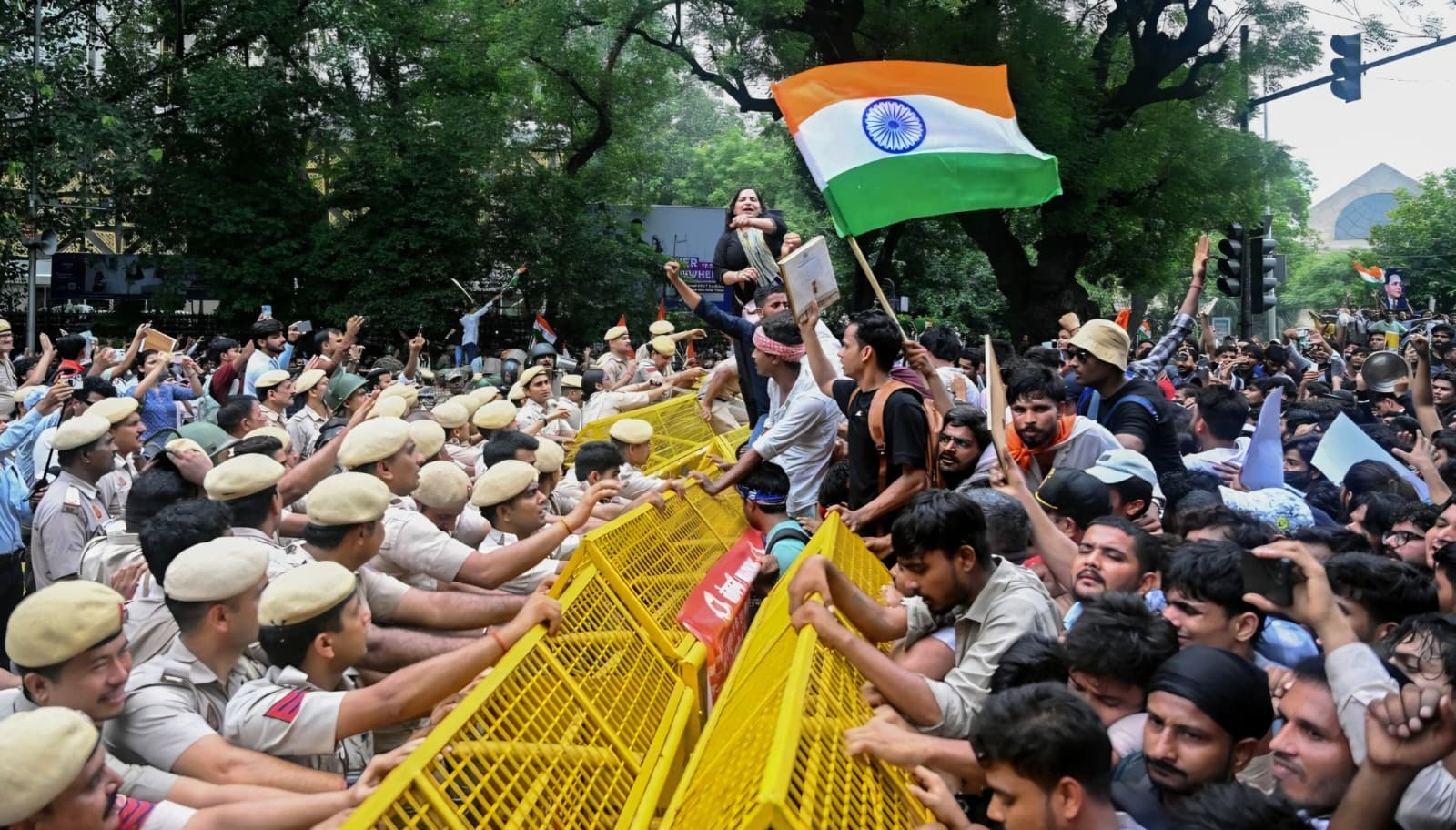
Student movements rarely emerge from abstraction. They ignite when a direct wound is felt, when a high ideal summons collective imagination, or when political actors intervene at a moment of vulnerability.
India’s present unrest began with all three. Cancellations of NEET and other examinations, allegations of corruption, and the sudden collapse of trust in the ladder that promised mobility produced an acute generational injury.
Into that confusion stepped Sonam Wangchuk. His moral authority reached students who had lost faith in every institution.
The intervention mattered. He was not Jayaprakash Narayan. JP had decades of organisational experience, a capacity for mass mobilisation, and a political imagination that could turn moral force into a national movement.

Wangchuk’s appeal was ethical, not strategic. The anger was already primed by structural failure.
The landscape in which that anger gathered was shaped by two Indian strongmen: Narendra Modi and Amit Shah. Their partnership produced a single deformation of the republic with three instruments. Modi built a political machine so tightly aligned with personal ambition that the party beneath him became an extension of his will. Shah consolidated the party-state and the federal coercive stack, converting dissent into file and fear.
Around them the regime turned education into ideological catechism and weakened the autonomy of universities, councils, and exam bodies. Machine in the party, coercion in the state, catechism in the classroom — three strands of one deformation.
The strands require one another. Catechism thins the habit of asking why, and a public that has stopped asking is easier to organise as a machine. A machine that reduces citizenship to loyalty must then coerce the questions that inquiry would still produce. Coercion, to last, needs a classroom that prefers obedience to doubt. This is not a conspiracy in a room. It is a logic. Once one strand takes hold, the others follow.
The revolt did not arrive in isolation. Governments in Sri Lanka, Bangladesh, and Nepal had just fallen with startling speed. India’s establishment watched.
Unemployment, on CMIE figures, fluctuated between 7 and 8 percent through 2025–26; household consumption diverged from official GDP projections. Into that divergence NEET struck the last reservoir of trust: the belief that hard work could still carve a path. Even when two in two hundred succeeded, the exam retained legitimacy because it appeared fair.
READ: Satish Jha | The AI divide: How America compounds leverage while India risks cognitive atrophy (
NEET shattered the appearance. Corruption did not merely distort outcomes. It destroyed meaning. When the ladder is rigged, those climbing it are not rising. They are being played.
The old bargain that made the ladder believable was thinner than the republic’s official story. From 1947 to 1991 the state spoke the language of scientific temper and merit while practising patronage, exclusion, and, in one long season, Emergency. The ladder was real enough to organise hope, and stained enough that hope was never innocent.
After 1991 the bargain changed and still held: markets would generate growth, coalition politics would slow overreach, exams would remain the visible stair. The structure was unequal. It was legible.
After 2014 the three instruments worked on the bargain at once. If exams can be rigged, effort loses meaning. If universities become instruments of ideology, inquiry becomes dangerous. If the civil service serves a leader rather than a constitution, legitimacy thins to ceremony.
When the Chief Justice referred to unemployed youth as “cockroaches,” a sharp digital joke turned humiliation into solidarity and solidarity into movement. Humor became resistance; resistance became identity. In that moment the country remembered something older than the republic and simpler than its laws: that a person has inherent worth the state does not grant and cannot revoke, and that effort has moral standing only when the test is real. The students were not drafting a treatise. They were refusing a category.
As the unrest widened, the government’s response showed inner disarray. A police complaint against an opposition leader for political speech signalled bewilderment rather than confidence. Modi and Shah were largely absent from sustained public engagement, apart from a brief address on 1 August.
Limited visibility was not tactics. It was paralysis. Modi collected symbolic awards from small nations; Shah seemed to mislay the strategic clarity that once defined him. A state built on spectacle and coercion has a grammar of command. It does not have a grammar of persuasion. When command fails, what remains is silence.
For twelve years the balance between hope and achievement, politics and economics, institutions and public trust eroded. The old equilibrium rested on a simple, imperfect bargain: exams as ladder, coalitions as drag on overreach, a residue of higher-order values in public speech. That equilibrium, not justice itself, held India through the post-liberalisation decades. Its breakdown is the end of an era.
READ: Satish Jha | When the cure becomes the disease (
Once equilibrium breaks, events accelerate. The student revolt is not an episode; it is a signal. The institutional collapse is not a malfunction; it is a verdict. The bewildered state is not a pause; it is an ending.
Reconstruction will take twenty years of institutional redesign and civic renewal. The principle is simple: the state is steward of the conditions in which dignity, meaning, and inquiry can exist — not director of what citizens must think, believe, or become. A steward builds rooms. A director writes the script. The rooms are five.
Exam integrity is not software. It is a public proof that the ladder still exists. Every paper, every answer sheet, every mark must leave a trail that a third party can reconstruct after the fact — who set the question, who printed it, who sat it, who scored it, where the file moved.
When that trail is ordinary rather than exceptional, corruption ceases to be a rumour and becomes a crime with a path. Technology here is salt, not the meal: it seasons a system that already believes effort counts.
Merit architecture is the opposite of a single national bottleneck. A republic that sorts two crore young people through one gate will always be one leak away from meaninglessness. Merit has to be made visible at more than one altitude: school-leaving evidence that cannot be purchased, district-level assessment that a local public can see, professional entry that tests judgment rather than recall.
The point is not to multiply exams. It is to make the relationship between work and outcome legible again. When a student can point to what was asked and how it was judged, effort recovers moral standing. When no one can, the climbers are being played.
Civic education fails when it is a chapter on duties. It works only when the classroom is a practice of inquiry. That requires a different object of assessment: not the approved answer, but the quality of the question, the handling of evidence, the willingness to revise. History taught as source and counter-source; science taught as method before conclusion; literature taught as contested meaning. A teacher who cannot do this cannot be ordered to. Teacher knowledge is infrastructure. Without it, “inquiry” is a slogan printed on a syllabus the catechism will outlive.
Judicial independence is not a temperament. It is an appointment rule that does not run through the men the court must later restrain. A commission whose majority is not the executive; published criteria; recorded reasons; a tenure long enough that a judge is not auditioning for the next favour. Anything less leaves the Constitution as a text that the machine can staff.
Economic design is the plank the essay cannot fake with audit trails. Official growth that diverges from household consumption is not a rounding error; it is a broken correspondence between the nation’s story and the nation’s life. Alignment means the state measures what households can feel — work, wages, participation — and treats those as the constraint on the projection, not the other way round. Dignity here is not a lecture. It is whether labour remains a path or becomes a residue.
These are administrative tasks. They are also moral ones. They do not restore a golden equilibrium. They rebuild the only thing the old bargain actually delivered: a public reason to believe that effort still had somewhere to go.
India stands at a threshold. The strongmen have exhausted their myths. The institutions have exhausted their legitimacy. The youth have exhausted their patience. The equilibrium has broken. What remains is the possibility of renewal — not through nostalgia, not through ideology, but through a new architecture of trust, merit, dignity, and meaning.
This is the work of a generation. This is the work of a republic reclaiming itself. This is the work of India’s next twenty years.