



By Satish Jha
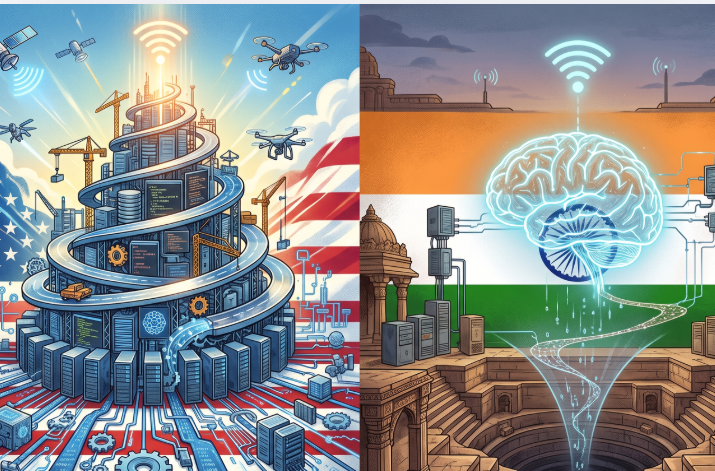
The most consequential divide created by artificial intelligence may not be between those who possess the technology and those who do not. It may be between societies that use AI to enlarge human capability and those that use it to avoid developing that capability in the first place.

This distinction is easy to miss because the same software appears on both sides of it. An engineer in Boston and a programmer in Bengaluru may use the same model to write code, analyse data or prepare a presentation. Both may report dramatic gains in productivity. Yet beneath that superficial similarity, two very different economic futures may be quietly assembling themselves.
In one, artificial intelligence is placed in the hands of people and institutions that already possess deep knowledge, control the architecture of the problem and own the resulting product. AI becomes a multiplier of judgment. The accomplished mind touches the lever and moves mountains.
In the other, it is introduced into a system built around inexpensive execution, standardised processes and billable human effort. There, AI does not merely make existing work faster. It begins to remove the elementary tasks through which workers once learned the true cost of difficulty, the hidden logic of failure, the patient accumulation of why things work the way they do.
The first system compounds intelligence. The second consumes its own apprenticeship ladder, burning the bridge that once connected execution to mastery.
This is the emerging danger for India.
The United States is hardly immune to intellectual decline. American companies, too, can mistake fluent output for thought, eliminate junior positions recklessly and allow automated systems to weaken professional judgment. A young lawyer who never learns to read a case, a programmer who cannot explain the code an agent has generated, or a researcher who outsources interpretation along with computation is not being cognitively amplified. She is being cognitively hollowed. The same hollowing is already visible in American payrolls: the youngest workers in the most exposed technical occupations have been hit first and hardest.
But the United States enters the AI transition with structural advantages that make a different outcome still possible. It does not monopolise intelligence. Model quality has converged; Chinese laboratories now sit within striking distance of the American frontier on public benchmarks, and open-weight systems have made raw capability widely available. What the United States still owns is the layer that turns capability into leverage: the capital that trains and serves the models, much of the cloud and compute on which they run, the platforms through which they reach customers, and the legal machinery that converts invention into property. Its strongest universities, laboratories and companies still reward those who define problems, design systems and retain custody of what is built.
When an accomplished scientist uses AI to search a vast body of literature, the machine can extend an already-formed capacity for judgment. When an experienced engineer directs several coding agents, she may move from executing individual tasks to designing the architecture within which those tasks belong. When a company owns the platform, the model and the customer relationship, every improvement compounds across millions of users at negligible additional cost.
The value lies not primarily in producing more text or code. It lies in knowing what should be built, determining how the parts fit together, recognising when the machine hallucinates and retaining custody of what the system creates.
READ: Satish Jha | When the cure becomes the disease (August 30, 2026)
That is architectural leverage: intelligence embedded in products, protocols and institutions, then multiplied at scale. That is the difference between owning the question and executing the answer. China is now in a third term in the model race. It does not cancel the American advantage in ownership. It clarifies it. Performance can be copied more quickly than platforms, distribution and residual claim on value.
India’s great information-technology success was built on a different foundation entirely. Its software and business-services industries created millions of jobs, earned enormous export revenues and gave an entire generation access to the global economy. They became, with good reason, a source of national confidence and possibility.
But much of that expansion depended on an abundant supply of educated labour performing work that was necessary, repeatable and cheaper to deliver from India: application maintenance, testing, customer support, process administration, documentation, data preparation and the management of ageing enterprise systems. Revenue often rose by simple multiplication: more employees, more projects, more billable hours accumulating.
This model did more than produce services. It produced people. That is the secret that most economic analysis misses.
Routine work was the first rung of a professional ladder built over decades. The junior programmer who corrected minor defects gradually learned why complex systems failed catastrophically. The analyst preparing reports began to understand not merely numbers, but the business whose data she handled: its logic, its contradictions, its hidden assumptions. The support engineer encountering hundreds of ordinary problems slowly acquired the pattern recognition required to diagnose the extraordinary ones, the ones that did not fit the manual.
The work was sometimes repetitive, but repetition was not always cognitively empty. At its best, it was incubation. It created tacit knowledge: the accumulated memory of errors, exceptions, consequences and institutional peculiarities that cannot be acquired from documentation alone. It created the texture of understanding. Yesterday’s entry-level executor could, through years of proximity to real problems and senior colleagues, become tomorrow’s project manager, domain specialist or systems architect.
The pathway was structural. It was not uniformly formative. A large share of the base spent years on work that taught utilisation more than judgment; wages at the mass entry point stagnated; benches and utilisation targets often rewarded compliance over diagnosis. The ladder existed. Conversion up it was uneven. That fact does not weaken the present danger. It sharpens it. Artificial intelligence is now removing even the portion of beginner work through which competence actually compounded.
Generative AI threatens precisely those tasks. Clients, armed with the same tools, are also pulling some of that work back in-house, collapsing the offshore first rung from the other end. Contracts are shifting from hours to outcomes because hours are no longer the scarce input. The commercial form of the change is a pricing model. The human form is a missing apprenticeship.
This is usually described as an employment problem. It is more deeply a problem of capability formation. If machines perform the work through which beginners once became competent, where will the next generation of architects and leaders come from?
The danger is not that Indian workers will use AI. They must. Refusing the technology would produce stagnation, not mastery. The danger is far more subtle and therefore more consequential: that firms will deploy it primarily to reduce labour costs and preserve the economics of outsourced execution, without redesigning how workers acquire the knowledge needed to supervise, challenge and improve the machine.
A company can eliminate half of an entry-level team and appear more productive next quarter. The metrics improve. The spreadsheet glows. But if that company has also eliminated the environment in which future senior talent learnsthe problems solved through struggle, the failures owned and examined, the conversations with experienced mindsthen its efficiency is an advance withdrawal from its own intellectual capital. It is asking for the wine without tending the grapes. Without the vineyard, without the years, without the patience.
READ: Satish Jha | The fragile theatre of scripted power: Why India deserves leadership that can face the world (August 24, 2026)
The seduction is strengthened by the quality of AI-generated output. The paragraph is polished. The code runs. The presentation is immaculate. The answer arrives before the worker has had time to even formulate the question. Managers under pressure can easily confuse this surface fluency with an increase in organisational intelligence. They cannot yet see the cost.
But finished-looking work can conceal an empty centre.
A programmer who repeatedly accepts generated code without reconstructing its logic may become faster while becoming less capable of reasoning independentlyless able to move from transcription to creation. An analyst who asks a model to synthesise every report may never acquire the domain memory needed to notice what the synthesis has omitted, the patterns it has flattened, the exceptions it has erased. A manager surrounded by plausible machine-produced recommendations may lose the habit of testing assumptions against reality, of feeling the resistance of a world that refuses to bend to theory.
The immediate product improves. The producer deteriorates.
Over time, this creates a peculiar and insidious form of institutional dependence. Junior employees depend on systems they cannot audit or challenge. Managers depend on juniors whose apparent productivity conceals shallow understanding. Clients depend on vendors who can operate tools but cannot redesign the underlying problem. The organisation possesses more answers and fewer people capable of recognising which answers are false, which solutions solve the wrong problem, which efficiency is actually a decline.
This is cognitive atrophynot a decline in Indians innate intelligence, not a claim about the country as a whole, but the gradual weakening of institutional muscles that are no longer exercised. It is what happens when capability formation is outsourced to machines. It is what happens when the ladder is removed.
The problem is not uniquely Indian. What makes India unusually exposed is the scale of its dependence on service work organised around execution rather than ownership.
The United States can automate labour and still capture value through models, platforms, patents, capital and global distribution. Its firms can reduce headcount and remain economically sovereign. If India merely automates the labour on which its competitive advantage was built, without transforming that labour into ownership and architecture, it may surrender both the work and the means by which its workers once learned to transcend that work. It becomes the executor of someone else’s intelligence forever.
India is not without alternatives. Its global capability centres now form a second employment system, not a scattering of labs: thousands of centres, millions of professionals, a rising share of work in research, product engineering and artificial intelligence. Many already own global product mandates in the operational sense. Indian engineers occupy the highest offices of the world’s technology companies. The country’s pharmaceutical, space and digital-public-infrastructure sectors contain genuine reservoirs of scientific and entrepreneurial competence. India Stackidentity, payments, consent, commerce is proof that the country can design protocols when the institutional goal is sovereignty rather than utilisation.
But a parallel system is not yet a transformed one. Capability-centre talent increasingly frames problems whose intellectual property, pricing power and residual value still sit with the parent. Islands of excellence, even large ones, do not by themselves rewrite an employment system of millions organised around billed execution. They do not automatically create the sustained, structured environment through which ordinary capable people become people who own the question. The question is whether India can move from supplying intelligence by the hour to embedding intelligence in things it owns: products, models, specialised datasets, industrial processes, scientific discoveries and globally consequential institutions. Whether it can move from renting its intelligence to owning the questions its intelligence answers.
READ: Satish Jha | The follower factory revolts (August 21, 2026)
That transition cannot be accomplished merely by adding AI skills to training programmes. Prompting is not mastery. Tool familiarity is not disciplinary knowledge. A nation does not become intellectually sovereign because millions of people learn to operate interfaces designed, hosted and governed elsewhere. That is not transformation. That is delegation.
The educational and corporate challenge is therefore to preserve cognitive struggleto keep the hard part hardwhile embracing computational assistance. Young professionals must still learn to write before delegating prose, reason through code before accepting generated solutions, examine primary evidence before requesting a synthesis, construct a judgment whose assumptions they can make explicit and defend. For a large fraction of Indian engineering graduates, the first collapse of struggle happened before the first job. Artificial intelligence then lands on a formation already thin. Firms cannot repair what colleges refused to demand, but they can stop completing the abdication.
AI should enter the learning process as an interlocutor, a simulator, a force multipliernot as an escape from first principles. Not as an excuse to skip the work that creates the worker.
Companies will have to create deliberate apprenticeship architectures for an age of machines. If AI inherits the old beginner tasks, firms must intentionally design their replacements: supervised diagnosis of failures, model auditing, examination of edge cases, cross-functional rotations that widen perspective, progressively harder problems whose purpose is learning rather than immediate utilisation. What the old workplace produced incidentally and unevenly is competence, judgment, the ability to know when something is wrong the AI-era workplace will have to produce intentionally, deliberately, as the primary work.
This requires something most organisations lack: the willingness to sacrifice short-term productivity for long-term capability. To say no to the easy automation that empties the junior ranks. To protect the struggle.
This is ultimately a question of ownership and judgmentbut ownership and judgment understood as structural realities, not individual virtues.
Who owns the machinery? Who owns the resulting knowledge? Who possesses the competence to frame the problem? Who understands the system deeply enough to dispute the machine, to recognize when it is confidently wrong? Who has been permitted to learn how to think?
And crucially: who captures the economic value when that knowledge is scaled?
There are two futures visible from this moment.
In one, artificial intelligence becomes a technology of acceleration for societies already organised around learning and ownership. It amplifies existing advantages. It widens the leverage already in place. The United States does not lose workers and become smarter. Rather, it retains the people who understand the architecture, directs more resources to owning the frontier, and captures the value when that frontier becomes products, platforms, intellectual propertythings sold at scale across the world. American decline continues in parts of the workforce, but American dominance deepens in the system.
In the other, artificial intelligence becomes a technology of extraction dressed in the language of efficiency. Firms reduce cost by eliminating the struggles through which competence was formed. They purchase the appearance of capability fluent outputs, plausible answers, completed work without investing in the deeper competence to supervise it. They remain dependent on machines they do not design, operated by people who do not understand them, generating value captured by others. The system becomes more efficient at doing what it was always doing, and therefore less capable of becoming anything else.
India is not fated to choose the second path. But the choice requires something more difficult than adding skills or acquiring technology. It requires decidingat the level of firms, institutions and policy whether the goal is productivity this quarter or possibility for the next generation. Whether the ladder should remain open or be pulled up to save money.
READ: Satish Jha | The Ceremony and the Citizen: On Patriotism, Duration, and Democratic Consent (August 18, 2026)
The deepest warning about artificial intelligence is not that machines will begin to think like human beings. It is that human institutions may organise themselves so thoroughly that fewer human beings are requiredor permittedto learn how to think deeply. That the ladder disappears not from malice but from efficiency. That we become a civilisation of operators rather than architects, of executors rather than questioners, of people who can answer the machine’s questions but cannot ask their own.
America’s structural advantage is not that every American worker will become smarter. It is that the country owns enough of the architecture to convert artificial intelligence into economic leverage and retained dominance even while parts of its workforce are displaced, deskilled, made redundant. Its centers of excellence are not isolated, they are connected to capital, to decision-making, to the machinery of ownership.
India’s vulnerability is not any deficiency of talent. It is that a large part of its modern economy has been built beneath the layer where problems are defined and systems are owned. It has become expert at answering questions, and now risks not having the time, space or institutional permission to develop the people who ask them. Even where Indian teams now define the problem, the residual claim on what they define too often lies elsewhere.
If that structure remains unchanged if efficiency remains the only metric, cost-reduction the only mandate then AI will not simply widen a technological gap. It will create a self-reinforcing division between societies that command intelligent systems and societies that rent access to them; between institutions that use machines to extend accumulated human expertise and those that use them to avoid cultivating expertise; between economies that own the question and economies paid to execute the answer; between nations that create the future and nations that adapt to it.
The choice appears technical. It is existential.
The future will not belong to the country that produces the greatest volume of AI-assisted work. It will belong to the country that produces the largest number of human beings capable of knowing what the work is for, when the machine is mistaken, when a different question should be asked, and what must be imagined next. It will belong to those who keep the ladder open, who protect the struggle, who understand that efficiency without apprenticeship is not progress, it is surrender.
The question is not whether AI will transform India. It is whether India will transform itself before efficiency makes transformation impossible.